Centre amends Export Promotion Mission rules to boost MSME exporters
Synopsis
India's export push just got a structural upgrade. The Centre has overhauled four key interventions under the Niryat Disha scheme — raising MSME airfare reimbursement to 95%, nearly doubling eligible certifications to 600, and extending logistics support to 34 states. For first-time and small exporters outside traditional hubs, the barriers just got meaningfully lower.
Key Takeaways
The Department of Commerce amended guidelines of four Niryat Disha interventions on 18 November 2026 .
Airfare reimbursement for export-related travel raised to 95% for Micro and Small Exporters; turnover cap lifted from ₹75 lakh to ₹50 crore .
TRACE certification eligibility expanded from 462 to 600 internationally recognised certificates.
LIFT logistics support extended from 13 to 34 States/UTs ; minimum distance cut from 200 km to 100 km ; J&K and Ladakh added for air freight support.
The Export Promotion Mission carries a ₹25,060 crore outlay for FY 2025-26 to FY 2030-31 , approved by the Union Cabinet on 12 November 2025 .
Mandatory Export Promotion Council membership period reduced from six months to three months .
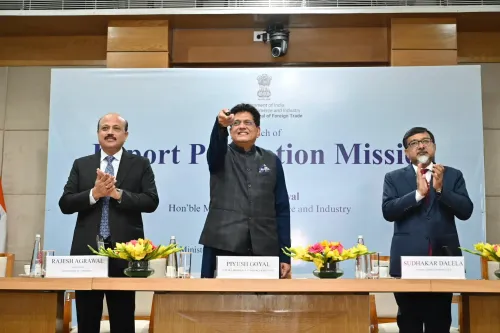
The Department of Commerce on 18 November 2026 amended the guidelines of four key interventions under the Niryat Disha sub-scheme of the Export Promotion Mission (EPM), broadening eligibility criteria and increasing financial support for Indian exporters — with a sharp focus on Micro, Small and Medium Enterprises (MSMEs), first-time exporters, and geographically disadvantaged regions.
What Was Changed and Why It Matters
The four interventions amended are Market Access Support (MAS), Trade Regulations, Accreditation and Compliance Enablement (TRACE), and Logistics Interventions for Freight and Transport (LIFT). Together, these cover the core non-financial barriers that have historically kept smaller Indian exporters from competing in global markets — from trade-fair access to quality certification costs and freight disadvantages.
This comes amid a broader government push to lift India's export competitiveness, encapsulated in the ₹25,060 crore EPM approved by the Union Cabinet on 12 November 2025 for the period FY 2025-26 to FY 2030-31.
Market Access Support: Higher Turnover Cap, Better Airfare Cover
Under the revised MAS guidelines, the maximum eligible export turnover for airfare reimbursement — covering participation in buyer-seller meets, trade fairs, and trade delegations — has been raised sharply from ₹75 lakh to ₹50 crore in the preceding year. This effectively opens the benefit to a significantly larger pool of mid-sized exporters who were previously locked out.
Airfare reimbursement rates have also been enhanced: up to 95 per cent for Micro and Small Exporters, and up to 80 per cent for other eligible exporters. Additionally, the mandatory membership period with Export Promotion Councils has been cut from six months to three months, lowering the entry barrier for newer businesses seeking to participate.
TRACE: Certification Coverage Widened for MSMEs
The TRACE intervention supports MSMEs in meeting internationally recognised quality, safety, and technical standards required by overseas markets. Under the amended rules, the number of certificates eligible for reimbursement has been expanded from 462 to 600, giving Indian small businesses access to a wider set of compliance pathways for export markets.
Notably, this addresses a persistent pain point for Indian MSMEs: the cost of obtaining multiple certifications for different destination markets often deters smaller players from pursuing export diversification.
LIFT: Logistics Relief Extended to 34 States and New Routes
The LIFT intervention targets MSMEs in low export-intensity regions that face structural freight and transportation disadvantages. The revised guidelines represent the most extensive expansion of this scheme since its launch. Key changes include:
Coverage of low export-intensity districts has been expanded from 13 States/UTs to 34 States/UTs. Eligible port categories have been widened to include Land Customs Stations (LCSs) and Integrated Check Posts (ICPs). Waterways have been added as an eligible mode of transport alongside existing road, rail, and air options. Air freight support has been extended to Jammu and Kashmir and Ladakh, in addition to the existing North-Eastern Region coverage. The minimum distance criterion between origin and destination ports has been reduced from 200 km to 100 km. Support has also been extended to all exportable merchandise items, barring those on the negative list.
The Bigger Picture: EPM's Dual-Track Architecture
The EPM operates through two integrated sub-schemes: Niryat Protsahan, which facilitates access to trade finance, and Niryat Disha, which addresses market access and non-financial export barriers. A total of 11 interventions under both sub-schemes have been operationalised so far.
The mission's stated priority of targeting MSMEs, first-time exporters, and under-represented regions signals a deliberate effort to broaden India's export base beyond its established manufacturing and IT services hubs. With global trade routes under pressure from geopolitical flux, analysts have argued that deepening domestic exporter participation — particularly from Tier-2 and Tier-3 regions — is critical to sustaining export momentum. The amended guidelines are expected to come into force immediately, though detailed operational circulars are yet to be issued by individual Export Promotion Councils.
Point of View
But the real test is uptake — past export promotion schemes have often suffered from low awareness and cumbersome claim processes that discourage the very MSMEs they target. Expanding LIFT from 13 to 34 States/UTs is a meaningful geographic leap, but only if district-level implementation infrastructure follows. The raise in turnover eligibility from ₹75 lakh to ₹50 crore for MAS benefits is the most consequential change: it plugs a gap that excluded growing mid-tier exporters, who are arguably better placed than micro enterprises to scale into new markets. Whether these amendments translate to measurable export diversification — or remain underutilised on paper — depends entirely on how aggressively Export Promotion Councils communicate and process claims.
NationPress
18 Nov 2026
Frequently Asked Questions
What is the Niryat Disha sub-scheme under the Export Promotion Mission?
Niryat Disha is one of two sub-schemes under the Export Promotion Mission (EPM), approved by the Union Cabinet on 12 November 2025 with a ₹25,060 crore outlay for FY 2025-26 to FY 2030-31. It addresses market access and non-financial barriers to exports, with interventions covering trade fairs, quality certifications, and logistics support, particularly for MSMEs and first-time exporters.
How has airfare reimbursement for exporters changed under the amended MAS guidelines?
Airfare reimbursement has been enhanced to up to 95% for Micro and Small Exporters and up to 80% for other eligible exporters under the revised Market Access Support (MAS) guidelines. The maximum eligible export turnover for availing this benefit has also been raised sharply from ₹75 lakh to ₹50 crore, widening access to a larger pool of exporters.
What is the LIFT intervention and which new areas does it now cover?
The Logistics Interventions for Freight and Transport (LIFT) scheme supports MSMEs in low export-intensity regions by subsidising freight and transportation costs. Under the amended guidelines, coverage has been expanded from 13 States/UTs to 34 States/UTs, air freight support has been extended to Jammu and Kashmir and Ladakh, and waterways have been added as an eligible transport mode alongside road, rail, and air.
How many certifications are now covered under the TRACE scheme?
The TRACE scheme now covers 600 internationally recognised quality, safety, and technical certificates eligible for reimbursement, up from the earlier list of 462. This expansion enables MSMEs to access support for a broader range of compliance requirements demanded by overseas markets.
Who are the primary beneficiaries of these Export Promotion Mission amendments?
The primary beneficiaries are MSMEs, Micro and Small Exporters, first-time exporters, and businesses located in low export-intensity and geographically disadvantaged regions, including the North-Eastern Region, Jammu and Kashmir, and Ladakh. The EPM is specifically designed to bring under-represented regions and smaller businesses into India's export ecosystem.