CM Sai's Cabinet Clears New Rural Drinking Water Rules for Chhattisgarh
Synopsis
The Chhattisgarh cabinet chaired by CM Vishnu Deo Sai approved the 2026 Rural Tap Water Rules on 18 November, scrapping 2024 norms to align with all 19 Jal Jeevan Mission standards, with a new grant and ₹50,000 incentive for small gram panchayats.
Key Takeaways
The Chhattisgarh cabinet approved the Chhattisgarh Panchayat (Rural Tap Water Operation, Maintenance and Management) Rules, 2026 on 18 November 2026 .
The new rules supersede the earlier 2024 rules and incorporate all 19 technical, administrative and financial points recommended by the Government of India under the Jal Jeevan Mission .
Gram panchayats with a population of fewer than 1,000 will receive financial support through the Mukhyamantri Nal Jal Anudan grant, subject to collecting at least 50% of monthly water charges .
Panchayats that collect more than 75% of annual water charges will receive an annual performance bonus of ₹50,000 as Mukhyamantri Nal Jal Protsahan Rashi .
The framework places gram panchayats at the centre of operation, maintenance and management of rural tap-water schemes.
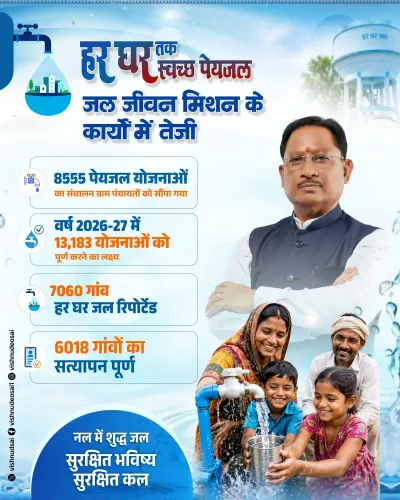
Every rural family in Chhattisgarh is a step closer to clean, reliable tap water — and the state government just rewired the rules that deliver it. The Chief Minister's Office of Chhattisgarh announced on Wednesday, 18 November 2026, that the cabinet chaired by Chief Minister Vishnu Deo Sai approved a sweeping new framework governing rural piped-water supply across the state.
What the 2026 rules replace — and why it matters
The cabinet cleared the draft of the 'Chhattisgarh Panchayat (Gramin Naljal Sanchaalan, Sandharan evam Prabandhan) Niyam, 2026' — the Chhattisgarh Panchayat (Rural Tap Water Operation, Maintenance and Management) Rules, 2026. The move scraps the earlier 2024 rules and brings the state fully in line with the national standards set under the Jal Jeevan Mission, the Government of India's flagship scheme launched in 2019 to deliver functional household tap connections to every rural home.
Crucially, the new framework incorporates all 19 technical, administrative and financial points recommended by the central government — a checklist states have been urged to adopt as the mission shifts its focus from laying pipes to actually keeping water flowing. Chhattisgarh's 2024 rules were an earlier attempt at the same goal; the 2026 version is a course-correction to close the remaining gaps.
Small panchayats, a targeted grant, and a performance incentive
The sharpest new provision targets the most financially vulnerable units: gram panchayats with a population below 1,000. For these villages, the state will provide direct financial support through a dedicated grant called 'Mukhyamantri Nal Jal Anudan' — the Chief Minister's Tap Water Grant — to help cover operation and maintenance costs that small villages cannot sustain alone.
To qualify, a panchayat must collect at least 50 percent of monthly water charges from residents. That floor condition is deliberate: it nudges villages toward financial self-reliance rather than pure dependence on the state. Go further — collect more than 75 percent of annual water charges — and the panchayat earns a performance bonus: an annual 'Mukhyamantri Nal Jal Protsahan Rashi' of ₹50,000. The incentive architecture rewards the panchayats that do the work.
Local bodies as the backbone of delivery
The rules anchor responsibility at the gram panchayat level, making village bodies directly accountable for the regular operation, upkeep and management of tap-water schemes. This is the broader pattern playing out across Indian states: Jal Jeevan Mission's second chapter is less about construction and more about sustainable service delivery through local institutions. Creating infrastructure was phase one. Making it last — and making someone locally accountable for that — is phase two.
Chhattisgarh's earlier 2024 rules were a first step in that direction; the 2026 framework embeds the full national checklist and pairs it with financial tools that make compliance viable for even the smallest panchayat. The cabinet's decision reduces the economic burden on small villages while creating a direct, measurable link between collection effort and state support.
The next test is in the gazette notification and on-ground rollout — particularly whether the grant and incentive flows reach the sub-1,000-population panchayats before the next monsoon strains aging rural water infrastructure once again.
Point of View
The state is effectively outsourcing last-mile accountability to gram panchayats while cushioning the smallest villages from fiscal strain. The ₹50,000 performance bonus is modest in absolute terms but significant as a behavioural nudge: it conditions state support on local revenue effort, nudging panchayats away from dependency. If the rollout matches the design, Chhattisgarh could emerge as a model for how mid-sized states operationalise JJM's maintenance mandate.
NationPress
18 Nov 2026
Frequently Asked Questions
What are the new Chhattisgarh rural tap water rules 2026?
The 'Chhattisgarh Panchayat (Rural Tap Water Operation, Maintenance and Management) Rules, 2026' were approved by the state cabinet on 18 November 2026. They replace the 2024 rules and align the state fully with all 19 technical, administrative and financial standards recommended under the Jal Jeevan Mission.
What is Mukhyamantri Nal Jal Anudan in Chhattisgarh?
Mukhyamantri Nal Jal Anudan is a new state grant for gram panchayats with a population below 1,000 to help them meet operation and maintenance costs of tap-water schemes. To qualify, the panchayat must collect at least 50% of monthly water charges from residents.
What is the ₹50,000 Mukhyamantri Nal Jal Protsahan Rashi?
It is an annual performance incentive of ₹50,000 awarded to gram panchayats that collect more than 75% of their annual water charges. It is designed to reward panchayats that demonstrate strong revenue collection from rural water supply schemes.
How do the 2026 rules relate to Jal Jeevan Mission?
Jal Jeevan Mission is the Government of India's national scheme launched in 2019 to provide tap water connections to rural households. The 2026 Chhattisgarh rules incorporate all 19 points recommended by the central government under the mission's operation and maintenance framework.
Who is responsible for managing rural tap water under the new Chhattisgarh rules?
Gram panchayats — village-level local bodies — are the primary institution responsible for the regular operation, maintenance and management of tap-water schemes under the new 2026 framework approved by the Chhattisgarh cabinet.