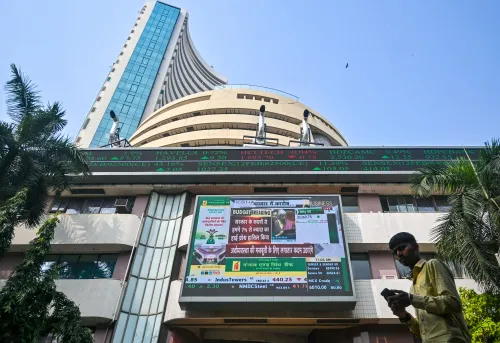
Indian Stock Markets Decline for Fifth Week Amid Tensions and High Oil Prices
Synopsis
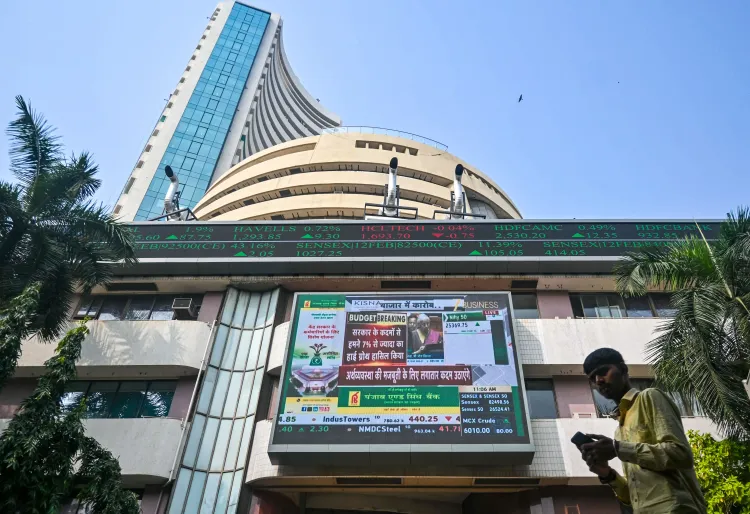
The Indian stock market has faced a fifth consecutive week of declines, influenced by geopolitical tensions and rising crude oil prices, leading to significant foreign capital outflows. This trend raises concerns about market stability and investor sentiment.
Key Takeaways
Fifth consecutive week of decline for Indian stock markets Influence of geopolitical tensions and high crude oil prices Bank Nifty underperformed with significant losses Nifty IT and pharma sectors showed positive gains Foreign institutional investors reported heavy selling
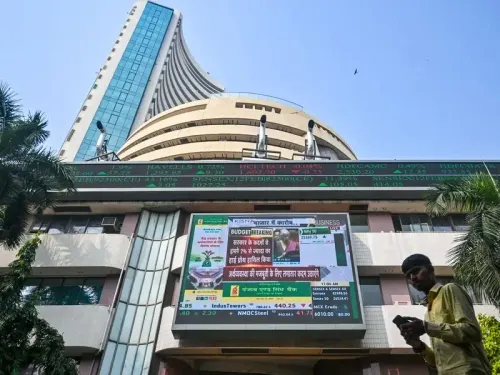
Mumbai, March 28 (NationPress) The Indian stock market indices have experienced a decline for the fifth consecutive week, driven by ongoing geopolitical tensions, soaring crude oil prices, and continued foreign capital outflows.
The Nifty index fell by 1.28% over the week and dropped 2.09% on the final trading day, closing at 22,819. The Sensex also saw a significant drop, losing 1,690 points or 2.25%, ending at 73,583, marking a weekly decrease of 1.27%.
Throughout the week, both indices exhibited volatility and pressure, though they made attempts at recovery intermittently.
The Bank Nifty underperformed compared to the broader market, concluding near 52,274 with a 2.67% fall on Friday, leading to a sharp weekly drop of about 2.16%.
The primary concern for investors remains the persistent geopolitical instability related to the US–Iran conflict, which has kept the markets highly reactive.
Worries regarding global energy supply interruptions have lingered, with Brent crude prices fluctuating between $98 and $115, continuing to influence inflation expectations and overall economic stability.
Sector-wise, Nifty metals and PSU Banks were the biggest losers for the week. In contrast, Nifty IT and pharma stocks were the only sectors to gain, increasing by 1.17% and 0.11%, respectively.
Broader market indices performed similarly to the benchmarks, as the Nifty Midcap100 fell by 1.38%, and Nifty Smallcap100 dropped by 0.63%.
The Indian rupee further weakened, crossing the 94-mark against the US dollar, driven by high crude prices and ongoing capital outflows.
Vinit Bolinjkar, Head of Research at Ventura, anticipates a range-bound market with a high VIX until global risk sentiment improves. He stated, “Strong domestic flows and any reduction in tensions should help limit downside risks, favoring quality large-cap stocks and domestic themes over high-beta investments.”
The Nifty 50 is currently trying to stabilize in the 22,850–22,750 range, indicating early signs of consolidation after recent declines, according to market participants. Immediate resistance is identified at the 23,000–23,100 levels.
For the Bank Nifty, support is anticipated around the 52,000–51,800 zones, followed by 51,500–51,000 levels. Conversely, resistance is seen at 53,000–53,600.
High oil prices are expected to continue exerting pressure on the markets, while any potential rebound could trigger short-covering to support recovery, analysts noted.
On Friday, foreign institutional investors (FIIs) continued their aggressive selling in Indian equities, registering net outflows of approximately Rs 25,000-30,000 crore throughout the week. March's month-to-date outflows exceeded Rs 1.13 lakh crore, marking the most significant single-month sell-off in FY26. Domestic institutional investors (DIIs) made a strong counter with over Rs 25,000 crore in net buying this week.
Point of View
The continued decline of the Indian stock market highlights the fragility of investor confidence amid geopolitical uncertainties. Market stability is crucial, and stakeholders must remain vigilant as external factors influence domestic financial health.
NationPress
1 Oct 2026
Frequently Asked Questions
Why are the Indian stock markets declining?
The Indian stock markets are experiencing a decline due to ongoing geopolitical tensions, high crude oil prices, and sustained foreign capital outflows.
What impact do high oil prices have on the market?
High oil prices pressurize inflation expectations and overall economic stability, leading to investor caution and potential market declines.
What sectors performed well during the recent downturn?
During the recent downturn, the Nifty IT and pharma sectors were the only ones to gain, with increases of 1.17% and 0.11%, respectively.
How are foreign institutional investors reacting?
Foreign institutional investors have continued to sell aggressively in Indian equities, with net outflows of around Rs 25,000-30,000 crore this week.
What is the outlook for the Nifty 50 index?
The Nifty 50 index is attempting to stabilize in the 22,850–22,750 range, with immediate resistance noted at 23,000–23,100 levels.