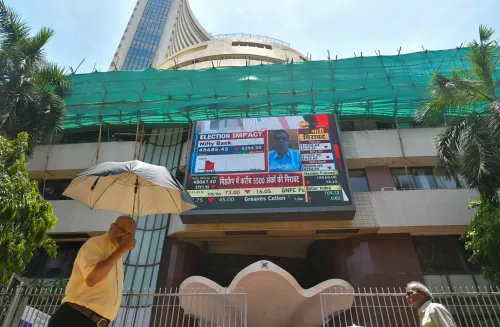
Indian Stock Markets Decline Amid Rising Oil Prices and Geopolitical Tensions
Synopsis
The Indian stock markets opened with significant losses due to escalating geopolitical tensions and rising oil prices. The Sensex and Nifty indices showed marked declines, raising concerns over inflation and corporate costs.
Key Takeaways
Indian equity markets opened sharply lower.
Rising oil prices influenced by US-Iran tensions.
Sensex and Nifty saw significant declines.
No immediate risk of fuel shortages in India.
Market participants remain cautious about inflation and corporate costs.
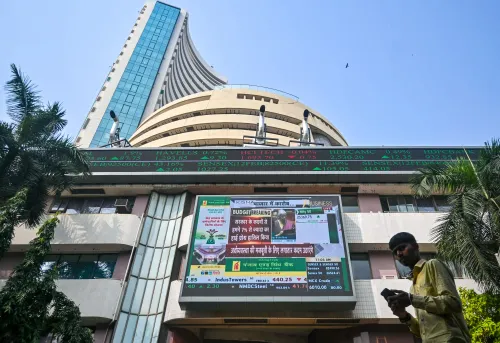
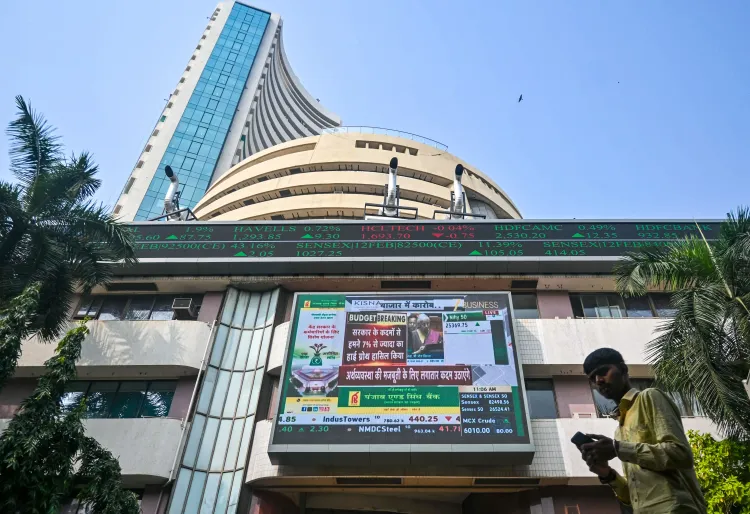
Mumbai, March 13 (NationPress) The Indian stock markets commenced trading significantly lower on Friday, impacted by rising crude oil prices amid escalating tensions from the US-Iran conflict, which has dampened investor confidence.
As of 9:25 AM, the Sensex plummeted by 516 points, reflecting a decrease of 0.68 percent, settling at 75,517, while the Nifty index fell by 174 points, or 0.74 percent, to 23,464.
Broad-cap indices followed suit, mirroring the downturn of benchmark indices, with the Nifty Midcap 100 dropping by 0.84 percent and the Nifty Smallcap 100 declining by 1.08 percent.
All sectoral indices traded in the negative, with the exception of Nifty FMCG, which managed a modest gain of 0.41 percent. The Nifty metal sector faced the steepest decline at 1.84 percent. Additionally, Nifty IT and media industries were among the significant losers, down 1.18 percent and 1.17 percent, respectively.
According to analysts, the near-term resistance for Nifty is identified at the 23,800 level, whereas the support is positioned around the 23,600 zone.
For Bank Nifty, resistance levels are observed near the 55,600–55,700 range, with support indicated at the 54,700 level, as per market participants.
Iran's newly appointed Supreme Leader, Mojtaba Khamenei, has stated that the Strait of Hormuz should remain closed, hinting at the possibility of opening new fronts in the ongoing conflict should it continue.
Despite the geopolitical turmoil influencing oil prices and financial markets, analysts suggest there is currently no immediate threat of fuel shortages in India.
The primary concern for the markets right now is the surge in oil prices and their potential repercussions on inflation, the rupee, and corporate expenses, rather than any disruption in fuel supply.
India is well-equipped with approximately 25 days' worth of crude oil reserves and an additional 25 days of refined fuel stocks, along with strategic petroleum reserves, ensuring a total supply cushion of about 50–60 days even without new imports.
In the Asian markets, China's Shanghai Composite fell by 0.22 percent, and Shenzhen decreased by 0.17 percent. Japan's Nikkei dropped by 1.22 percent, while Hong Kong's Hang Seng Index lost 0.43 percent. South Korea's Kospi declined by 1.58 percent.
The US markets closed significantly lower overnight, with the Nasdaq facing a drop of 1.78 percent. The S&P 500 slipped by 1.52 percent, and the Dow Jones fell by 1.56 percent.
On March 12, foreign institutional investors (FIIs) in India recorded net sales of equities amounting to Rs 7,049 crore, whereas domestic institutional investors (DIIs) were net buyers of equities worth Rs 7,449 crore.
aar/na
Point of View
Primarily driven by geopolitical tensions and soaring oil prices, raises critical concerns for investors. While short-term fluctuations are expected, the overall resilience of the Indian market, supported by adequate fuel reserves, may provide some reassurance amidst these challenges.
NationPress
24 Sept 2026
Frequently Asked Questions
What caused the decline in the Indian stock markets?
The decline is primarily attributed to rising crude oil prices due to escalating tensions from the US-Iran conflict, which has negatively impacted investor sentiments.
How did the Sensex and Nifty perform?
As of 9:25 AM, the Sensex fell by 516 points (0.68%) to 75,517, while the Nifty dropped by 174 points (0.74%) to 23,464.
Is there a risk of fuel shortages in India?
Analysts indicate that there is currently no immediate threat of fuel shortages in India, despite the geopolitical instability affecting oil prices.
What are the resistance and support levels for Nifty?
Resistance for Nifty is noted at around 23,800, while support is observed at the 23,600 level.
What is the state of the Asian markets?
Asian markets experienced declines, with notable drops in China's Shanghai, Japan's Nikkei, and South Korea's Kospi.