Indian Navy P-8I arrives in Hawaii for RIMPAC 2026 maritime exercise
Synopsis
India's P-8I maritime patrol aircraft has landed in Hawaii for RIMPAC 2026 — the 30th edition of the world's largest multinational naval exercise. With 30 nations, 30,000 personnel and over 200 aircraft converging around the Hawaiian Islands, the deployment is India's clearest signal yet of its intent to be a first-tier Indo-Pacific security partner, not just a regional observer.
Key Takeaways
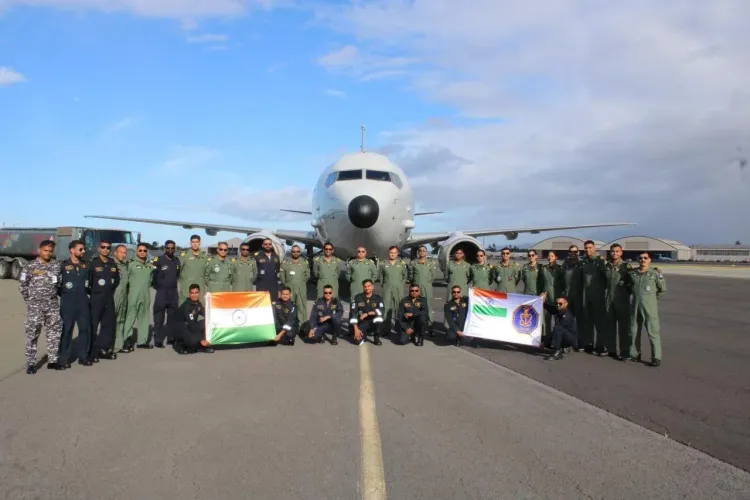
The Indian Navy's P-8I Long Range Maritime Reconnaissance and Anti-Submarine Warfare aircraft arrived in Honolulu, Hawaii on 3 July 2026 .
The aircraft is participating in RIMPAC 2026 , the 30th edition of the world's largest multinational maritime exercise, running 1–31 July 2026 .
RIMPAC 2026 involves 30 nations , over 30 surface ships , 5 submarines , more than 206 aircraft , and approximately 30,000 personnel .
The exercise theme is 'Partners: Integrated and Prepared' , emphasising collective readiness and interoperability in the Indo-Pacific.
India's deployment reaffirms its commitment to a free, open, and rules-based Indo-Pacific , according to the Indian Navy.
The Indian Navy's P-8I Long Range Maritime Reconnaissance and Anti-Submarine Warfare aircraft arrived in Honolulu, Hawaii on 3 July 2026 to take part in the Rim of the Pacific Exercise (RIMPAC) 2026, one of the world's largest multinational maritime drills. The deployment signals India's continued push to deepen operational ties with partner navies across the Indo-Pacific.
India's Role in RIMPAC 2026
The P-8I, a long-range platform optimised for maritime reconnaissance and anti-submarine warfare, will operate alongside forces from 30 nations during the exercise, which runs from 1 July to 31 July 2026. This is the 30th edition of RIMPAC, making it a landmark iteration of the biennial exercise hosted by the United States Navy in and around the Hawaiian Islands.
According to the Indian Navy's official statement, the deployment 'reaffirms Indian Navy's commitment to a free, open, inclusive and rules-based Indo-Pacific while enhancing interoperability, maritime domain awareness and operational cooperation with partner navies.'
Scale of the Exercise
RIMPAC 2026 is a formidable show of collective maritime power. Participating assets include more than 30 surface ships, five submarines, 15 national land forces, over 206 aircraft, and approximately 30,000 personnel. The sheer scale underscores the exercise's role as the premier platform for multinational naval coordination in the Pacific theatre.
The theme for this year's exercise is 'Partners: Integrated and Prepared' — a phrase that reflects the emphasis on collective readiness and seamless interoperability among allied and partner navies.
What the RIMPAC Commander Said
Vice Admiral Jeff Jablon, RIMPAC 2026 Commander of the Combined Task Forces (CCTF), underscored the exercise's strategic value. 'The Rim of the Pacific exercise continues to be the world's premier multinational maritime training event, bringing together allies and partners committed to strengthening security and stability across the region,' he said. 'By training together in complex, realistic scenarios, participating nations improve readiness, sharpen warfighting skills, and strengthen the interoperability required to operate effectively alongside one another whenever and wherever needed,' Vice Adm. Jablon added.
Strategic Significance for India
India's participation in RIMPAC is part of a broader pattern of expanding naval engagement in the Indo-Pacific. The P-8I — a platform India operates with advanced sensors and weapons systems — is particularly well-suited for joint anti-submarine operations, a capability of growing relevance as undersea competition intensifies in the region. Notably, this deployment comes amid heightened focus on maritime security frameworks such as the Quad, of which India is a member alongside the United States, Australia, and Japan — all of whom are also RIMPAC participants.
As the exercise progresses through July, India's P-8I is expected to participate in complex, high-end training scenarios designed to sharpen collective warfighting readiness across the participating navies.
Point of View
And flying that platform to Hawaii puts India in the room for the most sensitive collective training the exercise offers. What mainstream coverage underplays is the cumulative weight of these deployments: each RIMPAC appearance builds the interoperability muscle memory that would matter in a real contingency. The question is whether India's domestic naval expansion — in submarines, carriers, and P-8I fleet size — can keep pace with the partnership ambitions it is signalling abroad.
NationPress
2 Oct 2026
Frequently Asked Questions
What is RIMPAC 2026 and why does it matter?
RIMPAC 2026, or the Rim of the Pacific Exercise, is the 30th edition of the world's largest multinational maritime exercise, running from 1 to 31 July 2026 around the Hawaiian Islands. It brings together 30 nations, 30,000 personnel, and over 206 aircraft to train for collective maritime security, making it the premier forum for naval interoperability in the Indo-Pacific.
What is the Indian Navy's P-8I aircraft?
The P-8I is a long-range maritime reconnaissance and anti-submarine warfare aircraft operated by the Indian Navy, based on Boeing's P-8 Poseidon platform. It is equipped with advanced sensors and weapons systems suited for tracking submarines and conducting wide-area ocean surveillance.
Why is India participating in RIMPAC 2026?
India is participating to enhance interoperability, maritime domain awareness, and operational cooperation with partner navies. The deployment also reaffirms India's commitment to a free, open, inclusive, and rules-based Indo-Pacific, according to the Indian Navy's official statement.
Which countries are taking part in RIMPAC 2026?
A total of 30 nations are participating in RIMPAC 2026. While the full list was not specified in the announcement, the exercise traditionally includes the United States, Australia, Japan, Canada, and a wide range of Indo-Pacific and allied nations.
What is the theme of RIMPAC 2026?
The theme of RIMPAC 2026 is 'Partners: Integrated and Prepared,' underscoring the multinational commitment to collective readiness, tactical proficiency, and interoperability in support of regional security and a free and open Indo-Pacific.