What Will India’s AI Summit in New Delhi Focus On?
Synopsis
India's AI Impact Summit in New Delhi is set to address crucial themes of people, planet, and progress, aiming to reshape global AI discussions into actionable outcomes. With a strong emphasis on inclusivity and digital public infrastructure, this summit represents a pivotal moment for developing nations in the AI landscape. Don't miss the details!
Key Takeaways
Focus on People: AI should empower individuals and enhance accessibility.
Sustainability Goals: AI systems must align with environmental objectives.
Inclusive Growth: Emphasis on equitable economic development in vital sectors.
Global South Representation: First major AI summit led by a Global South nation.
Collaborative Framework: Strengthening US-India ties for AI innovation.
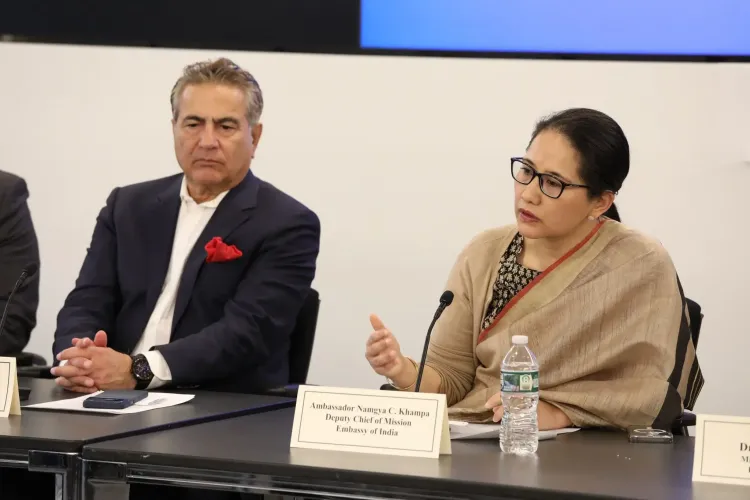
Washington, Jan 16 (NationPress) The forthcoming AI Impact Summit in New Delhi, hosted by India, will revolve around three fundamental themes: people, planet, and progress. The goal is to transition global discussions on artificial intelligence from theoretical principles to actionable outcomes, as stated by Namgya Khampa, India’s Deputy Chief of Mission in Washington.
Khampa shared these insights during the event titled “US-India Strategic Cooperation on AI,” organized by Observer Research Foundation America (ORF America), the Special Competitive Studies Project (SCSP), and the Embassy of India at the US Capitol, which convened policymakers and experts to define mutual priorities ahead of the summit.
According to Khampa, artificial intelligence has evolved beyond a niche technology; it now plays a crucial role in shaping economic competitiveness, geopolitical dynamics, and societal impacts.
She emphasized that India’s strategy regarding AI is rooted in its experiences with digital public infrastructure, showcasing how inclusive, interoperable, and cost-effective technology can revolutionize governance for large populations.
Platforms like Aadhaar and the unified payments interface have significantly enhanced access to public services, finance, and identity for over 1.4 billion residents of India.
Khampa articulated that India perceives AI not merely as an isolated solution but as a “force multiplier” that augments its digital public infrastructure, rendering systems “smarter, more responsive, more productive, and more accessible,” thus translating AI from abstraction to everyday utility and from innovation to transformative change.
She highlighted that the AI Impact Summit would mark the first significant global AI gathering led by a nation from the Global South. The summit aims to address disparities in global AI governance by enhancing participation and ownership without compromising standards.
Elaborating on the summit’s framework, she noted that the three themes—people, planet, and progress—mirror India’s vision of “AI for all.” AI should empower individuals rather than exclude them, be resource-efficient and aligned with sustainability goals, and foster equitable economic growth, particularly in sectors like healthcare, education, agriculture, and public service.
Khampa also pointed out that heightened geopolitical tensions and the weaponization of technology supply chains have rendered technological resilience a vital component of national strategy. She referenced the India-US trust initiative as a platform to advance cooperation from concepts to concrete projects across research, standards, skills development, and next-generation technologies.
She asserted that India’s linguistic diversity and population-scale digital platforms present an unmatched opportunity to develop inclusive, multilingual AI systems, while the United States contributes leading-edge research, funding, and advanced use cases that can be tested in India and scaled globally.
Dhruva Janshankar from ORF America remarked that India is increasingly establishing itself as a mediator in global discussions regarding AI safety and the necessity for large-scale, practical deployment, especially in developing nations.
He noted that earlier global AI dialogues had largely centered around abstract or existential risks, while nations in the Global South are more concerned about whether AI can yield tangible enhancements in healthcare, education, public services, and economic opportunities.
Janshankar mentioned that many developing countries share common challenges, including restricted access to technology, financial limitations, and the risk of being sidelined in global rule-making.
He cautioned that global competition in AI deployment is already underway in emerging markets. If democratic nations do not provide affordable, scalable, and trusted AI solutions, he warned, competing entities may fill that void.
Janshankar argued that deeper collaboration between the US and India could facilitate the creation of interoperable AI platforms that align with democratic values while ensuring that developing nations are not entrapped in technologies that do not serve their interests.
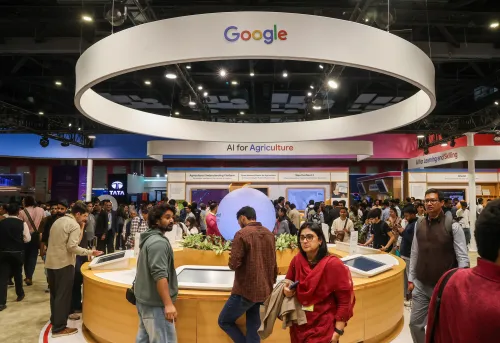
India will host the AI Impact Summit in New Delhi next month, uniting governments, industry, and civil society to concentrate on inclusive, development-oriented AI deployment, with a special focus on the priorities of the Global South.
Point of View
It is imperative to acknowledge India's significant role in the global AI dialogue, especially as it champions the needs of the Global South. The AI Impact Summit stands as a testament to India's commitment to inclusivity and sustainable development, reflecting a vision that prioritizes empowerment over exclusion. Such initiatives are crucial in addressing existing disparities in AI governance and ensuring that technological advancements benefit all.
NationPress
29 Sept 2026
Frequently Asked Questions
What are the main themes of the AI Impact Summit?
The main themes are people, planet, and progress, focusing on making AI accessible and beneficial for all.
When and where will the AI Impact Summit take place?
The summit will be held next month in New Delhi, India.
Who is leading the discussions at the summit?
Discussions will be led by key figures including India’s Deputy Chief of Mission, Namgya Khampa, and various policymakers and experts.
What is India's approach to AI?
India's approach to AI emphasizes inclusivity, leveraging digital public infrastructure to enhance governance and deliver equitable growth.
Why is this summit important for developing nations?
The summit aims to address imbalances in global AI governance and promote the interests of developing nations in the AI landscape.