Have MSME Exports Surpassed Rs 9.52 Lakh Crore During April-Sep?
Synopsis
India's MSMEs have achieved a staggering export figure of over Rs 9.52 lakh crore in the first half of FY 2025-26, showcasing the significant role they play in high-value sectors. Learn how government initiatives are fostering this growth and supporting local businesses in the global market.
Key Takeaways
MSME exports reached Rs 9.52 lakh crore in the first half of FY 2025-26.
Key sectors include electronics , pharmaceuticals , and engineering goods .
The government launched the Export Promotion Mission (EPM) to boost exports.
Niryat Protsahan provides financial support to MSME exporters.
Reduced GST rates have facilitated MSME growth.
New Delhi, Dec 18 (NationPress) The exports from India's micro, small and medium enterprises (MSMEs) reached a remarkable total of Rs 9,52,023.35 crore in the financial year up to September 2025-26, as reported in parliament on Thursday.
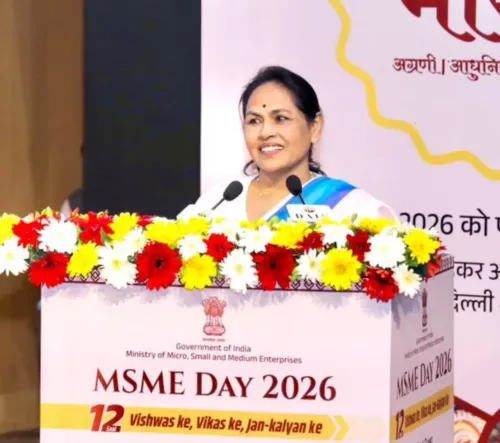
In a written response to a Lok Sabha inquiry, Sushri Shobha Karandlaje, the Minister of State for MSMEs, conveyed that this export data is compiled from the Directorate General of Commercial Intelligence and Statistics (DGCI&S) portal, focusing on MSME-related products.
The government highlighted that India's export performance in this timeframe demonstrated robust growth, particularly in high-value and technology-driven sectors including electronic goods, pharmaceuticals, and engineering products, where MSMEs contribute significantly.
“The total export value for MSME products during FY 2025-26 (up to September) stands at Rs 952023.35 crore, based on data extracted from the DGCI&S portal,” stated the minister.
“This export performance during the specified period showcases strong momentum in key high-value and technology-centric sectors, notably in electronic goods, pharmaceuticals, and engineering goods,” she further elaborated.
To bolster MSME exports, the government has initiated the Export Promotion Mission (EPM), a comprehensive strategy designed to enhance the overall export ecosystem.
This mission includes financial backing through the Niryat Protsahan initiative, aimed at facilitating access to trade finance for MSME exporters.
Additionally, non-financial assistance is being provided via Niryat Disha, which aids MSMEs in achieving export quality standards, regulatory compliance, market access, logistics support, and in building a robust export ecosystem.
“Reduced GST rates have made raw materials and services more economical, encouraging small and medium enterprises as well as start-ups to expand their operations, invest in innovation, and enhance their competitive edge both domestically and internationally,” she remarked.
This has fortified local supply chains in critical sectors such as automobiles, textiles, food processing, logistics, and handicrafts, prompting small businesses and start-ups to scale operations, invest in innovation, and compete more effectively on the global stage.
Point of View
I believe this significant milestone in MSME exports reflects the government's commitment to empowering local businesses. The initiatives launched are not just numbers; they represent opportunities for growth, innovation, and global competitiveness, ensuring that India remains a key player in the international trade landscape.
NationPress
24 Sept 2026
Frequently Asked Questions
How much did MSMEs export in the current financial year?
MSMEs exported goods worth Rs 9,52,023.35 crore during the first half of the financial year 2025-26.
What sectors are contributing to MSME exports?
Key sectors contributing to MSME exports include electronics , pharmaceuticals , and engineering goods .
What initiatives has the government introduced to support MSMEs?
The government has launched the Export Promotion Mission (EPM) and initiatives like Niryat Protsahan and Niryat Disha to enhance financial and non-financial support for MSMEs.
How has GST impacted MSME operations?
Lower GST rates have made raw materials and services more affordable, encouraging MSMEs and start-ups to expand their operations and invest in innovation.