How Is India's Neighbourhood Policy Evolving?
Synopsis
Explore how India's neighbourhood policy is transforming from merely historical goodwill to a responsive strategy shaped by evolving regional dynamics and political realities, as discussed by experts in a recent high-level dialogue.
Key Takeaways
India's neighbourhood policy is increasingly adaptive and country-specific.
The policy is influenced by historical goodwill but now responds to contemporary political realities.
Geopolitical competition and climate pressures complicate the neighbourhood landscape.
A one-size-fits-all approach is inadequate for engaging diverse neighbours.
Economic partnerships and security are central to India's regional strategy.
New Delhi, Feb 3 (NationPress) India's neighbourhood policy has transitioned to become more adaptive and tailored to individual nations, moving beyond just historical goodwill. This evolution is a response to a myriad of political realities while ensuring regional stability, as discussed by leading policymakers, industry experts, and thought leaders during a recent dialogue.
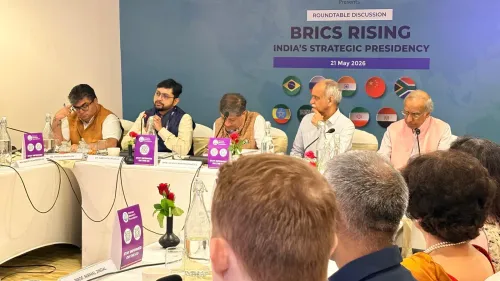
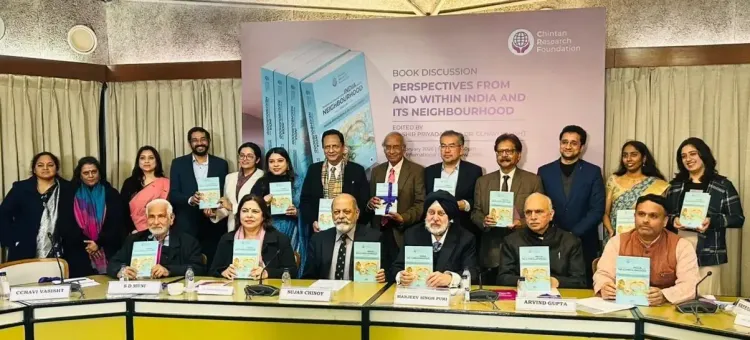
The high-level discussion, organized by the Chintan Research Foundation (CRF) and themed 'Perspectives From and Within India and Its Neighbourhood', provided a platform for analysts to explore the changing dynamics of India's neighbourhood policy, alongside thematic assessments of the economic, political, and security issues facing the region.
In light of shifting regional and global geopolitics, experts recognized that India has been increasingly working to balance security concerns, development partnerships, and economic diplomacy to promote stability and collaboration throughout South Asia and its broader neighbourhood.
They noted that India's relationship with its neighbours has always been influenced by geography and history, aptly summarized by former Prime Minister Atal Bihari Vajpayee's saying, "You can change your friends but not neighbours." This reality, as highlighted by the experts, continues to shape India's neighbourhood policy, where deep cultural connections coexist with critical strategic decisions.
CRF President Shishir Priyadarshi, who co-edited a book on this subject with Cchavi Vasisht, reiterated that the neighbourhood poses India's most challenging strategic theatre.
Priyadarshi, in his opening remarks, pointed out that the intricacies of India's neighbourhood policy have grown amid geopolitical rivalry, political changes in South Asia, climate challenges, and rising aspirations from a burgeoning Indian economy. He stressed that due to the region's vast diversity and ever-changing landscape, a one-size-fits-all approach is inadequate for India's engagement with its neighbours.
The discussion emphasized that shifting regional dynamics have contributed additional layers of complexity to India’s neighbourhood interactions.
Recent years have seen significant political changes and internal strife across South Asia, notably in Nepal, Bangladesh, and Sri Lanka, necessitating India to modify its diplomatic and strategic tactics. The political unrest in Bangladesh in 2024, coupled with situations in the Maldives and ongoing internal conflicts in Myanmar, have highlighted the urgency for a more nuanced neighbourhood strategy. This situation is further complicated by China’s growing influence in the region, particularly via the Belt and Road Initiative (BRI).
Vasisht, an Associate Fellow at the CRF, remarked that the region operates in a state of continuous flux rather than a fixed agency. She noted that 'Neighbourhood First' is more than just a motto in New Delhi; the allocations for immediate neighbours in the Union Budget highlight that development aid, connectivity initiatives, and security efforts are now central to India’s regional diplomacy.
Further dialogues underscored India's attempts to harmonize national interests with regional progress and security, illustrated by diplomatic milestones such as engaging neighbouring leaders during the 2014 swearing-in ceremony and providing assistance during the Covid-19 pandemic.
Experts concluded that while the principles of India’s 'Neighbourhood First' policy remain pertinent, their implementation must be recalibrated to reflect the evolving domestic politics of neighbouring nations, changing public perceptions of India, and emerging forms of strategic vulnerability. Engagement should be differentiated, acknowledging that Pakistan, Bangladesh, Nepal, Myanmar, Sri Lanka, the Maldives, Bhutan, and Afghanistan require unique policy tools rather than a uniform diplomatic approach.
Point of View
I believe that India's evolving neighbourhood policy reflects its commitment to not just regional stability but also to fostering cooperative relationships that adapt to changing political landscapes. The discussions highlighted the necessity for a nuanced approach that recognizes the diversity of the region while prioritizing India's national interests.
NationPress
1 Oct 2026
Frequently Asked Questions
What are the main challenges facing India's neighbourhood policy?
India's neighbourhood policy faces challenges such as political unrest in neighbouring countries, the growing influence of China in the region, and the need for a tailored approach to engage with each nation effectively.
How has India's approach to its neighbours changed recently?
India's approach has shifted from historical goodwill to a more adaptive and country-specific strategy, addressing diverse political realities while promoting regional stability.
What role does economic diplomacy play in India's neighbourhood policy?
Economic diplomacy is central to India's neighbourhood policy, as it aims to create development partnerships and enhance connectivity, contributing to overall regional stability.
What is the significance of the 'Neighbourhood First' policy?
'Neighbourhood First' signifies India's commitment to prioritizing its immediate neighbours in diplomatic engagements, adapting to their unique needs and challenges.
How does internal political change in neighbouring countries affect India?
Internal political changes in neighbouring countries require India to recalibrate its diplomatic strategies to maintain stability and foster cooperation amidst evolving dynamics.