India–Latin America ties: CRF Roundtable calls for structured strategic partnership
Synopsis
Ambassadors from six Latin American nations sat down in New Delhi with Indian strategic experts to make a pointed argument: the India–Latin America relationship has spent too long as a footnote in foreign policy. With India's BRICS presidency and Uruguay's CELAC presidency converging, the window to build a structured, complementarity-driven partnership may be narrower — and more consequential — than it looks.
Key Takeaways
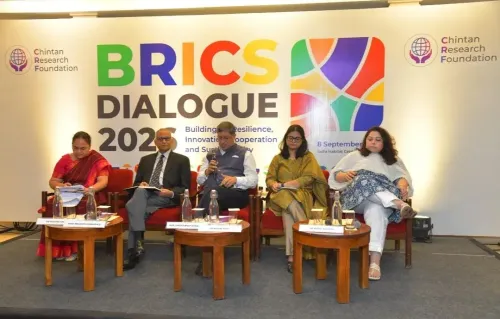
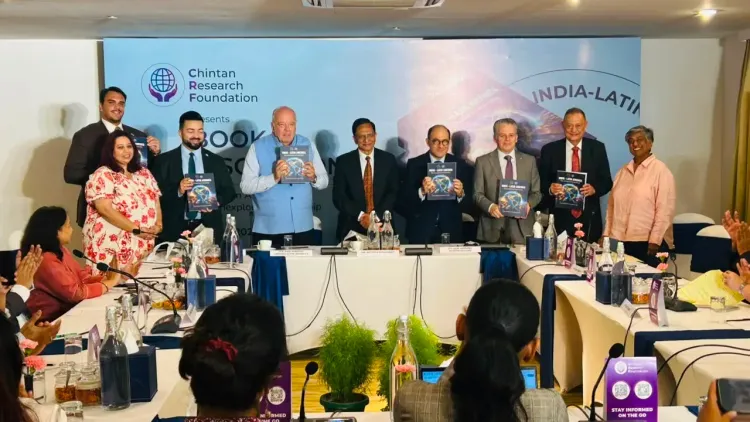
The Chintan Research Foundation (CRF) convened a roundtable in New Delhi on 23 June titled 'India–Latin America: The Unexplored Partnership' .
Ambassadors from Uruguay, Argentina, Colombia, Guatemala, Panama, and Costa Rica participated alongside Indian academics and strategic experts.
Participants called for institutionalising engagement across political, economic, strategic, and societal domains, with more frequent high-level visits.
India's upcoming BRICS presidency and Uruguay's CELAC presidency were identified as a key opportunity to deepen structured dialogue.
India was urged to engage Latin America through its own comparative strengths — pharmaceuticals, digital public infrastructure, affordable technologies — rather than viewing the region primarily through competition with China .
CRF President Shishir Priyadarshi committed the foundation to continuing as a platform for deeper India–Latin America research and dialogue.
India and Latin America stand at a pivotal juncture, with a Chintan Research Foundation (CRF) roundtable held in New Delhi on 23 June urging both sides to convert a long-underutilised relationship into a durable strategic partnership — one shaped by geopolitical realignment, supply-chain fragmentation, and growing concerns over strategic dependencies.
Who Was in the Room
The discussion, titled 'India–Latin America: The Unexplored Partnership', brought together ambassadors from Uruguay, Argentina, Colombia, Guatemala, Panama, and Costa Rica, alongside academics and strategic affairs experts. The breadth of diplomatic representation signalled that interest in deepening the relationship is no longer limited to bilateral conversations — it is becoming a regional conversation.
Key Themes: From Potential to Complementarity
Participants stressed that while India and Latin America are routinely described as regions of 'untapped potential', that potential has yet to translate into sustained political engagement, institutionalised cooperation, or diversified commercial partnerships. The roundtable argued that the relationship has moved from being largely unexplored to a phase of 'active engagement and discovery', and that the next stage must be defined by complementarity — paving the way for deeper structural convergence.
Speakers called for updating the narrative around India–Latin America ties to reflect recent developments, and for institutionalising existing channels across political, economic, strategic, and societal domains. More frequent high-level visits and sustained diplomatic outreach were flagged as immediate priorities.
Geopolitical Context and the China Question
A major thread running through the discussion was the changing geo-economic landscape — the fragmentation of global trade, the securitisation of supply chains, rising protectionism, and the growing weaponisation of economic interdependence. Participants noted that stronger India–Latin America engagement should be seen 'not as a substitute for existing partnerships, but as a means of enhancing strategic flexibility, economic resilience, and diversification.'
The roundtable also examined China's significant economic footprint across Latin America. Participants cautioned that India should avoid viewing the region solely through a competitive lens with China, and instead anchor its approach in its own comparative strengths — including demand-driven cooperation, capacity building, affordable technologies, pharmaceuticals, digital public infrastructure, and partnerships aligned with local development priorities.
BRICS and CELAC: A Window of Opportunity
Speakers drew particular attention to India's upcoming BRICS presidency and Uruguay's presidency of the Community of Latin American and Caribbean States (CELAC), describing the convergence as 'an opportunity to deepen dialogue and cooperation between the two platforms and advance a more structured India–Latin America partnership.' The dual presidencies offer a rare multilateral opening that both sides are being urged to use purposefully.
What Needs to Happen Next
The roundtable concluded that translating potential into outcomes will require sustained political attention, stronger institutionalisation, greater private-sector participation, and a near-term focus on a limited number of sectors where visible progress is achievable. CRF President Shishir Priyadarshi reaffirmed that the foundation 'will continue to provide a platform to build on existing efforts and facilitate deeper dialogue, research, and discussion on the relationship.'
The broad consensus was that the foundations for a stronger India–Latin America partnership are already in place — the challenge now is to build on them with structure, political will, and measurable outcomes.
Point of View
Especially when its diplomatic calendar is already stretched across the Indo-Pacific, the Middle East, and Europe. The BRICS–CELAC presidency overlap is a genuine structural opening, but openings of this kind have come and gone before without producing the 'durable, structured' partnership that participants keep calling for. The test will be whether this roundtable produces a follow-on institutional mechanism — or simply another well-intentioned communiqué.
NationPress
22 Sept 2026
Frequently Asked Questions
What was the CRF India–Latin America roundtable about?
The Chintan Research Foundation (CRF) roundtable, held in New Delhi on 23 June, brought together ambassadors from six Latin American nations and Indian strategic experts to discuss converting India's long-underutilised relationship with Latin America into a structured strategic partnership. Key themes included supply-chain diversification, institutionalising diplomatic engagement, and leveraging the BRICS–CELAC presidency overlap.
Which countries were represented at the roundtable?
Ambassadors from Uruguay, Argentina, Colombia, Guatemala, Panama, and Costa Rica participated, alongside academics and experts from India's strategic community.
How does India's BRICS presidency relate to Latin America?
Participants at the roundtable identified India's upcoming BRICS presidency — coinciding with Uruguay's presidency of CELAC — as a concrete opportunity to deepen dialogue between the two platforms and build a more structured India–Latin America partnership. The dual presidencies create a rare multilateral window for coordinated engagement.
What role does China's presence in Latin America play in this discussion?
The roundtable examined China's significant economic footprint across Latin America but cautioned India against viewing the region primarily through a competitive lens. Participants recommended that India anchor its engagement in its own strengths — pharmaceuticals, digital public infrastructure, affordable technologies, and demand-driven cooperation — rather than framing its strategy as a counter to China.
What are the next steps recommended for strengthening India–Latin America ties?
Participants called for sustained political attention, stronger institutionalisation of bilateral and regional channels, greater private-sector participation, and a near-term focus on sectors where tangible progress is achievable. More frequent high-level visits and sustained diplomatic outreach were also highlighted as immediate priorities.