Is Bangladesh Facing a Surge in Radicalisation After Jamaat-Backed Panel's University Election Victory?
Synopsis
The recent electoral victory by a Jamaat-backed panel at Jagannath University raises alarms about potential radicalization in Bangladesh. With 16 out of 21 posts secured, experts warn this trend could influence the youth significantly. What does this mean for the country's political landscape?
Key Takeaways
Odommo Jobian Oikko achieves a significant electoral victory.
Concerns over radicalisation among the youth are rising.
Allegations of electoral misconduct have been reported.
The political landscape in Bangladesh may face shifts.
Key positions were secured by Jamaat-backed candidates.
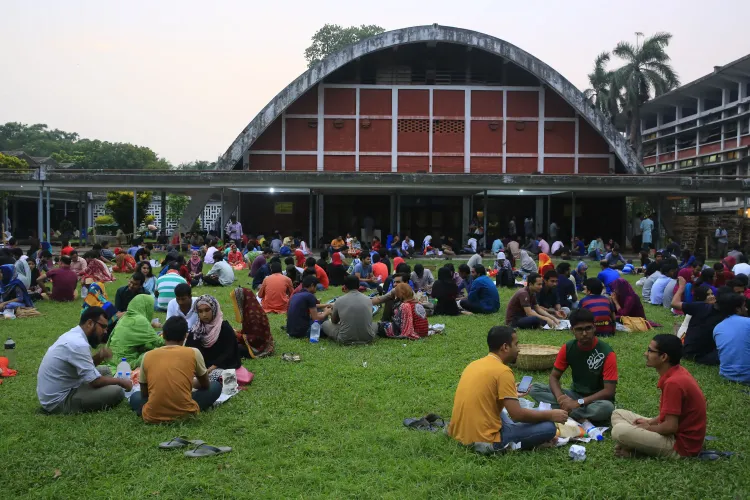
Dhaka, Jan 8 (NationPress) The Odommo Jobian Oikko, a coalition endorsed by the radical Islamist group Jamaat-e-Islami's student faction Islami Chhatra Shibir, has achieved a remarkable triumph, winning 16 out of the 21 positions—including the Vice-President (VP), General Secretary (GS), and Assistant General Secretary (AGS)—in the recently concluded elections for the Jagannath University Central Students Union (JnUCSU), as reported by local media on Thursday.
In contrast, the student factions of the Bangladesh Nationalist Party (BNP)'s Chhatra Dal and the Gono Odhikar Parishad managed to capture only five posts with their panel named ‘Oikkoboddho Nirbhik Jobian’.
The official results were disclosed early Thursday by JnUCSU Chief Election Commissioner Mostafa Hasan, according to the leading Bengali daily Prothom Alo.
Riazul Islam from the Odommo Jobian Oikko panel claimed the VP position with 5,558 votes, outpacing his nearest competitor, AKM Rakib from the Chhatra Dal-backed ‘Oikkoboddho Nirbhik Jobian’ panel, who garnered 4,688 votes.
Abdul Alim Arif was elected as GS with 5,475 votes, defeating the Chhatra Dal candidate Khadizatul Kubra, who received 2,023 votes. Masud Rana obtained the AGS position with 5,020 votes, while his opponent, Chhatra Dal's Atikul Islam Tanzil, received 4,022 votes.
Previously, candidates supported by Islami Chhatra Shibir dominated student council elections at various universities such as Dhaka University, Jahangirnagar University, Rajshahi University, and Chittagong University, and also excelled in the inaugural JnUCSU elections.
In September of last year, multiple student leaders denounced the Dhaka University Central Students' Union (DUCSU) election results, labeling them a “planned fraud” as Chhatra Shibir's Shadik Kayem was declared VP, according to local media.
Shibir candidates such as Abu Shadik Kayem were elected as VP, with SM Farhad as General Secretary and Mohiuddin Khan as Assistant General Secretary (AGS).
Allegations of electoral misconduct arose during this election cycle, with candidates such as Abidul Islam Khan, the BNP-backed VP candidate, and independent candidate Umama Fatema, alongside representatives from other panels, opting to boycott the election.
They asserted that the Shibir coalition won with the backing of the university administration.
The Awami League party of Bangladesh accused the “Muhammad Yunus-backed” Dhaka University authorities of manipulating ballots to ensure victory for the “Pakistan-backed Chhatra Shibir”.
Describing the election as a farce, the party alleged that voters who came to cast their votes were handed slips with pre-marked votes for Shibir-backed candidates SM Farhad and Shadiq Kayem.
Critics express concerns that the resurgence of candidates supported by Jamaat in university elections could potentially trigger an increase in radicalisation among the youth of Bangladesh.
Point of View
The significant victory of Jamaat-backed candidates in university elections is a cause for concern. It highlights a potential shift in the political and social landscape of Bangladesh, warranting close attention. The rise of radical ideologies in student bodies could affect the broader societal fabric, necessitating a nuanced discussion on youth engagement and political activism.
NationPress
25 Sept 2026
Frequently Asked Questions
What is the impact of the Jamaat-backed panel's victory?
The victory raises concerns about increasing radicalisation among the youth and potential shifts in the political landscape of Bangladesh.
How many positions did the Odommo Jobian Oikko panel win?
The Odommo Jobian Oikko panel won 16 out of 21 positions in the JnUCSU elections.
What were the allegations during the elections?
Several candidates raised allegations of electoral irregularities, claiming the Shibir alliance won with the university administration's support.
Who were the key figures elected in the JnUCSU elections?
Key figures include Riazul Islam as Vice-President, Abdul Alim Arif as General Secretary, and Masud Rana as Assistant General Secretary.
What has been the reaction from political parties?
The Awami League has accused the university authorities of manipulating the election results to favor Jamaat-backed candidates.