Jammu & Kashmir's Economy: A Transformative Resilience Beyond Indicators
Synopsis
Delve into the evolving landscape of Jammu and Kashmir's economy, revealing a narrative of resilience and structural strength that transcends traditional economic indicators. Discover how strategic developments are paving the way for sustainable growth amidst challenges.
Key Takeaways
Jammu and Kashmir's economy is transitioning towards structural resilience and diversified growth.
Recent improvements in security and governance have fostered a conducive environment for economic activities.
The services sector now accounts for over 60% of the GSDP, emerging as a key growth driver.
Tourism has shown remarkable recovery and resilience, contributing significantly to employment and regional branding.
Investments in infrastructure are crucial for integrating the region with national markets and enhancing overall economic performance.
Srinagar, March 10 (NationPress) An in-depth examination of the structural resilience and strength of Jammu and Kashmir's economy reveals a transformative narrative that extends beyond traditional economic indicators.
Rather than being merely reliant on public sector employment, budgetary support, and tourism cycles, the years 2024-2025 and 2025-2026 reflect a significant shift and enhancement in the region's economy.
One of the most encouraging aspects of this improvement is the emerging reality that the Union Territory's economy is evolving beyond mere recovery, entering a phase of structural consolidation and diversified growth that exceeds conventional measures of output and income.
Enhanced security conditions and improved administrative normalcy have created a conducive environment for economic activities. This newfound stability naturally diminishes uncertainty, boosts consumer confidence, and fosters both public and private investments.
This stabilization was particularly noticeable in April 2025, when a terrorist incident in the Pahalgam area disrupted tourism and temporarily stalled economic progress. The drop in tourist numbers and livelihoods exposed the Valley's historical susceptibility to security shocks.
Regardless of these vulnerabilities, the response under Operation Sindoor marked a significant departure from previous strategies. Prompt security measures, trust-building initiatives, and visible governance, including a cabinet session in Pahalgam, helped to rebuild trust and reactivate economic activity.
This development underscored the fact that Kashmir's economy is no longer structurally weak. This transition has empowered policymakers to shift focus from short-term relief to a long-term economic framework, especially in infrastructure, energy, tourism, and human capital development.
In 2025–26, Jammu and Kashmir's Gross State Domestic Product (GSDP) maintained its upward trend, growing at a rate faster than its long-term average prior to 2019. At current prices, the GSDP was projected to be approximately Rs 2.65 lakh crore in the fiscal year 2024–25.
The Union Territory now contributes around 0.7–0.8 percent to India's GDP, a significant portion considering its population, geographical challenges, and climate constraints.
Rather than being driven solely by government spending, growth is increasingly underpinned by capital expenditure, service sector expansion, tourism-related ventures, and sectoral diversification.
With per capita income rising at over 10 percent annually, it indicates that economic benefits are reaching households reliant on tourism, trade, transport, and related services.
This structural transformation illustrates that the services sector is now the economic backbone, contributing over 60 percent to the GSDP. This sector has become the primary engine of economic growth.
Core areas of this expansion include tourism, trade, transport, communications, and public administration. The increase in tourist arrivals during 2024–25 generated significant multiplier effects.
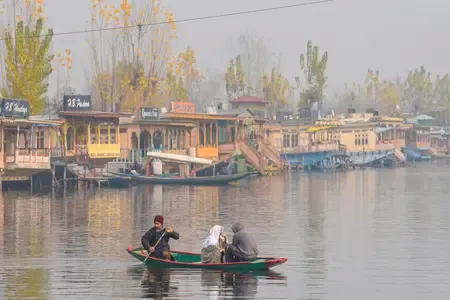
The post-Pahalgam downturn highlighted tourism's pivotal role while also showcasing its evolving resilience. The reopening of key tourist sites, gradual improvements in hotel occupancy, and targeted initiatives like “Return to Kashmir 2025” successfully restored visitor numbers.
Unlike previous cycles, tourism growth is now more comprehensive and institutionally supported. Jammu and Kashmir experienced record tourist arrivals, surpassing 2.36 crore visitors in 2024, followed by a steady 1.62 crore in the 2025 season.
Since 2019, the region has welcomed more than 7.85 crore tourists between 2023 and 2025. Investments in eco-tourism, heritage preservation, winter tourism, and urban amenities are mitigating seasonality and environmental strain.
Tourism now plays a crucial role in ensuring employment stability, cultural preservation, and regional branding.
All-weather road connectivity, tunnels, rail networks, and airport enhancements have alleviated the physical isolation that once hindered growth.
Improved logistics have reduced transport costs, stabilized supply chains, and broadened market access for local producers.
During disruptions, this infrastructure has proven vital in facilitating quicker reopenings of markets and tourist areas.
Beyond mere GDP metrics, infrastructure enhances access to healthcare and education, diminishes regional inequalities, and integrates Kashmir more deeply with national markets.
Connectivity has transformed from a geographic drawback into a strategic advantage.
Hydro-electric power stands out as one of Jammu and Kashmir's most underrated growth contributors. It also aligns the Union Territory with India's clean energy and climate commitments.
When evaluated beyond immediate financial returns, the energy advantage significantly bolsters economic resilience.
Agriculture and horticulture continue to foster high-value rural growth. Agriculture remains central to livelihoods, contributing approximately 18–20 percent of GSDP, but its composition is rapidly evolving.
Traditional subsistence farming is yielding to high-value horticulture, medicinal plants, and agri-processing. Products like apples, saffron, walnuts, and floriculture are driving this transition. Policy support for orchard rejuvenation, cold-chain infrastructure, and digital advisory services has enhanced productivity and minimized post-harvest losses.
Although smaller in size, the industrial sector has shown steady progress. Food processing, handicrafts, handlooms, pharmaceuticals, and construction-linked manufacturing have benefitted from improved connectivity and favorable policies.
MSMEs play a pivotal role in accommodating local labor and linking rural and urban economies. Investment proposals exceeding Rs 1.6 lakh crore, with nearly 2,000 operational units, reflect a growing investor confidence. While large-scale industrialization faces constraints from terrain and ecology, niche value-added industries are emerging as sustainable growth avenues.
Urban development has become another cornerstone of economic performance. Investments in smart city initiatives, municipal reforms, housing, sanitation, and urban transport are boosting productivity in cities like Srinagar and Jammu.
Economic planning increasingly incorporates disaster resilience and climate adaptability. Investments in flood control, river training, resilient infrastructure, and early warning systems mitigate vulnerability to climate-related shocks.
Given the region's exposure to floods, earthquakes, and extreme weather, resilience itself has become a valuable economic asset.
With one of the youngest populations in India, Kashmir's long-term economic outlook hinges on skill development and employment diversification.
Growing participation in IT-enabled services, creative industries, sports, tourism management, and digital entrepreneurship reflects the changing labor landscape.
Government-led skill initiatives, paired with digital connectivity, are paving the way for non-traditional employment opportunities.
Equally crucial is the social resilience exhibited during recent upheavals. Community collaboration, the revival of local festivals, and renewed trust between citizens and institutions have bolstered recovery and reinforced grassroots efforts.
The Jammu and Kashmir Budget 2026–27 underscores the Union Territory's transition from recovery-focused spending to resilience-driven development. With a total allocation of Rs 1,13,767 crore, including Rs 33,127 crore for capital (development) spending and Rs 80,640 crore for revenue expenditure, the budget highlights a strategic move towards asset creation while fulfilling routine administrative and social commitments.
Estimated own revenue stands at Rs 31,800 crore, supplemented by Rs 42,752 crore in central assistance, reflecting the continued importance of external fiscal support in maintaining the region's developmental momentum.
The budget emphasizes capital expenditure over consumption, prioritizing investment in infrastructure, connectivity, power, tourism, urban renewal, and human capital.
Jammu and Kashmir's economy has progressed beyond mere recovery into a phase characterized by resilient, diversified growth. Supported by infrastructure-led integration, service sector expansion, energy development, industrial revival, and human capital investment, the region is redefining its economic trajectory.
As India pursues long-term developmental goals, Jammu and Kashmir's experience illustrates that genuine economic performance cannot be solely quantified by numbers; it must be assessed through the lenses of resilience, inclusion, sustainability, and confidence.
By these meaningful and broader benchmarks, Jammu and Kashmir is not only performing; it is exceeding expectations.
Point of View
It's evident that Jammu and Kashmir's economic evolution reflects a broader narrative of resilience and strategic growth. Policymakers are focusing on durability and diversification, moving beyond historical challenges towards a promising future.
NationPress
16 Oct 2026
Frequently Asked Questions
How has Jammu and Kashmir's economy improved recently?
Recent years have shown significant growth in Jammu and Kashmir's economy, characterized by structural consolidation and a shift away from dependence on public sector employment and tourism cycles.
What are the main sectors driving growth in Jammu and Kashmir?
The primary sectors driving growth include services, tourism, trade, transport, and agriculture, with a notable emphasis on high-value horticulture and eco-tourism.
How has tourism impacted the economy of Jammu and Kashmir?
Tourism has become a critical component of the economy, contributing to employment stability and regional branding, with record tourist arrivals reported in recent years.
What role does infrastructure play in Jammu and Kashmir's economic development?
Infrastructure improvements have facilitated enhanced connectivity, reduced transport costs, and expanded market access, thereby supporting economic growth and resilience.
What is the significance of the Jammu and Kashmir Budget 2026–27?
The Jammu and Kashmir Budget 2026–27 emphasizes a shift towards resilience-driven development, prioritizing capital expenditure in sectors like infrastructure, tourism, and human capital.