Will Karnataka Take Legal Action Against the VB–G RAM G Scheme?
Synopsis
In a bold move, the Karnataka cabinet is set to challenge the VB–G RAM G scheme in court, following the Union government's withdrawal of MGNREGA. Minister H.K. Patil highlights the impacts on rural employment and decentralization, indicating a significant political battle ahead.
Key Takeaways
Karnataka cabinet to legally challenge the VB–G RAM G scheme.
Withdrawal of MGNREGA raises concerns about rural employment.
Decentralization principles are under threat.
Cabinet emphasizes need for local governance autonomy.
Financial burden on states due to new scheme costs.
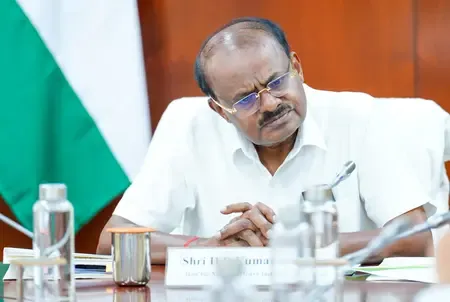
Bengaluru, Jan 8 (NationPress) On Thursday, the Karnataka cabinet convened to address the Union government's decision to retract the Mahatma Gandhi National Rural Employment Guarantee Scheme (MGNREGA). The cabinet has resolved to pursue legal action against the recently launched VB–G RAM G scheme, as stated by H.K. Patil, the state’s Minister for Tourism, Law, and Parliamentary Affairs.
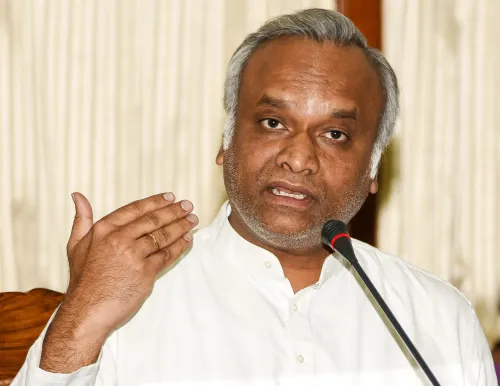
During the press briefing regarding the cabinet's resolutions, Patil emphasized that the new scheme would also be taken to the people’s court. He noted that the 73rd Constitutional Amendment had bolstered decentralization in India, yet this scheme undermines its very essence. By withdrawing MGNREGA, the Union government has revoked the employment rights of rural citizens, he asserted.
According to Patil, while MGNREGA facilitated asset creation through local panchayats, the new 'draconian law' mandates that laborers work on national highway projects handled by contractors. He criticized the Union government for its apparent disregard for laborers' welfare, claiming it has stripped them of their employment rights.
Previously, panchayats had the autonomy to determine which projects were to be executed in their villages, a power that has now been entirely usurped, with directives coming solely from the Centre regarding work to be undertaken, Patil alleged. The Karnataka government stands firmly against this 'draconian legislation' and is committed to opposing it through political, legal, and public channels, he insisted.
Despite claims of providing 125 days of work, there remains a lack of clarity on how this will be implemented, Patil questioned, pointing out concerns over funding. He indicated that state governments would need to cover approximately 40% of the costs, which would create a significant financial strain. He criticized the Centre for not consulting states before imposing such burdens, suggesting that the scheme's introduction followed the 15th Finance Commission's recommendations.
In addition, Patil revealed that the cabinet has decided to expedite panchayat elections. Several panchayats have requested the state government to seek intervention from the Supreme Court on this matter, and a decision will be made shortly.
Furthermore, the cabinet has approved the early release of 33 life convicts from various central prisons based on good conduct, with consent from the Union Ministry of Home Affairs required for two of those cases.
The cabinet has also allocated 10 guntas of land in Survey No. 2.2.39 within the limits of Sirwar taluk in the Raichur district to the 'Congress Bhavan Trust, Bengaluru' for the establishment of a Congress Bhavan.
Additionally, the cabinet has granted 'A-Khata' status to 'B-Khata' sites, buildings, apartments, and flats located in layouts formed without the approval of the relevant authorities within the limits of urban local bodies statewide.
Patil mentioned that the scheme would encompass roughly 10 lakh properties.
The Cabinet has also resolved to execute the 'Akka Pada' scheme in collaboration with the Home Department across 31 districts and five police commissionerates in the state.
Point of View
This decision by the Karnataka cabinet underscores the ongoing tensions between state and central governments over rural employment policies. It reflects a broader discourse on decentralization and the rights of local governing bodies. The implications of this legal challenge may resonate beyond Karnataka, affecting national policy discussions.
NationPress
1 Oct 2026
Frequently Asked Questions
What is the VB–G RAM G scheme?
The VB–G RAM G scheme is a new initiative introduced by the Union government, which has raised concerns due to the withdrawal of MGNREGA.
Why is Karnataka opposing the VB–G RAM G scheme?
Karnataka is opposing the scheme because it undermines the rights of rural workers and the decentralization established by the 73rd Constitutional Amendment.
What actions is the Karnataka cabinet planning to take?
The Karnataka cabinet plans to initiate legal action against the VB–G RAM G scheme and challenge it in the people's court.
What are the financial implications of the new scheme?
The Karnataka government estimates that it would need to bear around 40% of the costs associated with the new scheme, creating a financial burden.
When will panchayat elections be held?
The cabinet has decided to hold panchayat elections as soon as possible, with a decision on seeking Supreme Court intervention expected soon.