Why was Kashmiri Linguist Prof Shafi Shauq Conferred with the Padma Shri Award?

Synopsis
Kashmiri poet and linguist Shafi Shauq has received the Padma Shri award, a prestigious recognition for his contributions to literature, especially reflecting the rich culture of Kashmir. Discover how his work has shaped Kashmiri studies and literature.
Key Takeaways
Shafi Shauq awarded the Padma Shri for contributions to literature.
Significant advocate for Kashmiri studies .
Authored over 100 books in multiple languages.
Retired Dean of the Faculty of Arts at the University of Kashmir.
His works remain critical for scholars and students.
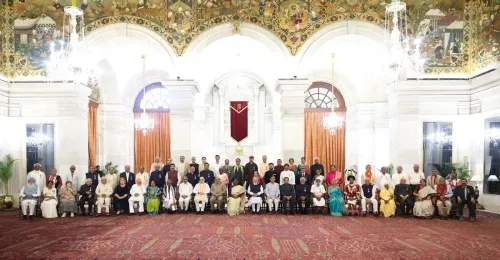
Srinagar, Jan 25 (NationPress) The esteemed Kashmiri poet, writer, linguist, and critic, Shafi Shauq, was honored with the Padma Shri award on Sunday, just before the nation's 77th Republic Day celebrations.
Upon receiving news of his nomination for this prestigious award, Shafi Shauq expressed to IANS, “This recognition not only acknowledges my modest contributions to Kashmiri literature but also signifies the acknowledgment of Kashmir's literary heritage.”
“I feel incredibly honored to be nominated among those recognized for their literary contributions to public life,” he added.
The Padma Shri stands as India's fourth-highest civilian honor, following the Bharat Ratna, the Padma Vibhushan, and the Padma Bhushan.
Established on January 2, 1954, this award recognizes “distinguished contributions across various fields including the arts, education, industry, literature, science, acting, medicine, social service, and public affairs.” It is awarded annually on India's Republic Day by the Government of India.
Shafi Shauq was born in 1950 in the region of Jammu and Kashmir. He earned his PhD in English and is renowned as a poet, fiction writer, linguist, and critic.
Hailing from Kaprin village in the Shopian district, he is widely regarded as an authoritative figure in the field of Kashmiri studies. Over a remarkable academic career that spans more than thirty years at the University of Kashmir, he has authored, edited, and translated over 100 works in Kashmiri, Urdu, Hindi, and English.
His pivotal works, such as ‘Keeshur Lugaat’ (Kashmiri Dictionary), ‘Keeshryuk Grammar’, and ‘Kaeshir Zaban ti Adibuk Tawaariekh’ (History of the Kashmiri Language and Literature), are considered essential texts for scholars, students, and researchers alike.
After dedicating thirty-three years to the University of Kashmir, Prof. Shauq retired in 2010 as the Dean of the Faculty of Arts.
Interestingly, despite passing his postgraduate and PhD exams in English literature, he ultimately chose to communicate in Kashmiri.
He has penned numerous books and possesses fluency in Kashmiri, Urdu, English, and Hindi languages.
Point of View
It's essential to recognize the profound impact that Prof. Shafi Shauq's contributions have had on Kashmiri literature and culture. His Padma Shri award is not only a personal achievement but a celebration of the literary heritage of Kashmir. This recognition serves as a reminder of the importance of preserving and promoting regional languages and literature in our diverse nation.
NationPress
20 Sept 2026
Frequently Asked Questions
What is the Padma Shri award?
The Padma Shri is India's fourth-highest civilian award, established in 1954, recognizing distinguished contributions across various fields, including literature, arts, education, and public service.
What are some notable works of Shafi Shauq?
His key works include ‘Keeshur Lugaat’ (Kashmiri Dictionary), ‘Keeshryuk Grammar’, and ‘Kaeshir Zaban ti Adibuk Tawaariekh’, which are essential texts in Kashmiri studies.
When is the Padma Shri awarded?
The Padma Shri is awarded annually on India’s Republic Day, January 26.
What is the significance of Shafi Shauq's award?
His award highlights the importance of Kashmiri literature and recognizes the rich cultural contributions of the region.