Kaziranga confirms 55+ Greater Hog Badgers in first-ever scientific count
Synopsis
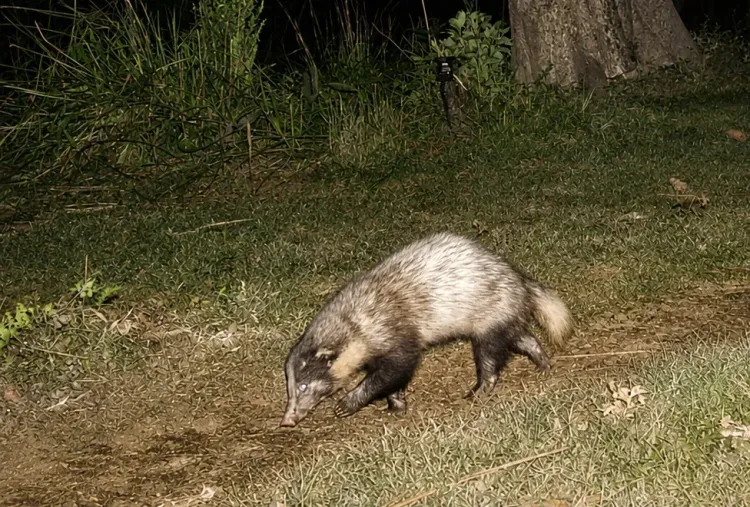
For the first time, scientists have put a number to Kaziranga's Greater Hog Badger population — at least 55 individuals across 1,100 sq km. With the species in global decline and India now considered one of its last healthy strongholds, this assessment quietly repositions Northeast India as a frontline in the fight to save a vulnerable but critically overlooked mesocarnivore.
Key Takeaways
Kaziranga National Park and Tiger Reserve released the first-ever scientific assessment of the Greater Hog Badger on 12 June .
At least 55 individual Greater Hog Badgers were estimated across nearly 1,100 square kilometres of the reserve.
The study used camera-trap bycatch data from All India Tiger Estimation exercises, conducted by the Tiger Cell and Wildlife Conservation Trust .
The Greater Hog Badger is listed as vulnerable on the IUCN Red List , with its global population declining due to habitat loss and poaching.
India and Thailand are believed to hold some of the healthiest remaining populations of the species.
Director Sonali Ghosh called for further studies using detection covariate data to refine the preliminary estimates.
Kaziranga National Park and Tiger Reserve (KNPTR) in Assam has released the first-ever scientific assessment of the Greater Hog Badger (Arctonyx collaris), confirming that at least 55 individual animals inhabit the reserve across nearly 1,100 square kilometres of diverse habitat. The report, officially released on 12 June, marks the first structured population estimate for a species listed as vulnerable on the IUCN Red List and protected under the Wildlife Protection Act, 1972.
How the Assessment Was Conducted
The study was carried out by Kaziranga's Tiger Cell in collaboration with the Wildlife Conservation Trust, using camera-trap images collected during previous All India Tiger Estimation exercises — a method known as camera-trap bycatch analysis. KNPTR Director Sonali Ghosh, a senior Indian Forest Service (IFS) officer, noted that while the findings represent a healthy and potentially viable population, they should be treated as a preliminary estimate. She said further studies using detection covariate data — currently unavailable — are needed to refine the results.
Separately, Assam Environment and Forest Minister Jayanta Mallabaruah cited a figure of more than 60 Greater Hog Badgers documented in the park, reflecting the range of estimates emerging from the bycatch data. The species is locally known as Mati Gahori in Assamese.
Why This Species Matters
The Greater Hog Badger is the largest of three extant hog badger species globally — the other two being the Northern Hog Badger and the Sumatran Hog Badger. Of these, only the Greater and Northern Hog Badgers are found in India. Their range spans parts of South Asia, Central Asia, and Southeast Asia, from Bangladesh and northeastern India eastward through Myanmar, Thailand, Lao PDR, and Vietnam, and southward into Cambodia and peninsular Thailand.
According to the International Union for Conservation of Nature (IUCN), no precise global population figure exists, but the overall trend is declining — driven by habitat degradation and intense poaching pressure. The species has experienced severe declines across much of its Southeast Asian range, with India and Thailand now believed to harbour some of the healthiest remaining populations.
Ecological Role of the Greater Hog Badger
Director Ghosh described the Greater Hog Badger as an ecologically significant mesocarnivore whose conservation value extends well beyond the survival of a single species. As a highly fossorial and omnivorous mammal, it contributes to soil aeration, nutrient redistribution, and the turnover of leaf litter during foraging. Its digging behaviour may also facilitate seed germination and creates microhabitats that support invertebrates and small vertebrates, thereby enhancing broader ecosystem health.
Kaziranga's Role as a Critical Refuge
Ghosh emphasised that Northeast India holds greater international significance for the conservation of this species than is commonly recognised. 'This elevates its conservation priority in South Asia, particularly in Assam and the broader Northeast Indian region,' she said. The Kaziranga findings, she added, help establish the park's role as a critical refuge for the long-term survival of the vulnerable species.
The assessment reinforces Kaziranga's standing not just as a haven for the one-horned rhinoceros and Bengal tiger, but as a biodiversity stronghold for lesser-studied species whose ecological contributions are only now being systematically documented.
Point of View
Overshadowed by the rhinoceros and tiger that define the park's global identity. The use of camera-trap bycatch data is methodologically pragmatic but inherently limited; the study's own authors flag the absence of detection covariate data as a gap. The more consequential finding may be geopolitical: if India and Thailand are genuinely the last viable strongholds for this species, the conservation burden on Assam's protected areas just quietly increased. That responsibility deserves a dedicated monitoring programme, not a preliminary estimate buried in a tiger census.
NationPress
27 Oct 2026
Frequently Asked Questions
What did the Kaziranga Greater Hog Badger assessment find?
The first-ever scientific assessment of the Greater Hog Badger at Kaziranga National Park and Tiger Reserve estimated the presence of at least 55 individual animals across nearly 1,100 square kilometres of the reserve. The report was officially released on 12 June and describes the population as healthy and potentially viable.
Why is the Greater Hog Badger considered vulnerable?
The Greater Hog Badger is listed as vulnerable on the IUCN Red List because its global population is declining due to habitat degradation and intense poaching pressure. It has experienced severe declines across much of its Southeast Asian range, though no precise global population count exists.
How was the Kaziranga study conducted?
The study was carried out by Kaziranga's Tiger Cell in collaboration with the Wildlife Conservation Trust, using camera-trap images collected as bycatch during previous All India Tiger Estimation exercises. KNPTR Director Sonali Ghosh noted the findings are preliminary and that further research is needed.
Where else is the Greater Hog Badger found?
The Greater Hog Badger's range spans northeastern India, Bangladesh, Myanmar, Thailand, Lao PDR, Vietnam, and Cambodia. India and Thailand are currently believed to harbour some of the healthiest remaining populations of the species globally.
What is the ecological importance of the Greater Hog Badger?
The Greater Hog Badger is a mesocarnivore that contributes to soil aeration, nutrient redistribution, and leaf litter turnover through its digging and foraging behaviour. Its fossorial habits may facilitate seed germination and create microhabitats that support other wildlife, making it an important contributor to ecosystem health.