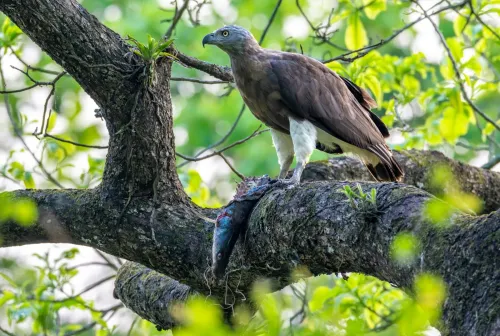
Kaziranga Logs Six Stork Species, Half of India's Raptors

Synopsis
A wildlife survey at Kaziranga National Park, Assam, has documented six of India's eight stork species and nearly half of the nation's raptor diversity, the Chief Minister's Office of Assam announced on June 7, 2026, reinforcing the UNESCO World Heritage Site's standing as a critical avian habitat.
Key Takeaways
Kaziranga National Park has recorded six of India's eight stork species in a recent wildlife survey.
The park hosts nearly half of India's total raptor species , signalling a healthy apex predator population.
Kaziranga is a UNESCO World Heritage Site and Tiger Reserve in Assam , with biodiversity monitoring mandated under the Wildlife (Protection) Act, 1972 .
The findings align with India's intensified biodiversity documentation drive under the National Wildlife Action Plan for Northeast protected areas.
The survey data strengthens the case for wetland restoration funding and enhanced anti-encroachment measures in the park.
Kaziranga's avian records contribute to Central Asian Flyway monitoring, given the migratory range of several species documented there.
The Chief Minister's Office of Assam shared findings on Sunday, June 7, 2026, highlighting that Kaziranga National Park has recorded six of India's eight stork species and nearly half of the country's raptor species, according to a wildlife survey — underscoring the park's significance as one of South Asia's most biodiverse wetland ecosystems.
Context
Kaziranga National Park, a UNESCO World Heritage Site in Assam, is globally recognised for its population of the Indian one-horned rhinoceros, but its avian richness has increasingly drawn scientific attention. The park's expansive floodplains, grasslands, and wetlands along the Brahmaputra river create ideal habitat for both resident and migratory bird species. This latest survey adds fresh documentation to Kaziranga's growing status as a premier birdwatching and conservation destination.
The findings — six of India's eight stork species and close to half of the nation's raptor diversity recorded within a single protected area — are a significant ecological benchmark. Raptors, which include eagles, hawks, falcons, and vultures, are apex predators whose presence signals a healthy, functioning food chain within the reserve.
Policy Backdrop
Kaziranga was declared a national park in 1974 under Assam law, with conservation initially centred on rhinoceros protection. Its designation as a UNESCO World Heritage Site in 1985 broadened the mandate to encompass full biodiversity monitoring aligned with international ecological reporting standards. India's Wildlife (Protection) Act, 1972 requires periodic species surveys across protected areas, and Kaziranga has been subject to regular avian and mammal counts ever since.
The park also functions as a Tiger Reserve under Project Tiger, launched nationally in 1973, which supports comprehensive habitat monitoring beyond just big cats. Bird population data gathered through such surveys feeds into India's national reporting obligations under international biodiversity conventions and the National Wildlife Action Plan.
Stakeholders and Impact
For Assam's forest communities and ecotourism operators, the survey results carry direct economic implications. Kaziranga already attracts tens of thousands of domestic and international visitors annually, and documented avian diversity — particularly rare stork and raptor sightings — strengthens the park's appeal as a wildlife tourism circuit. Conservationists working across Northeast India view such data as critical baseline evidence for lobbying against encroachments and for wetland restoration funding.
The stork and raptor figures also matter for broader migratory corridor planning. Several species recorded at Kaziranga travel across national and international boundaries, making the park a node in Central Asian Flyway monitoring efforts. Any degradation of Kaziranga's wetlands would have cascading effects on bird populations well beyond Assam.
What's Next
Attention will now turn to the release of the next comprehensive Kaziranga wildlife census, which is expected to cover both mammal and bird populations in greater detail. Observers will also watch whether the Government of Assam allocates dedicated funds for wetland restoration and anti-encroachment measures in the state budget — investments that directly determine whether the park's exceptional avian diversity can be sustained over the long term.
The survey results provide the Assam administration with strong scientific backing to push for enhanced protection of Kaziranga's floodplain ecosystems, at a time when annual Brahmaputra floods and human-wildlife interface pressures continue to test the park's ecological resilience.
Point of View
Stricter buffer zone enforcement, and coordinated floodplain management along the Brahmaputra.
NationPress
21 Oct 2026
Frequently Asked Questions
How many stork species are found in Kaziranga National Park?
According to a recent wildlife survey shared by the Chief Minister's Office of Assam, Kaziranga National Park has recorded six of India's eight stork species, making it one of the most important stork habitats in the country.
Why is Kaziranga important for birds in India?
Kaziranga's extensive floodplains, grasslands, and wetlands along the Brahmaputra river provide habitat for a wide range of resident and migratory birds. The park has now been documented to host nearly half of India's raptor species and six of its eight stork species.
Is Kaziranga a UNESCO World Heritage Site?
Yes, Kaziranga National Park was designated a UNESCO World Heritage Site in 1985. It was originally declared a national park in 1974 to protect the Indian one-horned rhinoceros and has since expanded its conservation focus to full biodiversity monitoring.
What raptors are found in Kaziranga National Park?
Kaziranga is home to a wide variety of raptors including eagles, hawks, falcons, and vultures. The recent survey indicates the park holds nearly half of India's total raptor diversity, though the exact species list from this survey has not been fully detailed in official communications.
What is the significance of the Kaziranga bird survey 2026?
The 2026 survey findings highlight Kaziranga as a critical node in South Asia's avian ecosystem, supporting international migratory corridor monitoring and providing scientific evidence for increased wetland restoration and anti-encroachment funding in Assam.