Kerala to challenge SC highway construction curbs, thousands of homes at risk
Synopsis
Kerala is taking the Supreme Court to task over its own order — arguing that a blanket highway construction ban designed for North Indian road conditions is a near-demolition notice for thousands of homes and businesses in one of India's most densely packed states. The fight over 40-metre setbacks could reshape how national safety norms are applied to geographically unique states.
Key Takeaways
Kerala will petition the Supreme Court against its order mandating 40-metre residential and 75-metre commercial setbacks from national highway centre lines.
Public Works Minister P.K.
Basheer made the announcement on 20 August , calling the directive 'not practical' for Kerala.
The Supreme Court issued the order in a suo motu case following a fatal road accident in North India .
Potentially hundreds of acres of private land and thousands of homes and businesses from Kasaragod to Thiruvananthapuram could be affected.
The ongoing six-laning of National Highway 66 and new NHAI projects in Kerala add urgency to the challenge.
Kerala argues it has already restricted highway access to designated entry and exit points , addressing the safety concern behind the original order.
The Kerala government will move the Supreme Court against its recent order imposing construction setback limits along national highways, Public Works Minister P.K. Basheer announced on Thursday, 20 August. The minister argued that the directive is unworkable in a state defined by high population density and acute land scarcity, with potentially thousands of homes and commercial establishments facing legal jeopardy from Kasaragod to Thiruvananthapuram.
What the Supreme Court Ordered
The Supreme Court issued the directive in a suo motu case triggered by a fatal road accident in North India. The order mandates that residential buildings must not come up within 40 metres of the centre line of national highways, while commercial establishments must maintain a setback of 75 metres. Additional land is also to be kept vacant for service roads and adjoining areas.
The court's intent was to regulate highway access points and reduce accident risk — a concern that arose after vehicles were found to be entering national highways freely from multiple points along service roads.
Why Kerala Says It Is a Special Case
Minister Basheer contended that the conditions prompting the Supreme Court's intervention do not replicate themselves in Kerala. The state has already modified its highway access system: vehicles can no longer enter national highways freely and are restricted to designated entry and exit points. This structural change, the minister argued, addresses the very safety concern the court sought to remedy.
'Given Kerala's special circumstances, it is not possible to leave such large stretches of land free for construction. It is not practical. Kerala will directly place its concerns before the Supreme Court. The state government will take a clear and firm stand on the matter,' Basheer said.
The government also intends to highlight Kerala's unusually high population density and the limited land available compared with most other Indian states — factors that make a blanket national standard particularly punishing for property owners here.
Scale of the Impact
If the order stands without modification, hundreds of acres of privately held land and thousands of houses and commercial establishments along the length of the state could be affected, according to the minister. The issue is further sharpened by the ongoing six-laning of National Highway 66, which cuts through the state, and by several new projects recommended by the National Highways Authority of India (NHAI) that could also be stalled.
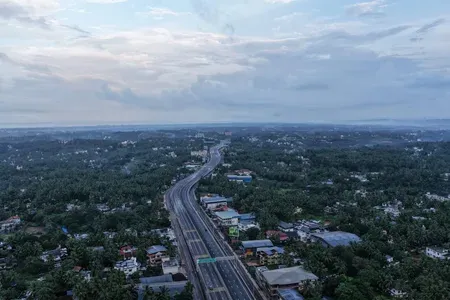
Notably, Kerala's linear geography — a narrow coastal strip hemmed by the Western Ghats — leaves little room for the kind of buffer zones that the order envisions, a reality the state will press before the court.
Kerala's Legal Strategy
The state government plans to seek appropriate relief from the Supreme Court, arguing that road safety can be achieved without imposing uniform restrictions that do not account for Kerala's unique geographical and demographic conditions. The petition is expected to make the case for a state-specific exemption or a modified compliance framework. How the Supreme Court responds could set a precedent for other densely populated states facing similar constraints.
Point of View
But this order exposes the limits of one-size-fits-all regulation in a country of wildly varying geographies. Kerala's population density is among the highest of any large Indian state, and its linear topography leaves almost no room for the buffer zones the court envisions. The deeper question is whether the court's suo motu framework — shaped by a North Indian accident scenario — adequately considered the structural differences before issuing a national directive. If Kerala wins a carve-out, it will invite similar petitions from other dense states and potentially dilute the order's national reach. If it loses, the fallout for property owners along NH66 could be severe and politically explosive for the ruling dispensation.
NationPress
5 Oct 2026
Frequently Asked Questions
What did the Supreme Court order regarding national highway construction?
The Supreme Court directed that residential buildings must not be constructed within 40 metres, and commercial establishments within 75 metres, of the centre line of national highways. The order also requires additional land to be kept clear for service roads and was issued in a suo motu case following a fatal road accident in North India.
Why is Kerala challenging the Supreme Court's highway construction order?
Kerala argues the order is impractical given the state's high population density and scarce land. Public Works Minister P.K. Basheer said Kerala has already restricted highway access to designated points — addressing the core safety concern — and that a blanket setback rule would endanger thousands of homes and businesses across the state.
How many properties could be affected in Kerala if the order stands?
According to Minister P.K. Basheer, hundreds of acres of privately owned land and thousands of houses and commercial establishments from Kasaragod to Thiruvananthapuram could be impacted if the Supreme Court order is not modified.
What is the connection to National Highway 66 in Kerala?
Construction for the six-laning of National Highway 66, which runs the length of Kerala, is currently under way. The Supreme Court's setback order adds legal uncertainty to this project and to several new projects recommended by the National Highways Authority of India in the state.
What relief is Kerala seeking from the Supreme Court?
Kerala plans to seek a state-specific exemption or a modified compliance framework, arguing that highway safety can be ensured through controlled access points without imposing the same construction setback distances applied in states with more available land.