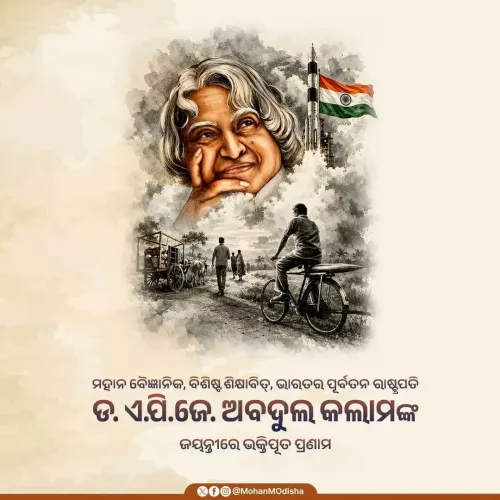
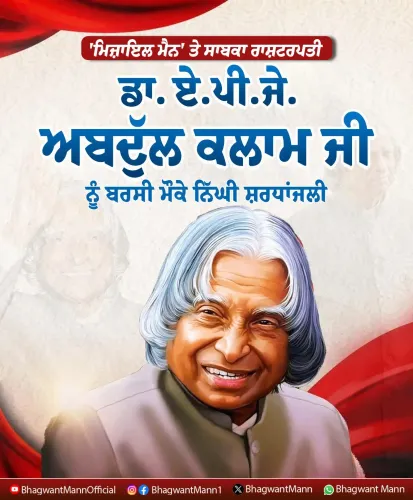
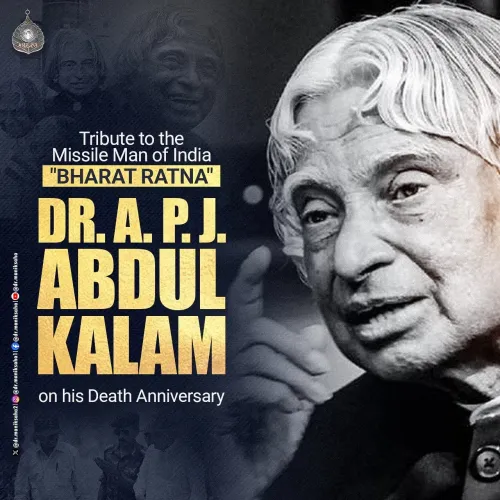
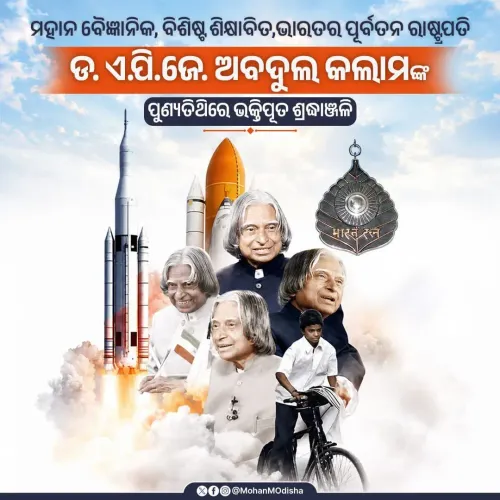
APJ Abdul Kalam death anniversary: Leaders honour 'People's President'
Synopsis
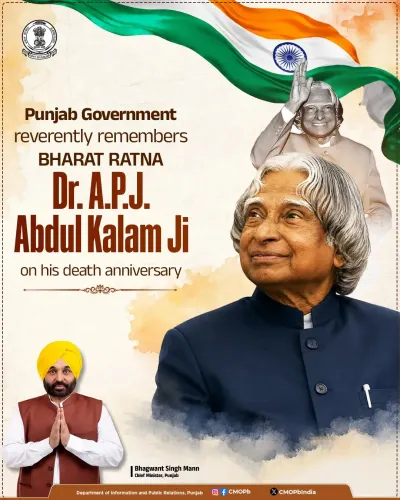
Ten years after his passing, Dr. APJ Abdul Kalam continues to command rare cross-party reverence. On his death anniversary, tributes from the Home Minister to state chief ministers converged on one point: that the Missile Man's blend of scientific rigour and public humility remains India's most enduring leadership template.
Key Takeaways
Abdul Kalam's death anniversary was observed on 27 July 2025 , marking 10 years since his passing in Shillong .
Union Home Minister Amit Shah called him 'a role model for the patriots' in a post on X.
Lok Sabha Speaker Om Birla and UP CM Yogi Adityanath also paid tribute, citing his contributions to India's missile and space programmes.
Kalam served as India's 11th President (2002–2007) and received the Bharat Ratna in 1997 .
He was the principal architect of India's integrated guided missile development programme and played a key role in the 1998 Pokhran-II nuclear tests .
The nation on Monday, 27 July paid tribute to former President and celebrated scientist Dr. A.P.J. Abdul Kalam on his death anniversary, honouring his transformative contributions to India's defence, space, and missile programmes. Dr. Kalam passed away on 27 July 2015 while addressing students at the Indian Institute of Management, Shillong — a fitting final moment for a man who dedicated his life to inspiring the young.
Amit Shah Leads Tributes
Union Home Minister Amit Shah was among the first to pay homage, posting on X: 'Tributes to a visionary and architect of India's space & missile programmes Dr APJ Abdul Kalam Ji on his Punyatithi. Dr Kalam Ji's excellence in the field of science lit India's path to becoming a formidable strategic power, and his wisdom illuminated millions of lives by inspiring them to achieve greatness. The People's President Dr Kalam Ji will always remain a role model for the patriots.'
Lok Sabha Speaker and UP CM Remember the Missile Man
Lok Sabha Speaker Om Birla also marked the occasion, writing on X that Dr. Kalam was 'a visionary dreamer for a developed, self-reliant, and strong India.' Birla noted that his contribution in taking indigenous missile and space programmes to new heights 'is etched in golden letters in the history of Indian science.' He also invoked one of Kalam's most celebrated quotes: 'Dreams are not those that come while sleeping; dreams are those that do not let you sleep.'
Uttar Pradesh Chief Minister Yogi Adityanath offered his own tribute on X, describing Dr. Kalam's role in giving India 'a new global identity in the field of defence and space science, along with making the nation a nuclear power' as unprecedented. 'His vision, simplicity, and dedication to national service are an inspiration for the youth,' Adityanath wrote.
The Legacy of the Missile Man of India
Fondly known as the 'Missile Man of India', Dr. Kalam served as the 11th President of India from 2002 to 2007 and was awarded the country's highest civilian honour, the Bharat Ratna, in 1997. He was the principal architect of India's integrated guided missile development programme and played a central role in the 1998 Pokhran-II nuclear tests.
Beyond his scientific achievements, Dr. Kalam was celebrated for his extraordinary connect with students and ordinary citizens — a quality that earned him the affectionate sobriquet of the 'People's President.' He authored several widely read books, including Wings of Fire, which remains a staple of inspirational reading across India.
A Vision That Endures
Dr. Kalam's dream of a developed, self-reliant India — articulated in his Vision 2020 framework — continues to resonate in national policy discourse. His emphasis on science education, innovation, and youth empowerment has influenced generations of students, engineers, and policymakers. As India advances its space and defence ambitions through missions such as Chandrayaan and Agni missile systems, his foundational work remains deeply relevant.
On his 10th death anniversary, tributes from across the political spectrum reflect a rare consensus on Dr. Kalam's stature as a national icon who transcended partisan divides.
Point of View
The gap between tribute and policy investment remains wide.
NationPress
25 Oct 2026
Frequently Asked Questions
When did APJ Abdul Kalam pass away and where?
Dr. A.P.J. Abdul Kalam passed away on 27 July 2015 while delivering a lecture to students at the Indian Institute of Management in Shillong, Meghalaya. He was 83 years old at the time of his death.
Why is APJ Abdul Kalam called the 'Missile Man of India'?
Dr. Kalam earned the title 'Missile Man of India' for his pivotal role in developing India's ballistic missile and launch vehicle programmes, including the Agni and Prithvi missiles. He served as the chief architect of India's integrated guided missile development programme from the 1980s onward.
What was APJ Abdul Kalam's role as President of India?
Dr. Kalam served as the 11th President of India from 2002 to 2007. He was widely known as the 'People's President' for his accessibility, his deep engagement with students, and his ability to connect with ordinary citizens across the country.
What awards did APJ Abdul Kalam receive?
Dr. Kalam was awarded the Bharat Ratna, India's highest civilian honour, in 1997. He also received the Padma Vibhushan in 1990 and the Padma Bhushan in 1981, among numerous other national and international recognitions.
Who paid tribute to APJ Abdul Kalam on his 2025 death anniversary?
Senior leaders including Union Home Minister Amit Shah, Lok Sabha Speaker Om Birla, and Uttar Pradesh Chief Minister Yogi Adityanath paid tribute on 27 July 2025, each posting on X to mark the occasion and honour his contributions to India's science and defence heritage.