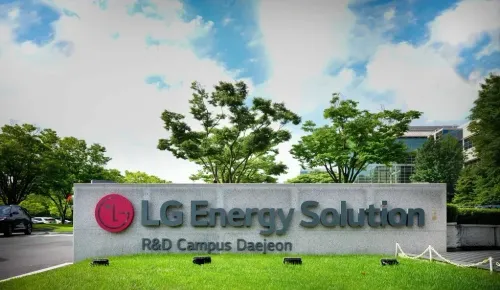
LG Energy Solution Q3 2026: Net loss of ₩296.9bn as EV slowdown bites
Synopsis
South Korea's biggest battery maker swung to a ₩296.9 billion net loss in Q3 2026 even as sales jumped 59 percent — a stark illustration of how deep the EV market's slowdown is cutting. With AMPC credits masking real operating pain and a bold 50 GWh LFP capacity push underway, LGES is betting its recovery on US energy storage, not electric cars.
Key Takeaways
LG Energy Solution (LGES) posted a net loss of 296.9 billion won (US$221.3 million) in Q3 2026 , reversing a 536.1 billion won profit in Q3 2025.
Operating profit rose 25.7% to 756 billion won , but stripped of 416.9 billion won in US AMPC tax credits , the figure falls to 339.1 billion won .
Sales surged 59% to 9.64 trillion won in Q3 2026, yet the nine-month cumulative net loss reached 1.57 trillion won .
Growth in ESS shipments to North America and mid/low-priced pouch-type batteries in Europe partially offset the EV demand slump.
LGES targets over 50 GWh of LFP battery cell capacity in North America by December 2026 , spread across three plants and two joint ventures.
The US ESS market is projected to grow fourfold to 499 GWh by 2031 , according to Wood Mackenzie .
LG Energy Solution Ltd. (LGES), South Korea's largest battery manufacturer, swung to a net loss of 296.9 billion won (approximately US$221.3 million) in the third quarter ended September 2026, reversing a net profit of 536.1 billion won in the same period a year earlier, as a prolonged downturn in the global electric vehicle (EV) market continued to weigh on the company's bottom line. The results were disclosed in a regulatory filing on Tuesday, 3 November.
Key Financial Results
Despite the net loss, operating profit climbed 25.7 percent to 756 billion won in the July–September quarter, up from 601.3 billion won a year ago. Sales surged 59 percent to 9.64 trillion won from 6.06 trillion won in the year-earlier period — a significant top-line expansion even as profitability remained under pressure.
However, the headline operating profit figure includes a substantial boost from US federal incentives. LGES received 416.9 billion won in tax credits under the Advanced Manufacturing Production Credit (AMPC) programme of the US Inflation Reduction Act. Stripped of that benefit, operating profit stood at a more modest 339.1 billion won for the quarter.
Nine-Month Performance Paints a Harder Picture
For the January–September 2026 period, the company recorded a cumulative net loss of 1.57 trillion won, compared with a net profit of 853.3 billion won in the same stretch a year prior — a dramatic reversal. Operating profit for the nine months fell 54.9 percent to 661.6 billion won from 1.47 trillion won, even as sales rose 26 percent to 23.75 trillion won from 18.84 trillion won. The divergence between revenue growth and profit contraction underscores how margin compression — driven by pricing pressure and higher input costs — is eating into the company's earnings base.
ESS Demand Cushions the EV Blow
LGES credited energy storage system (ESS) demand for partially offsetting the EV weakness. According to the company, 'increased energy storage system (ESS) shipments to North America and sales of mid- and low-priced pouch-type batteries in Europe helped support earnings despite a prolonged slowdown in the EV sector.'
The company currently operates seven battery plants in North America — six in the United States and one in Canada. Five of these produce batteries for both ESS and EV applications, while the remaining two manufacture EV batteries exclusively. LGES also operates joint ventures with Honda Motor Co. in Ohio and General Motors Co. in Tennessee.
LFP Capacity Push and US ESS Market Outlook
Amid growing ESS demand, LGES plans to have more than 50 gigawatt-hours (GWh) of lithium iron phosphate (LFP) battery cell production capacity in North America by end of December 2026. This capacity will span three wholly owned plants — LG Energy Solution Michigan-Lansing, LG Energy Solution Michigan-Holland, and NextStar Energy in Ontario, Canada — plus the two joint venture facilities.
The pivot toward ESS is well-timed: the US ESS market is projected to grow fourfold by 2031, reaching a capacity of 499 GWh, according to market research firm Wood Mackenzie. Battery makers across the industry have been accelerating ESS order pipelines to compensate for sluggish EV battery demand, and LGES appears to be among the more aggressive movers in that direction.
This comes amid a broader industry-wide recalibration, as automakers in the US and Europe have trimmed EV production targets in response to softer consumer uptake. How quickly LGES can scale its ESS business — and whether AMPC credits remain intact under future US legislative conditions — will likely define its financial trajectory over the next several quarters.
Point of View
A 59 percent revenue surge alongside a net loss signals severe margin compression, likely from aggressive pricing to hold market share in a saturated EV supply chain. The ESS pivot is strategically sensible, but scaling LFP capacity to 50 GWh by December is an ambitious timeline; execution risk is real. The deeper question mainstream coverage skips is whether the EV slowdown is cyclical or a structural plateau — because if it is the latter, no amount of ESS diversification fully compensates.
NationPress
3 Nov 2026
Frequently Asked Questions
Why did LG Energy Solution report a net loss in Q3 2026?
LGES posted a net loss of 296.9 billion won in Q3 2026 primarily because of a prolonged slowdown in global EV demand, which compressed margins and reduced battery shipment volumes. This reversed a net profit of 536.1 billion won in the same quarter a year earlier, despite a sharp rise in overall sales.
What is the AMPC tax credit and how much did LGES receive?
The Advanced Manufacturing Production Credit (AMPC) is a US federal subsidy under the Inflation Reduction Act designed to incentivise domestic battery manufacturing. LGES received 416.9 billion won in AMPC credits in Q3 2026; without them, its operating profit would have been 339.1 billion won rather than the reported 756 billion won.
How is LG Energy Solution responding to weak EV demand?
LGES is pivoting toward energy storage system (ESS) batteries to cushion the impact of the EV downturn. The company is targeting over 50 GWh of LFP battery cell production capacity in North America by December 2026 and has stepped up ESS shipments to North America and mid/low-priced pouch-type battery sales in Europe.
How large is the US ESS market expected to grow?
According to market research firm Wood Mackenzie, the US ESS market is projected to expand fourfold by 2031, reaching a total installed capacity of 499 GWh. This projected growth is a key driver behind LGES and other battery makers' accelerated push into ESS orders.
What were LGES's sales and operating profit figures for the first nine months of 2026?
For January–September 2026, LGES reported sales of 23.75 trillion won, up 26 percent from 18.84 trillion won in the same period a year earlier. However, operating profit fell 54.9 percent to 661.6 billion won, and the company recorded a cumulative net loss of 1.57 trillion won, compared with a net profit of 853.3 billion won a year ago.