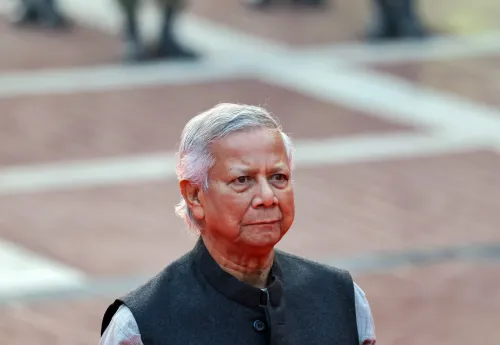
Is the Yunus Government Prioritizing Luxury for Ministers Amidst Public Hardships in Bangladesh?
Synopsis
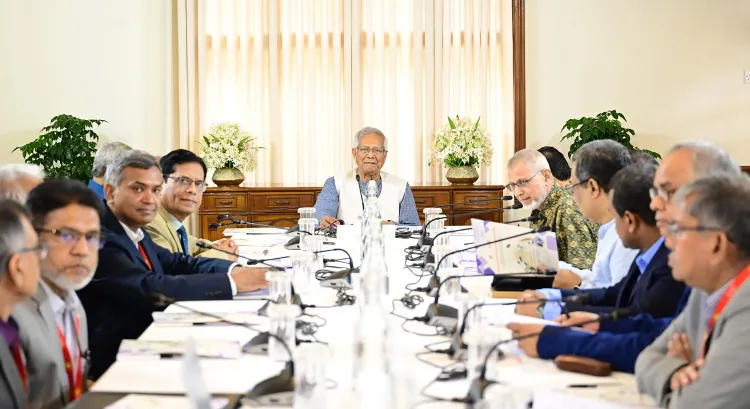
As Bangladesh deals with dire economic challenges, the interim government’s recent approval of 71 luxury flats for ministers raises eyebrows. Critics argue this decision reflects elite privilege at the expense of public welfare. What does this mean for the country's future?
Key Takeaways
Bangladesh is facing significant economic challenges.
The Yunus government has approved luxury accommodations for ministers.
Critics view this as a misallocation of public funds.
The decision highlights a disconnect between government actions and public needs.
Political silence raises questions about accountability and representation.
Dhaka, Feb 2 (NationPress) As Bangladesh faces soaring inflation, severe housing deficits, water shortages, and a decline in public services, the interim government led by Muhammad Yunus has sanctioned a scheme to erect three new structures featuring 71 opulent flats for ministers on Minto Road in Dhaka, according to a report released on Monday.
The initiative is projected to cost Bangladeshi Taka (Tk) 786 crore, with an extra Tk 20 crore set aside for furnishings and fittings. Each flat, spanning between 8,500 and 9,300 square feet, will boast rooftop swimming pools and will be outfitted using taxpayer money.
“This is not just a questionable financial decision. It serves as a political and ethical indictment of an interim government that claims to advocate reform while perpetuating the very model of elite privilege it professes to dismantle. The decision is flawed in four significant ways: it contravenes principles of fairness and justice, undermines public trust and symbolic legitimacy, betrays the spirit of July 2024 amid official silence, and reinforces authoritarian elite privilege through a rushed pre-election decision,” reported New Age, a leading newspaper in Bangladesh.
“Bangladesh is not a prosperous nation. It is a lower-middle-income country burdened by significant inequality, vulnerability to climate change, urban congestion, and chronically underfunded public services. Millions inhabit unsafe housing. Educational institutions lack basic resources, and hospitals are overstretched. In this context, channeling hundreds of crores of taka into luxurious flats for ministers is a violation of the most fundamental tenets of distributive justice. Public funds should address essential community needs, particularly those of the most disadvantaged, rather than cater to the comforts of political elites,” the report outlined.
As per the report, even if the flats are officially designated as “government residences,” their scale and luxury render such justification ethically void, highlighting the stark contrast between modest official housing and elite extravagance.
“Flats resembling palatial estates, equipped with lavish interiors and swimming pools, far exceed any reasonable functional requirements. Opting for luxury over necessity reveals not fiscal compulsion but political inclination. It illustrates what the state values, and here that value is elite comfort over citizen welfare,” it emphasized.
The report further pointed out that the silence of major political entities expected to form the next government after the February 12 elections is particularly alarming.
“No party has raised principled objections. None have questioned the moral rationale behind this expenditure or committed to reversing it. No one has voiced concerns on behalf of citizens forced to endure austerity while elites indulge in luxury. In a moment that was intended to signify a departure from the past, this silence is not neutrality; it is complicity,” it remarked.
Point of View
It's crucial to emphasize that while the Yunus government claims to advocate for reform, the decision to construct luxury flats for ministers starkly contrasts with the pressing needs of the population. This move raises serious questions about priorities and accountability in governance, reflecting a disconnection from the realities faced by the citizens.
NationPress
15 Oct 2026
Frequently Asked Questions
What is the main issue regarding the new luxury flats for ministers?
The issue centers around the construction of 71 luxury flats for ministers amidst rising public hardships, including inflation, housing shortages, and declining public services.
How much will the luxury flats cost?
The project is estimated to cost Bangladeshi Taka (Tk) 786 crore, with an additional Tk 20 crore allocated for furniture and fittings.
Why is this decision considered controversial?
Critics argue that the expenditure on luxury flats for ministers violates principles of justice and public trust, especially when many citizens face economic hardships.
What do critics say about the government's priorities?
Critics claim that this decision reflects a preference for elite comfort over addressing the needs of the most disadvantaged citizens, highlighting a disconnect between the government and the populace.
What does the silence of political parties indicate?
The silence of major political parties regarding this expenditure suggests complicity, raising concerns about accountability and representation of citizens' interests.