Are Human Rights Abuses Rising Under the Yunus-led Interim Government in Bangladesh?
Synopsis
In a troubling revelation, Bangladesh's Awami League raises alarms over escalating human rights abuses under the leadership of Muhammad Yunus. As fear grips ordinary citizens, the implications for democracy and civic life in the nation are dire. Explore the chilling reality that unfolds in this report.
Key Takeaways
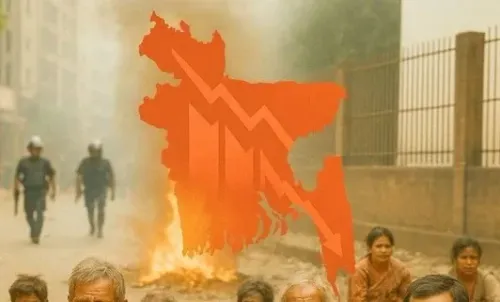
Human rights abuses are reportedly escalating in Bangladesh.
The interim government is accused of ruling through fear and intimidation.
Reports indicate a significant increase in mob violence.
Many citizens now live under constant fear of arrest and harassment.
The decline in civil liberties poses a serious threat to democracy.
Dhaka, Dec 9 (NationPress) The Awami League of Bangladesh has raised serious alarm regarding the ongoing human rights violations in the nation, accusing the interim government led by Muhammad Yunus of governing through intimidation.
The party pondered the implications for the country's future when dozens can lose their lives in a single month, several individuals are detained for their Facebook posts, and countless others are subjected to terror during raids.
Pointing out what it termed as a swift decline in human rights under Yunus’s interim administration, the Awami League indicated that November unveiled a harsh reality for Bangladesh, where ordinary individuals – including students, journalists, and political activists – now live in a state of perpetual fear.
It emphasized that voicing opinions, engaging in protests, or sharing thoughts online could lead to arrests, harassment, or even worse consequences.
The party further contended that the interim government has converted state entities, including police and intelligence agencies, into mechanisms of oppression, often acting with total impunity.
“These violations are not merely random occurrences. They reflect a calculated and systematic initiative to suppress dissent and centralize power. Evidence indicates that lethal force has been sanctioned against demonstrators, illustrating a government that prioritizes power over the safety and rights of its citizens,” the Awami League remarked.
“In this atmosphere, human dignity is disregarded, due process is routinely overlooked, and the institutions designed to uphold justice fail to perform. November stands as a stark reminder: when the interim government opts for fear instead of safeguarding rights, the very essence of democracy and civic existence is jeopardized,” it added.
Beyond politically related clashes, the Awami League noted that the previous month also saw a rise in mob violence, resulting in 16 fatalities and 11 injuries from over 20 mob-attack incidents.
“The incidence of bodies discovered under dubious circumstances, abandoned in rivers, canals, or secluded areas, has significantly increased, contributing to the pervasive atmosphere of dread enveloping numerous communities,” the party asserted.
According to the party, rights organizations have recorded over 300 house-to-house raids throughout November, many conducted without warrants and accompanied by intimidation, property destruction, and arbitrary detentions.
Claiming that this decline has altered everyday life, the Awami League indicated that teachers are shying away from discussions, activists are clearing their online footprints, and community engagements are diminishing as fear becomes a “default social status”.
“The interim government has established a scenario where fear supplants law, and compliance replaces citizenship, ensuring that dissent is unfeasible and accountability is nonexistent,” the party concluded.
Point of View
The situation in Bangladesh signals a concerning trend regarding human rights and democratic principles. The reports from the Awami League highlight an urgent need for international awareness and intervention to uphold the dignity and rights of the citizens.
NationPress
20 Sept 2026
Frequently Asked Questions
What are the main allegations against the Yunus-led interim government?
The Awami League alleges that the interim government is responsible for widespread human rights abuses, including unlawful detentions and suppression of dissent.
How have citizens reacted to the current situation?
Many citizens are living in fear, with reports of activists deleting their online history and teachers avoiding discussions on sensitive topics.
What evidence supports the claims of human rights violations?
Rights groups have documented numerous unlawful raids and instances of violence, with over 300 reported house-to-house searches in November alone.