Is Maharashtra Set to Advance Its Green Energy Goals with an 800-MW Thermal Unit at Chandrapur?
Synopsis
Maharashtra's commitment to green energy is evident as it outlines an ambitious roadmap to achieve net-zero emissions by 2050. Alongside this, plans for an 800-MW thermal unit at Chandrapur are underway to meet rising energy demands effectively.
Key Takeaways
Maharashtra aims for net-zero emissions by 2050.
Plans for an 800-MW thermal unit at Chandrapur are underway.
The State targets 40% of electricity from renewable sources.
Advanced Ultra Supercritical technology will be used in the new thermal unit.
Efforts are in place to provide reliable power supply alongside renewable energy growth.
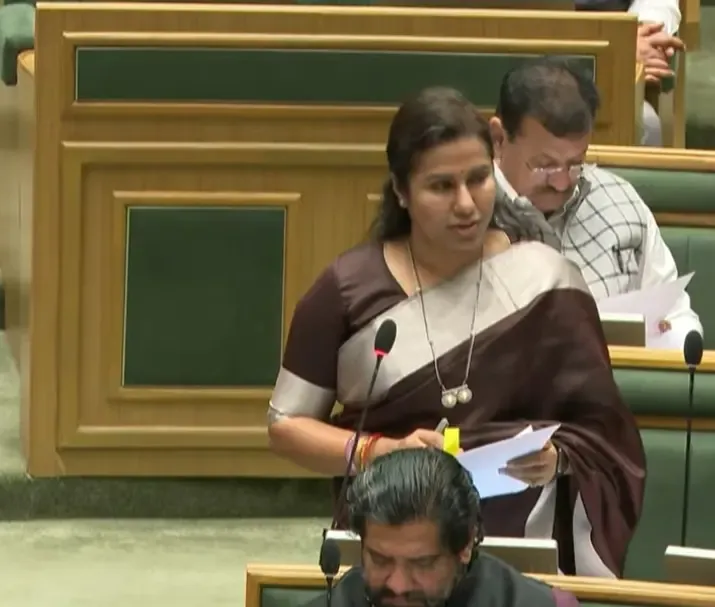
Nagpur, Dec 13 (NationPress) Maharashtra's Minister of State for Energy, Meghana Bordikar Sakore, presented the State’s ambitious renewable energy agenda on Saturday, while also confirming intentions to enhance thermal power capacity due to a significant surge in electricity demand from both industry and residential sectors.
In response to a calling attention motion by MLA Kishore Jorgewar regarding the addition of renewable energy capacity and the proposed thermal facility at Chandrapur, the Minister emphasized the government's dedication to providing a stable and reliable power supply during the transition to cleaner energy alternatives.
The Minister stated that Maharashtra has pledged to reach net-zero emissions from fossil fuels by 2050. According to the National Building Code (NBC) 2016, structures exceeding 15 meters must reduce reliance on fossil fuels by 2030. The State's goal is to derive 40 percent of its total electricity from renewable sources.
Highlighting the New and Renewable Energy Sources Policy launched in 2020, the Minister mentioned that Maharashtra aims to create 17,360 MW of renewable energy capacity. She pointed out the ongoing Chief Minister Solar Power Mission (Mukhyamantri Saur Krushi Vahini Yojana), which is an extensive initiative to supply solar feeders to farmers for a continuous and sustainable power supply.
The Minister informed the assembly that the Maharashtra State Electricity Distribution Company Limited (Mahavitaran) has signed power purchase agreements (PPAs) amounting to 42,518 MW from various sources, which include 2,203 MW through short-term contracts and 984 MW through medium-term contracts. She added that these PPAs have been strategized to secure power supply until 2031-32.
To tackle the intermittency associated with solar and wind energy and to ensure grid stability, the State is advancing new thermal projects. The Chandrapur Super Thermal Power Station (CSTPS) currently stands as the largest power plant in Maharashtra, boasting an installed capacity of 3,340 MW from its existing units (2 × 210 MW and 5 × 500 MW).
“The State is contemplating the establishment of a new 800-MW unit at CSTPS utilizing Advanced Ultra Supercritical technology, which includes provisions for flexible operation. The detailed project report along with technical and financial viability studies has been submitted, with project feasibility extending to 2038-39,” stated the Minister.
She mentioned that Advanced Ultra Supercritical technology is prioritized nationally for its increased efficiency and reduced emissions compared to older thermal units.
The Minister added that the proposed expansion of the State-owned Chandrapur Super Thermal Power Station by Maharashtra State Power Generation Company Limited (MAHAGENCO) is a central aspect of Maharashtra’s energy strategy, though the project is still in the detailed planning and approval phases.
The primary objective, she noted, is to harmonize the rapid growth of renewable energy with reliable base-load power, ensuring effective load management, preventing outages, and depending on “must-run” thermal generation when solar energy is not available.
Point of View
Maharashtra's dual approach of expanding renewable energy while ensuring reliable base-load power highlights a thoughtful strategy. This balance is crucial for meeting the energy demands of a growing population and industry, making it a significant step in India's overall energy transition.
NationPress
1 Oct 2026
Frequently Asked Questions
What is the goal of Maharashtra's renewable energy roadmap?
Maharashtra aims to achieve net-zero emissions from fossil fuels by 2050 and generate 40% of its electricity from renewable sources.
What is the capacity of the proposed thermal unit at Chandrapur?
The proposed thermal unit at Chandrapur is set to have a capacity of 800 MW.
How much renewable energy capacity does Maharashtra plan to create?
Maharashtra has set a target to create 17,360 MW of renewable energy capacity.
What technology will the new thermal unit utilize?
The new thermal unit will utilize Advanced Ultra Supercritical technology for higher efficiency and lower emissions.
How does Maharashtra plan to ensure stable power supply?
Maharashtra plans to balance renewable energy expansion with reliable base-load power to prevent outages and maintain grid stability.