Manipur law and order improving, says CM Singh at NITI Aayog meet
Synopsis
At the NITI Aayog Governing Council, Manipur CM Yumnam Khemchand Singh reported that 11,000 displaced families have been resettled, Jiribam has become a rare inter-community peace symbol, and 130 km of India-Myanmar border fencing is either complete or underway — the most detailed public accounting yet of where Manipur's recovery actually stands.
Key Takeaways
Manipur CM Yumnam Khemchand Singh addressed the NITI Aayog Governing Council in New Delhi on 10 June , reporting improved law and order.
Around 11,000 families displaced by ethnic violence have been resettled under the Resettlement and Rehabilitation Package .
The Centre approved 5,000 additional houses under PMAY-G for 2026-27 for Manipur.
Jiribam district cited as a peace model where Meitei, Kuki, Paite, and Hmar communities shared a meal together; IDPs have begun returning home.
50 km of India-Myanmar border fencing completed; work on another 80 km underway to curb smuggling and trafficking.
Manipur's Gross Enrolment Ratio at 35.5% exceeds the national average of 28.4% ; state records the country's lowest infant mortality rate .
Manipur Chief Minister Yumnam Khemchand Singh on Thursday, 10 June told the NITI Aayog Governing Council meeting in New Delhi that the security situation in the state has significantly improved, crediting the decisive interventions of Union Home Minister Amit Shah and the coordinated efforts of the Central and state governments. Singh also expressed gratitude to Prime Minister Narendra Modi for his sustained commitment to Manipur's recovery and development.
Law and Order: Key Developments
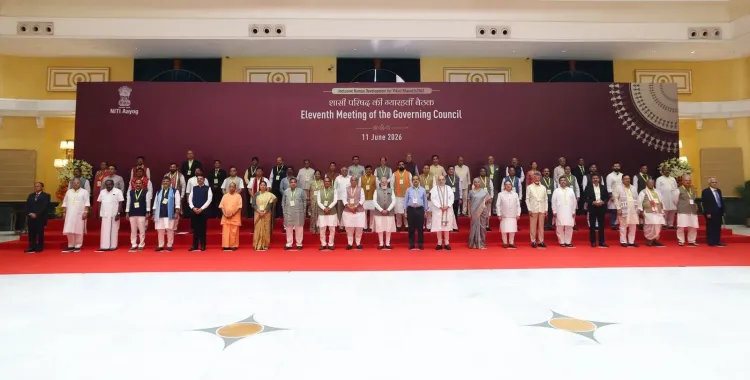
Addressing the full council — chaired by Prime Minister Modi in his capacity as NITI Aayog Chairman — Singh stated that the overall law and order situation across Manipur has visibly improved. He said offices are functional, schools are reopening, festivals have returned, and businesses are reviving. The theme of the meeting was 'Inclusive Human Development for Viksit Bharat @ 2047', which frames the development blueprint for states and the nation ahead of India's centenary of independence.
Rehabilitation of Displaced Families
On the resettlement of ethnic violence-affected Internally Displaced Persons (IDPs), Singh said that approximately 11,000 families have been resettled so far under the Resettlement and Rehabilitation Package, with Central government support. He noted that the state is working to resettle the remaining displaced families at the earliest. Singh also thanked the Centre for approving 5,000 additional houses under PMAY-G for 2026-27 and sought further support for restoring dignity, security, and livelihoods for those still displaced.
The Jiribam Model for Peace
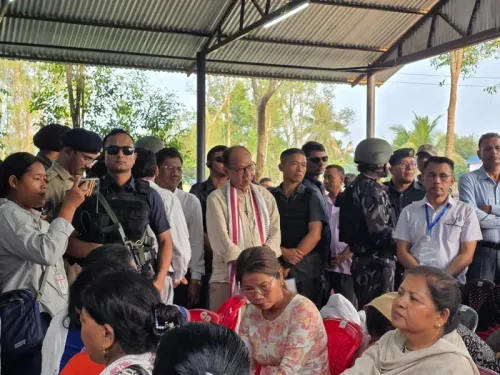
The Chief Minister highlighted Jiribam district as a symbol of renewed hope, noting that it was the first district where members of the Meitei, Kuki, Paite, and Hmar communities came together peacefully and shared a meal. He said he had visited the district twice personally for peace-building efforts, and that IDPs from Jiribam have begun returning to their original homes. Singh expressed his intent to replicate the Jiribam model across all other districts of Manipur. He also personally visited relief camps in Jiribam and Imphal, and travelled to Senapati district via Kangpokpi, meeting both Naga and Kuki communities.
Border Security and Myanmar Challenges
Singh flagged ongoing challenges from the conflict in Myanmar, stressing the need for stronger management of the long India-Myanmar border. He informed the council that the Ministry of Home Affairs has completed 50 kilometres of border fencing to check illegal arms and drug smuggling, with work on an additional 80 kilometres already underway. He called for better surveillance systems and joint action against drug trafficking, arms smuggling, and human trafficking.
Healthcare, Education, and Skill Development
In healthcare, Singh said that over 1.4 lakh free treatments worth more than ₹181 crore have been delivered under Ayushman Bharat and the state's Chief Minister's Hakshelgi Tengbang scheme. He added that Manipur now records the lowest infant mortality rate in the country.
On higher education, the state's Gross Enrolment Ratio stands at 35.5%, above the national average of 28.4%. Mission-mode recruitment of teaching faculty is underway, and universities are aligning with the National Credit Framework and NEP 2020 reforms. Singh requested that Manipur be included in the national Research and Innovation Parks and Mega Educational Hubs initiative, with at least one regional node linking local universities, NIT, IIIT, and enterprise clusters.
On skill development, Singh said Manipuri youth have been trained in Japanese and placed in the healthcare and hospitality sectors in Japan, with others working in Dubai, Abu Dhabi, Portugal, and the United States under the DDU-GKY programme. He also sought accelerated support for Act East connectivity — including national highways, railways, and border trade infrastructure at Moreh — to position Manipur as India's gateway to East Asia.
The session was attended by Union Ministers, NITI Aayog Vice-Chairman Ashok Kumar Lahiri, Jammu and Kashmir Lieutenant Governor Manoj Sinha, and chief ministers of all states. Singh reaffirmed his government's resolve — formed on 4 February 2026 — to rebuild trust, restore peace, and deliver a 'Viksit Manipur' as part of the broader Viksit Bharat vision.
Point of View
Part resource pitch. The 11,000-families resettlement figure is significant, but the number of families still displaced was not stated, making it impossible to assess how far the rehabilitation process has actually advanced. The Jiribam model is genuinely noteworthy as a rare instance of inter-community convergence, but scaling it to districts with deeper fault lines — Churachandpur, Kangpokpi — will test whether it is replicable or an exception. The border fencing update (50 km done, 80 km underway) signals that the Centre is treating the Myanmar spillover as a structural, not temporary, security challenge. What remains unaddressed publicly is a credible timeline for full IDP return and a mechanism for community reconciliation beyond symbolic shared meals.
NationPress
29 Jul 2026
Frequently Asked Questions
What did Manipur CM Yumnam Khemchand Singh say at the NITI Aayog meeting?
CM Singh reported that the law and order situation in Manipur has significantly improved, with around 11,000 displaced families resettled and the Jiribam district emerging as a peace model. He also sought additional Central support for rehabilitation, border security, and infrastructure development.
How many displaced families have been resettled in Manipur so far?
Approximately 11,000 families displaced by ethnic violence have been resettled under the Resettlement and Rehabilitation Package, with Central government support. The state government said it is working to resettle the remaining families at the earliest.
What is the Jiribam peace model that CM Singh referred to?
Jiribam is described as the first district in Manipur where members of the Meitei, Kuki, Paite, and Hmar communities came together peacefully and shared a meal. IDPs from Jiribam have begun returning to their original homes, and CM Singh has expressed his intent to replicate this model across other districts.
What is the status of India-Myanmar border fencing in Manipur?
The Ministry of Home Affairs has completed 50 kilometres of border fencing along the India-Myanmar border, with work on an additional 80 kilometres already underway. The fencing is aimed at curbing arms smuggling, drug trafficking, and human trafficking.
What development achievements did CM Singh highlight for Manipur?
Singh highlighted that over 1.4 lakh free treatments worth more than ₹181 crore have been provided under Ayushman Bharat and the state's Hakshelgi Tengbang scheme. Manipur also records the country's lowest infant mortality rate, and its Gross Enrolment Ratio of 35.5% exceeds the national average of 28.4%.