PM Modi Highlights Rapid Growth of India's Semiconductor Sector with New Facility Launch
Synopsis
Prime Minister Modi emphasizes India's rapid advancements in the semiconductor industry with the launch of Kaynes Semicon's facility in Sanand, showcasing its integration with global supply chains. This marks a significant milestone in India's technological journey.
Key Takeaways
PM Modi inaugurated Kaynes Semicon's OSAT facility , demonstrating India's semiconductor growth.
Production aligns with global supply chains and enhances domestic capabilities.
Investment of Rs 3,300 crore signifies commitment to technology.
India's semiconductor market projected to exceed $100 billion by 2030.
Focus on training over 85,000 design professionals for the industry.
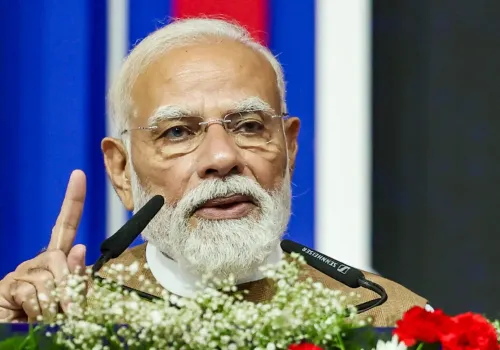
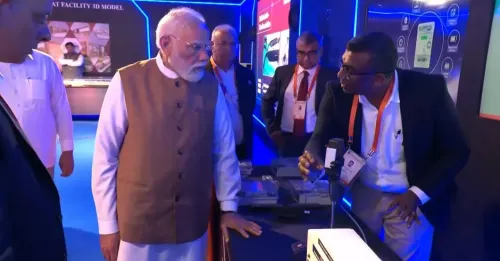
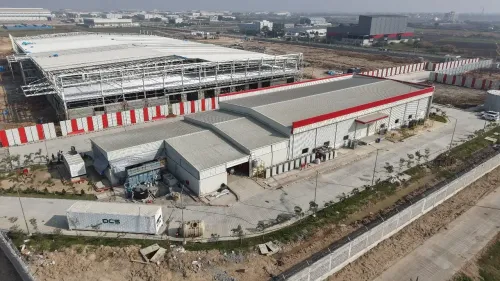
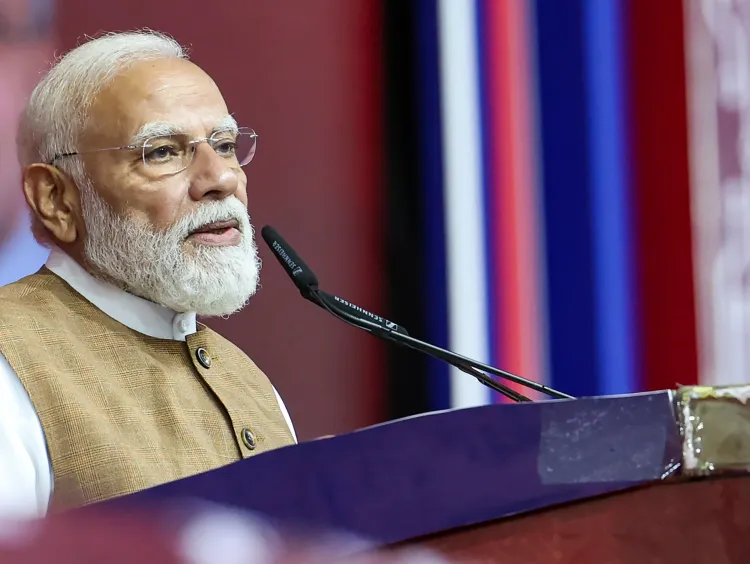
Sanand (Gujarat), March 31 (NationPress) Prime Minister Narendra Modi stated on Tuesday that the commencement of operations at Kaynes Semicon's OSAT facility in Sanand is indicative of the rapid progress and expansion of India’s semiconductor landscape, showcasing its growing integration with international supply chains.
During the facility's inauguration, the Prime Minister highlighted the timely developments in the semiconductor sector.
“On February 28, we saw production kick off at Micron Technology’s facility, and now, on March 31, we are witnessing the start of operations here at Kaynes,” he remarked.
“This is not mere coincidence; it signifies the swift advancement of India’s semiconductor ecosystem,” he asserted.
Reflecting on his previous visit to Sanand, he noted, “I was here at the end of last month, and today I return as the month concludes.”
He added, “Earlier today, I participated in a ‘divine’ event, and now I am engaged in a ‘digital’ one.”
PM Modi expressed pride in the fact that an Indian enterprise is venturing into semiconductor production.
“I take satisfaction in the fact that an Indian company is committed to semiconductor chip manufacturing, with Kaynes poised to become an integral player in the global supply chain,” he said, emphasizing that numerous Indian firms will soon collaborate internationally to forge resilient semiconductor supply chains.
He remarked that this initiative is in line with the “Make in India, Make for the World” vision, reinforcing India’s position in the global market.
Describing this development as a “new connection between Sanand and Silicon Valley,” he mentioned that the plant will provide Intelligent Power Modules (IPMs) to a company based in California.
“A significant portion of the chips produced is already earmarked for export,” he stated.
The Prime Minister pointed out that the modules created in Sanand will reach American companies and enhance both global industrial and electric vehicle ecosystems.
“These Intelligent Power Modules will empower the electric vehicle sector and heavy industries in India and worldwide,” he stated, referring to global collaborations as “the strongest foundation for a better future for the world.”
The facility, established with an investment of approximately Rs 3,300 crore, is an outsourced semiconductor assembly and test (OSAT) plant, designed to produce 6.3 million units daily.
PM Modi emphasized India's domestic capabilities, mentioning advancements in microprocessing technologies like 'Dhruv64' for sectors such as 5G infrastructure, automotive electronics, and industrial automation.
He also discussed initiatives to cultivate a skilled workforce, noting that over 85,000 design professionals will be trained, more than 400 universities and start-ups will have access to advanced design tools, and upwards of 55 chips have been developed.
He highlighted that India’s semiconductor market is currently valued at $50 billion (Rs 4 lakh crore) and is projected to surpass $100 billion (Rs 9 lakh crore) by the decade's end.
“Our goal is to manufacture the majority of our required chips within India,” he stated, adding that the nation is striving to enhance business efficiency, manufacturing, and logistics while fostering innovation in AI and expanding private sector involvement in the space industry.
Point of View
The inauguration of Kaynes Semicon's facility marks a significant leap forward for India's semiconductor landscape. It showcases the country's commitment to becoming a global player in technology while fostering domestic production capabilities.
NationPress
30 Sept 2026
Frequently Asked Questions
What is the significance of Kaynes Semicon's new facility?
The facility signifies India's rapid growth in the semiconductor sector and its integration into global supply chains, enhancing domestic capabilities.
How does this facility relate to global supply chains?
Kaynes Semicon's facility is expected to produce Intelligent Power Modules that will be supplied to international markets, thereby integrating India more deeply into global supply chains.
What are Intelligent Power Modules?
Intelligent Power Modules are advanced components used primarily in electric vehicles and industrial applications, enhancing efficiency and performance.
What investments are being made in India's semiconductor market?
The facility was established with an investment of around Rs 3,300 crore, contributing to the projected growth of India's semiconductor market to over $100 billion by 2030.
How is India preparing its workforce for the semiconductor industry?
India plans to train over 85,000 design professionals and provide access to advanced design tools for more than 400 universities and start-ups.