MP distributes 74.31 lakh MT of free food grains under PMGKAY since Dec 2023
Synopsis
Since December 2023, Madhya Pradesh has quietly delivered 74.31 lakh metric tonnes of free food grains — worth ₹24,209 crore — to over 5.39 crore residents. The state has now extended PMGKAY coverage to unorganised and migrant workers via the e-Shram portal, a structural shift that could set a precedent for how India's informal workforce accesses welfare entitlements.
Key Takeaways
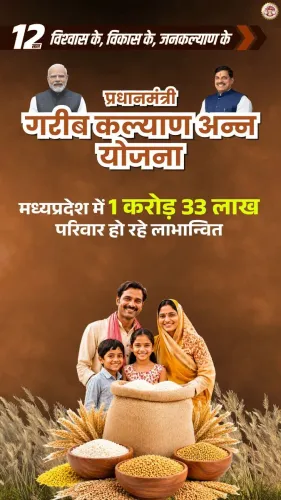
Madhya Pradesh distributed 74.31 lakh metric tonnes of free food grains under PMGKAY since December 2023 , valued at ₹24,209 crore .
More than 5.39 crore eligible beneficiaries across the state have received the supplies.
Eligibility slips issued to 27.80 lakh new unorganised and migrant workers from 7.82 lakh families registered on the e-Shram portal .
Approximately ₹40 crore disbursed monthly since February 2024 to 896 transporters and 27,872 fair price shops via an online payment system.
Operational PDS supply centres expanded from 269 to 273 , including 42 newly established centres .
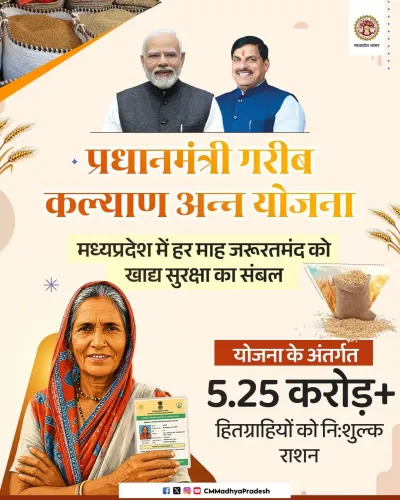
The Madhya Pradesh government has distributed 74.31 lakh metric tonnes of free food grains worth ₹24,209 crore under the Pradhan Mantri Garib Kalyan Anna Yojana (PMGKAY) since December 2023, reaching more than 5.39 crore eligible beneficiaries across the state. The figures were shared by Food, Civil Supplies, and Consumer Protection Minister Govind Singh Rajput on 10 June, underscoring the scale of the state's food security push.
Key Developments
Among the notable expansions under the scheme, a dedicated priority category has been created for unorganised and migrant workers registered on the e-Shram portal. Eligibility slips have been issued to 27.80 lakh new workers from 7.82 lakh families, with free ration distribution to these beneficiaries already underway. This marks a significant broadening of the scheme's reach beyond traditional beneficiary categories.
Reforms in the Public Distribution System
Minister Rajput also detailed a set of structural reforms to the state's Public Distribution System (PDS) aimed at improving transparency and operational efficiency. An online payment mechanism has been introduced for commission dues owed to transporters and fair price shop operators. Since February 2024, approximately ₹40 crore has been disbursed every month to 896 transporters and 27,872 fair price shops across the supply chain. The shift to digital payments has, according to officials, streamlined settlement timelines and reduced administrative delays.
Expansion of Supply Centres
The number of operational PDS supply centres in Madhya Pradesh has been increased from 269 to 273, with 42 newly established centres added to the network. Officials say this expansion has generated measurable savings in distribution time and logistics costs, benefiting both the administration and end beneficiaries at the grassroots level.
Impact on Vulnerable Sections
The combined effect of wider coverage, digital payments, and infrastructure expansion reflects the state government's stated objective of strengthening food security for low-income and unorganised workers. Notably, the integration of the e-Shram database into the PMGKAY framework is among the first such moves at the state level, potentially offering a model for other states managing large informal labour populations. Officials believe these measures will contribute to reducing hunger and supporting economic stability among the state's most vulnerable households.
Point of View
But the more consequential development is the integration of the e-Shram database into PMGKAY eligibility — a move that attempts to formalize welfare access for India's vast informal workforce. If the 27.80 lakh new worker beneficiaries translate into sustained coverage, it would represent a genuine structural shift, not just a numerical expansion. The monthly ₹40 crore digital payout mechanism is also worth watching: timely, transparent payments to fair price shop operators have historically been a weak link in PDS chains. Whether Madhya Pradesh's model holds up at scale — and whether the Centre replicates it — is the real story beneath the distribution figures.
NationPress
14 Sept 2026
Frequently Asked Questions
How much free food grain has Madhya Pradesh distributed under PMGKAY?
Madhya Pradesh has distributed 74.31 lakh metric tonnes of free food grains under PMGKAY since December 2023 , with a total value of ₹24,209 crore . The supplies have reached more than 5.39 crore eligible beneficiaries across the state.
Who are the new beneficiaries added under PMGKAY in Madhya Pradesh?
A new priority category has been created for unorganised and migrant workers registered on the e-Shram portal . Eligibility slips have been issued to 27.80 lakh workers from 7.82 lakh families, and free ration distribution to this group is already underway.
What reforms has Madhya Pradesh introduced in its Public Distribution System?
The state has introduced an online payment mechanism for commission dues to transporters and fair price shop operators. Since February 2024 , approximately ₹40 crore is disbursed monthly to 896 transporters and 27,872 shops , streamlining the supply chain through digital settlements.
How many PDS supply centres are now operational in Madhya Pradesh?
The number of operational PDS supply centres has been increased from 269 to 273 , with 42 newly established centres added. Officials say this expansion has reduced distribution time and logistics costs.
What is the Pradhan Mantri Garib Kalyan Anna Yojana (PMGKAY)?
PMGKAY is a central government scheme that provides free food grains to economically vulnerable households across India. It was originally launched during the COVID-19 pandemic and has since been extended as a permanent welfare measure, with states like Madhya Pradesh responsible for last-mile distribution.