Norway raises US tariff concerns in Washington trade talks
Synopsis
Norway's state secretary flew to Washington and told the US deputy trade representative directly: Oslo won't be treated worse than the EU, won't accept a bad trade deal, and formally contests the Section 301 overcapacity probe. The exchange signals Oslo is prepared for a prolonged diplomatic standoff over Washington's sweeping July tariffs.
Key Takeaways
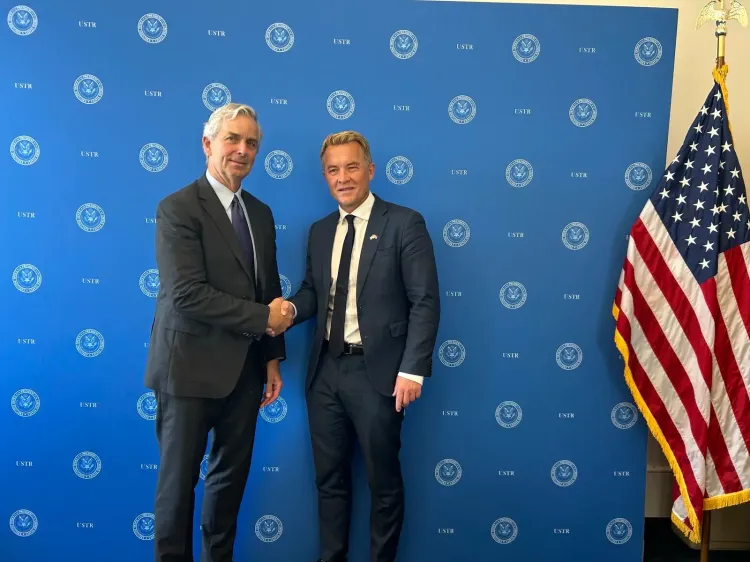
Norwegian State Secretary Andreas Motzfeldt Kravik met Deputy USTR Jeff Goettman in Washington on 21 August .
The US imposed tariffs on goods from 60 countries , including Norway and the EU , on 24 July , citing forced-labour import concerns.
Foreign Minister Espen Barth Eide said Norway 'strongly disagrees' with the unilateral tariff measures and sees no basis for being treated differently from the EU.
Norway also challenged the US Section 301 overcapacity investigation , which covers Norway, the EU, and 14 other countries .
A bilateral trade agreement was discussed, but Oslo said it 'will not enter into an agreement at any price'.
Norwegian State Secretary Andreas Motzfeldt Kravik met Deputy United States Trade Representative Jeff Goettman in Washington on Wednesday, 21 August, raising formal concerns over US tariffs on Norwegian goods and challenging an ongoing American investigation into global industrial overcapacity. The talks, confirmed by the Norwegian Ministry of Foreign Affairs, mark Oslo's most direct diplomatic push yet against Washington's sweeping new trade measures.
Background: The US Tariff Sweep
The United States announced new tariffs on goods from 60 trading partners — including Norway and the European Union (EU) — on 24 July. Washington cited, in part, concerns that these countries lacked adequate restrictions on imports of products manufactured using forced labour. The announcement drew immediate pushback from several affected nations, with Norway among the most vocal.
What Norway Told Washington
Norwegian Foreign Minister Espen Barth Eide said in a ministry statement that Kravik had made Oslo's position unambiguous in the meeting. 'We strongly disagree with the US's unilateral use of tariffs and the justification for them. Kravik emphasized in the meeting that there is no basis for treating Norway differently than the EU,' Eide said.
Kravik also challenged the basis of the US overcapacity investigation, which currently covers Norway, the EU, and 14 other countries, according to the foreign minister.
Trade Agreement on the Table — With Conditions
The two sides also discussed the possibility of a bilateral trade agreement between Norway and the United States. Oslo, however, signalled it would not accept terms unfavourable to its interests. 'An agreement must be in Norway's interest. We will not enter into an agreement at any price,' Eide said, adding that US tariff policy continued to generate uncertainty even for countries that had already concluded agreements with Washington.
Kravik's Post-Meeting Statement on X
Following the talks, Kravik posted on X: 'Constructive meeting with Deputy @USTradeRep Jeffrey Goettman. We discussed the longstanding trading relationship between Norway and the US. I reiterated Norway's firm opposition to the Section 301 investigations of Norway. I look forward to continuing our dialogue on this issue.'
The reference to Section 301 — a US trade law that allows unilateral tariffs in response to foreign trade practices deemed unfair — signals that Oslo views the overcapacity investigation as legally contestable, not merely a diplomatic inconvenience. This is the latest in a series of bilateral exchanges between Washington and affected trading partners since the 24 July announcement, with outcomes so far ranging from preliminary agreements to continued standoffs.
Point of View
Oslo is effectively tying its fate to Brussels' negotiating leverage — a smart move given the EU's far greater economic weight. The Section 301 challenge is the sharper edge here; contesting the legal basis of the investigation, rather than just its outcomes, signals Oslo may be preparing a formal trade dispute. What the meeting did not produce is any sign of concessions from Washington, and Eide's warning that US tariff policy creates uncertainty even for countries that have reached deals is a pointed message to other trade partners watching these talks closely.
NationPress
5 Oct 2026
Frequently Asked Questions
Why did Norway raise concerns over US tariffs?
Norway objected to new US tariffs announced on 24 July that targeted goods from 60 countries, including Norway, partly on grounds that those nations lacked sufficient restrictions on forced-labour imports. Oslo disputes both the justification and the decision to treat Norway differently from the EU.
What is the US Section 301 overcapacity investigation?
It is a US trade probe under Section 301 of the Trade Act that examines alleged industrial overcapacity in Norway, the EU, and 14 other countries. Norway's state secretary formally challenged the basis of this investigation during the 21 August Washington meeting.
Is Norway negotiating a trade deal with the United States?
The possibility of a bilateral trade agreement was discussed during the meeting, but Norwegian Foreign Minister Espen Barth Eide made clear that Oslo will not accept unfavourable terms, saying Norway 'will not enter into an agreement at any price'.
Who represented Norway and the US in the trade talks?
Norway was represented by State Secretary Andreas Motzfeldt Kravik, while the US side was led by Deputy United States Trade Representative Jeff Goettman. The talks took place in Washington on 21 August.
What did the Norwegian state secretary say after the meeting?
Kravik posted on X that the meeting was 'constructive', that he reiterated Norway's 'firm opposition' to the Section 301 investigations, and that he looked forward to continuing dialogue with the US trade representative's office.