Nepali youths rally in Pokhara for Agnipath entry into Indian Army
Synopsis
Nepali Gurkha recruitment into the Indian Army has been frozen since 2019 — and a rally in Pokhara shows the human cost. Young men who trained for Indian Army service are instead heading to the Gulf, while a diplomatic deadlock over the Agnipath scheme's pension terms keeps the door shut. The protest is a rare, organised public demand for Kathmandu to reconsider.
Key Takeaways
Nepali youths and veterans rallied in Pokhara on 12 August , demanding resumption of Gurkha recruitment into the Indian Army under the Agnipath scheme .
Gurkha recruitment has been frozen since 2019 ; Nepal formally suspended it after India introduced Agnipath in 2022 .
Under Agnipath , only 25 per cent of recruits are retained permanently; the rest are discharged after four years without pensions.
Nepal argues the scheme violates the 1947 Tripartite Agreement governing Gurkha service terms.
Protesters submitted a memorandum to the Chief District Officer of Kaski , calling for immediate reopening of the recruitment process.
Demonstrators warned that the freeze is pushing Nepali youth toward Gulf labour migration instead.
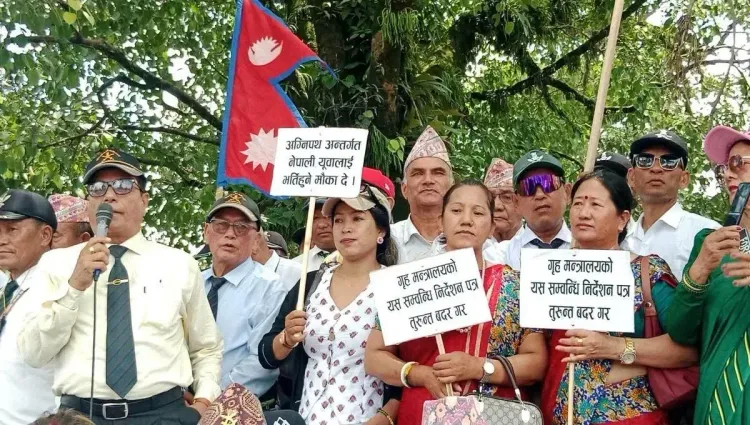
Hundreds of Nepali youths and family members of former Indian Army personnel marched through Pokhara on Wednesday, 12 August, demanding that the Nepali government allow their enlistment as Agniveers under the Agnipath scheme. The rally, organised by the Indian Ex-Servicemen Gorkha Brigade Nepal, marks one of the most visible public pushes yet to break a recruitment freeze that has kept Nepali Gurkhas out of the Indian Army for over five years.
Background: Why Recruitment Stalled
Gurkha recruitment into the Indian Army was first paused in 2019, initially on account of the Covid-19 pandemic. The suspension became entrenched when India introduced the Agnipath scheme in 2022, under which recruits serve for four years, with only up to 25 per cent retained for permanent service. The remaining 75 per cent are discharged with a one-time lump-sum payment, receiving no pension or long-term career benefits.
The Nepali government objected, arguing that the scheme conflicts with the provisions of the 1947 Tripartite Agreement signed between India, Nepal, and Britain — an accord that has historically governed the terms of Gurkha service, including pension entitlements. Kathmandu has since declined to allow recruitment to resume under the revised framework.
What Protesters Demanded
The demonstration began at Pokhara Stadium and proceeded to the District Administration Office, where organisers submitted a memorandum to the Chief District Officer of Kaski district. Participants carried placards calling for the immediate reopening of the Agnipath recruitment process.
Protesters argued that Nepali youths should be permitted to join the Indian Army as Agniveers rather than being forced to seek work in Gulf countries. Among the demands shared on social media was the preservation of the identity and tradition associated with Gurkha soldiers — a heritage that demonstrators said is being eroded by the prolonged freeze.
The rally also called on authorities not to halt the registration process for organisations representing former soldiers that carry the term 'ex-servicemen' in their name. Such bodies, protesters said, are essential to safeguard the rights and dignity of veterans.
The Employment Dimension
With formal employment opportunities in Nepal remaining limited, the Indian Army has historically served as a critical livelihood pathway for young men from hill districts, particularly around Pokhara — long considered the heartland of Gurkha recruitment. The prolonged pause has coincided with a rise in Nepali labour migration to the Gulf, a trend protesters explicitly cited as a consequence of the stalled recruitment.
This comes amid broader diplomatic sensitivity between India and Nepal over the Agnipath framework, with Kathmandu yet to signal any formal shift in its position despite sustained pressure from veterans' groups and families of former servicemen.
What Comes Next
The memorandum submitted to the Chief District Officer of Kaski is expected to be forwarded to the central government in Kathmandu. Whether the rally translates into a policy review remains uncertain, as the Nepali government has maintained its objection to the Agnipath terms since 2022. Diplomatic engagement between the two countries on the matter has not produced a resolution as of the date of the protest.
Point of View
But has offered no alternative framework, leaving thousands of trained young men in limbo. The irony is acute — a scheme India designed partly to reduce long-term pension liability is now costing it soft-power equity with one of its most historically loyal recruitment pools. For Kathmandu, the calculus is equally uncomfortable: blocking a livelihood option for its own youth in defence of a 1947 agreement that Britain — the third signatory — no longer enforces. A bilateral renegotiation of the Tripartite Agreement's pension provisions is the obvious path forward; neither capital has publicly pursued it.
NationPress
27 Sept 2026
Frequently Asked Questions
Why are Nepali youths demanding entry into the Indian Army under Agnipath?
Nepali youths want to enlist as Agniveers because formal employment opportunities in Nepal are limited and the Indian Army has historically been a major livelihood pathway for hill-district youth. The recruitment freeze since 2019 has left trained candidates without options, pushing many toward Gulf labour migration instead.
Why has Nepal suspended Gurkha recruitment under the Agnipath scheme?
Nepal suspended recruitment in 2022 after India introduced Agnipath, arguing the scheme contradicts the 1947 Tripartite Agreement between India, Nepal, and Britain. The key objection is that Agnipath discharges 75 per cent of recruits after four years without pensions, which Nepal says violates agreed service terms for Gurkha soldiers.
What is the Agnipath scheme and how does it affect Gurkhas?
Agnipath is India's military recruitment model introduced in 2022, under which soldiers serve for four years with only up to 25 per cent retained permanently. For Gurkhas, this means most recruits would lose pension entitlements that were guaranteed under the 1947 Tripartite Agreement — the core of Nepal's objection.
What happened at the Pokhara rally on 12 August?
The Indian Ex-Servicemen Gorkha Brigade Nepal organised a march from Pokhara Stadium to the District Administration Office, where organisers submitted a memorandum to the Chief District Officer of Kaski. Protesters — including veterans, family members, and trained youths — demanded immediate resumption of Agnipath recruitment and protection of ex-servicemen organisations.
What is the 1947 Tripartite Agreement and why does it matter here?
The 1947 Tripartite Agreement between India, Nepal, and Britain established the terms under which Nepali Gurkhas could serve in the Indian and British armies, including pension and service-condition guarantees. Nepal argues that Agnipath's limited retention and no-pension model for 75 per cent of recruits is incompatible with those agreed terms.