Can Peace Exist Without Justice? Prez Murmu Celebrates Human Rights Day
Synopsis
In a powerful address during the Human Rights Day celebration, President Droupadi Murmu calls for universal human rights, emphasizing their importance in achieving a just society. Her remarks underline the connection between human rights and national development, urging every citizen to contribute towards a Viksit Bharat by 2047.
Key Takeaways
Human rights are fundamental for all individuals , especially the most vulnerable.
The government's focus has shifted towards empowerment over entitlement.
The NHRC plays a crucial role in safeguarding constitutional rights.
Women’s empowerment is key to human rights.
Aiming for a Viksit Bharat by 2047 involves active citizen participation.
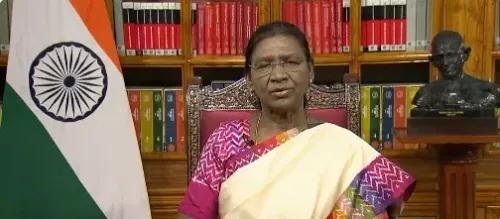
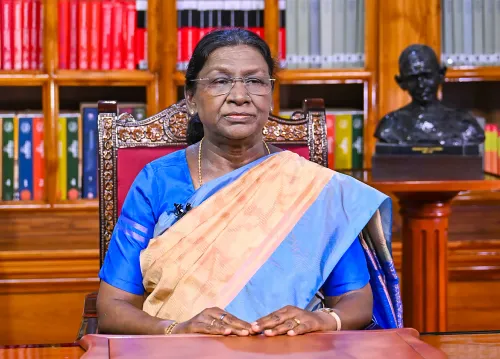
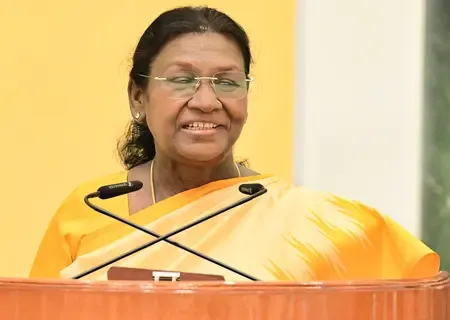
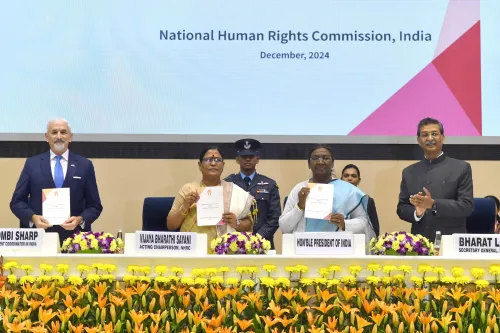
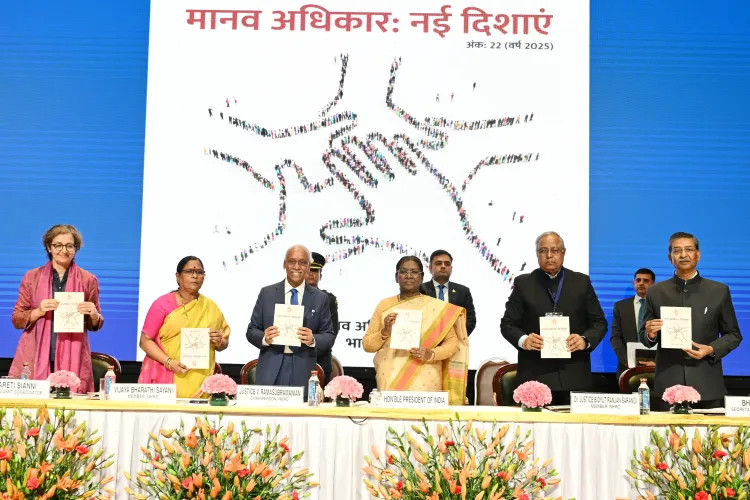
New Delhi, Dec 10 (NationPress) President Droupadi Murmu attended and spoke at the Human Rights Day celebration organized by the National Human Rights Commission in New Delhi. She highlighted the principle that human rights must be secured for everyone, particularly for those at the last mile, in line with the Antyodaya philosophy.
The President urged that every citizen must actively engage in the nation’s development journey towards achieving a Viksit Bharat by 2047.
“Seventy-seven years ago, the global community united to express a fundamental yet transformative truth: every human being is born free and equal in dignity and rights,” she stated, emphasizing India's significant contribution to the formation of a worldwide human rights framework and how freedom fighters envisioned a world anchored in human dignity, equality, and justice.
She underscored that the essence of human rights is embedded in our Constitution.
“Human rights foster social democracy. They include the right to live without fear, to access education without obstacles, to work without exploitation, and to grow old with dignity,” she remarked.
“We have reminded the global community that human rights are intrinsically linked to development. Furthermore, India adheres to the ageless truth: ‘There is no peace without justice, and there is no justice without peace,’” she added.
The President commended the NHRC, State Commissions, the judiciary, and civil society for serving as vigilant guardians of the Constitutional ethos.
She acknowledged the NHRC's vital efforts, particularly in addressing issues affecting SC/ST communities, women, and children, along with its commitment to the rights of prison inmates.
Highlighting women's empowerment as essential to human rights, she praised the NHRC's conference focused on women's safety.
The President noted the government's shift in approach from entitlement to empowerment and from charity to rights over the past decade, ensuring that essential services like clean water, healthcare, and sanitation are accessible to all, thus safeguarding dignity.
She also pointed out the implementation of the four Labour Codes as a significant reform aimed at preparing a workforce for the future.
Point of View
We must continue to advocate for these ideals, ensuring that every citizen's rights are upheld.
NationPress
14 Oct 2026
Frequently Asked Questions
What was the main message of President Murmu's address?
President Murmu emphasized that human rights should be guaranteed for everyone, especially for marginalized individuals, and highlighted their significance in achieving national development.
What role does the NHRC play in human rights?
The NHRC acts as a guardian of human rights in India, addressing issues related to marginalized communities and ensuring that constitutional rights are upheld.
How does the government’s approach to human rights differ now?
The government has shifted its approach from entitlement to empowerment, focusing on providing essential services to all citizens to secure their dignity.