Quad nations vow to oppose forced status quo changes, back North Korea denuclearisation
Synopsis
At their New Delhi ministerial, the Quad's four foreign ministers delivered a unified message against coercive territorial changes — a pointed signal aimed at regional flashpoints — while expanding their agenda to cover North Korea's weapons programmes, critical mineral supply chains, and energy security through the Strait of Hormuz. The grouping's rapid evolution from security dialogue to multi-domain platform is accelerating faster than most analysts anticipated.
Key Takeaways
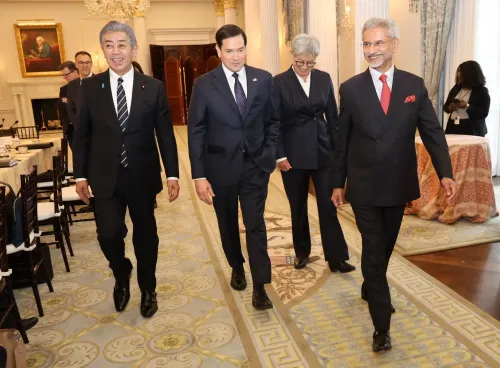
The Quad foreign ministers met in New Delhi on 26 May , with India , Japan , Australia , and the US represented.
All four nations agreed to 'strongly oppose' attempts to unilaterally change the status quo by force or coercion .
The Quad reaffirmed its commitment to the complete denuclearisation of North Korea , including discussion of Pyongyang's cyber activities.
Ministers expressed 'deep concern' over critical mineral export restrictions and backed the Critical Minerals Initiative Framework .
Free navigation through the Strait of Hormuz and Middle East stability were flagged as Indo-Pacific energy security priorities.
Japanese Foreign Minister Toshimitsu Motegi linked the meeting's outcomes to Japan's Power Asia energy procurement framework.
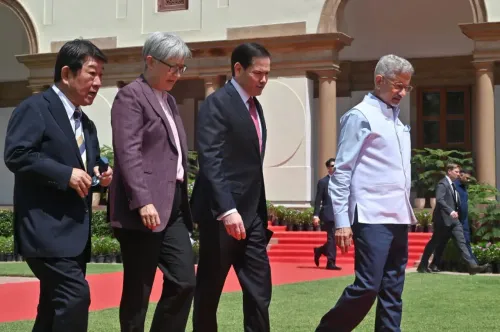
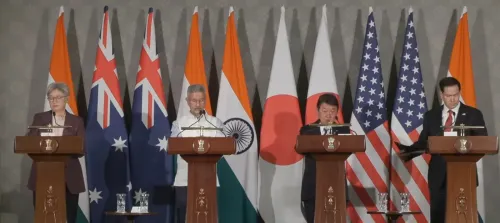
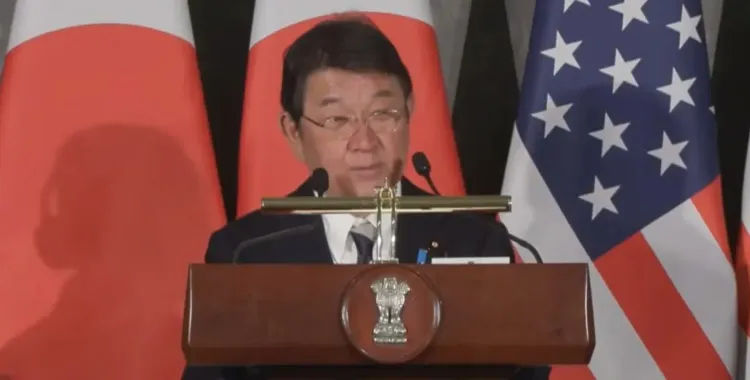
Japanese Foreign Minister Toshimitsu Motegi on Tuesday, 26 May said the Quad nations — India, Japan, Australia, and the United States — have agreed to strongly oppose any attempts to unilaterally alter the status quo through force or coercion. The declaration came at the conclusion of the Quad Foreign Ministers' Meeting held in New Delhi, where all four foreign ministers addressed the press jointly.
Key Declarations from the Meeting
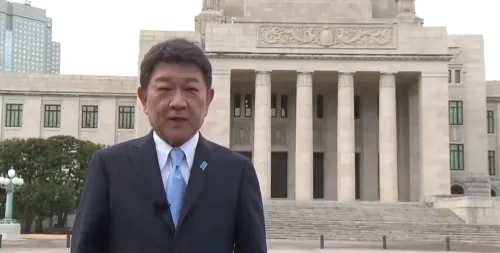
Speaking after the ministerial, Motegi said the gathering offered an opportunity to send what he called an 'unswerving and unshaken message' on regional security. 'Today's meeting gave us a good opportunity to send an unswerving and unshaken message that the Quad will advance the necessary concrete cooperation for this. Also today, through frank exchange of views, we were able to align our strategic perceptions on regional developments and agreed to strongly oppose attempts to unilaterally change the status quo by force or coercion,' he said.
The four ministers also reaffirmed their collective commitment to the complete denuclearisation of North Korea, with Motegi noting that nuclear and missile programmes as well as cyber activities linked to Pyongyang were discussed at length. He added that he received support from the other three nations on seeking an 'immediate solution to the abduction issue' — a longstanding Japanese diplomatic priority.
Critical Minerals and Supply Chain Concerns
The Quad nations expressed what Motegi described as 'deep concern' over export restrictions on critical minerals. He termed the Critical Minerals Initiative Framework 'very important' for reinforcing supply chain resilience across the Indo-Pacific. This concern reflects a broader global anxiety about chokepoints in the supply of materials essential to semiconductors, clean energy, and defence manufacturing.
Middle East Stability and Energy Security
Motegi emphasised that the Iranian situation carries 'an enormous impact on the Indo-Pacific region,' particularly from an energy supply perspective. The four nations confirmed the importance of diplomatic efforts to ensure free and safe navigation through the Strait of Hormuz and to bring stability to the Middle East. He linked this to Japan's Power Asia framework — a cooperation mechanism for procuring crude oil and petroleum products — and described the Energy Security Initiative as a 'timely initiative' for securing stable energy supply across the Indo-Pacific.
Quad's Growing Strategic Footprint
Motegi, who also participated in the inaugural Quad Foreign Ministerial in 2019, said he was encouraged by the progress of Quad cooperation since then, describing the grouping as the 'propellant for realising the Free and Open Indo-Pacific.' The New Delhi meeting marks a continued deepening of the Quad's agenda — from security and denuclearisation to supply chains and energy — reflecting its evolution from an informal strategic dialogue into a substantive multilateral platform. Notably, this is only the second in-person Quad Foreign Ministers' gathering, underscoring the grouping's accelerating institutionalisation.
The four nations said they would continue to promote cooperation projects aimed at building regional resilience and strengthening the capacity of Indo-Pacific countries to determine their own paths.
Point of View
Even as no country is named. What is notable is how far the agenda has stretched since 2019: from security signalling to critical minerals, energy corridors, and cyber threats from North Korea. The risk is that breadth dilutes depth — the Quad now covers so much ground that accountability for any single deliverable becomes harder to track. The abduction issue Motegi raised is also a reminder that Japan's domestic political imperatives shape multilateral agendas in ways that do not always align with the grouping's core strategic focus.
NationPress
10 Oct 2026
Frequently Asked Questions
What did the Quad nations agree on at the New Delhi meeting?
The Quad foreign ministers agreed to strongly oppose any attempts to unilaterally change the status quo by force or coercion, reaffirmed commitment to North Korea's complete denuclearisation, and backed initiatives on critical minerals and Indo-Pacific energy security. The meeting was held in New Delhi on 26 May.
Which countries are part of the Quad?
The Quad comprises India, Japan, Australia, and the United States. The grouping was revived as a Foreign Ministerial format in 2019 and has since expanded its agenda significantly.
Why did the Quad raise concerns about critical minerals?
The four nations expressed deep concern over export restrictions on critical minerals, which are essential for semiconductors, clean energy, and defence manufacturing. They backed the Critical Minerals Initiative Framework to strengthen Indo-Pacific supply chain resilience.
What is the Quad's position on the Strait of Hormuz?
The Quad nations confirmed the importance of diplomatic efforts to ensure free and safe navigation through the Strait of Hormuz, citing the Iranian situation's impact on Indo-Pacific energy supply. Japan linked this to its Power Asia crude oil procurement framework.
What is the significance of the Quad Foreign Ministers' Meeting in 2025?
The New Delhi meeting marks a continued deepening of Quad cooperation since its inaugural ministerial in 2019, with the grouping now addressing security, supply chains, energy, and cyber threats. It signals the Quad's evolution from an informal dialogue into a structured multilateral platform.