Rajnath Singh at SCO Dushanbe: India blends strength with global peace
Synopsis
At the SCO Heads of Government summit in Dushanbe, Defence Minister Rajnath Singh declared India's defence exports have hit a record ₹38,424 crore and production has reached ₹1.80 lakh crore — framing the 'ships and chips' industrial push as inseparable from India's commitment to global peace and the Vasudhaiva Kutumbakam philosophy.
Key Takeaways
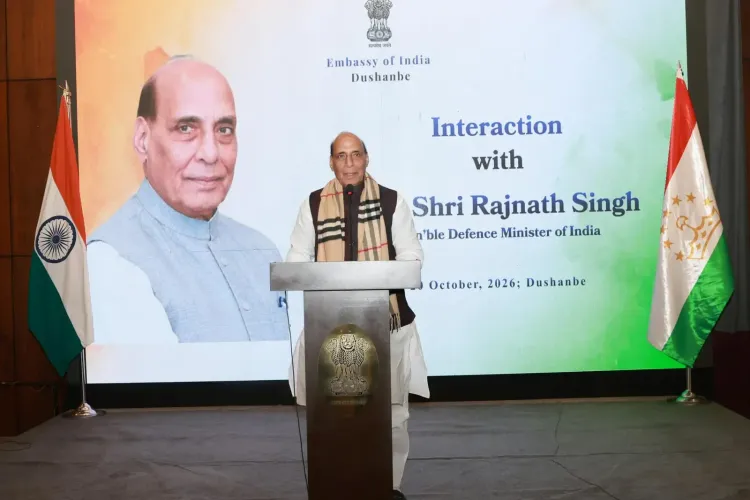
Defence Minister Rajnath Singh addressed the Indian diaspora in Dushanbe, Tajikistan on 20 October 2026 on the sidelines of the SCO Heads of Government meeting.
India's defence exports have reached a record ₹38,424 crore ; defence production has risen to ₹1.80 lakh crore .
Singh invoked Vasudhaiva Kutumbakam to describe India's commitment to global peace and the well-being of humanity.
He described India's policy shift from 'policy paralysis' to a 'reform express,' saying 'reforms are not a compulsion; they are a conviction.' Singh met Tajikistan PM Qohir Rosulzoda bilaterally and felicitated Professor Habibullo Rajabov , the first Padma Shri awardee from Tajikistan.
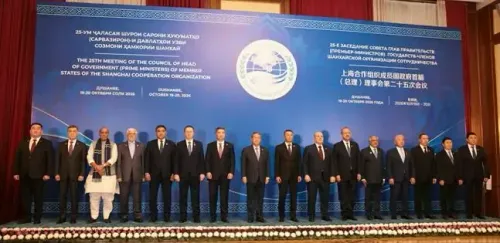
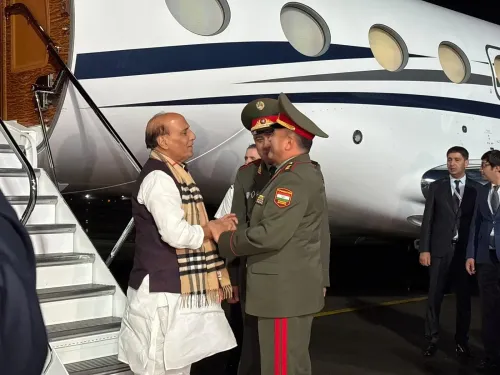
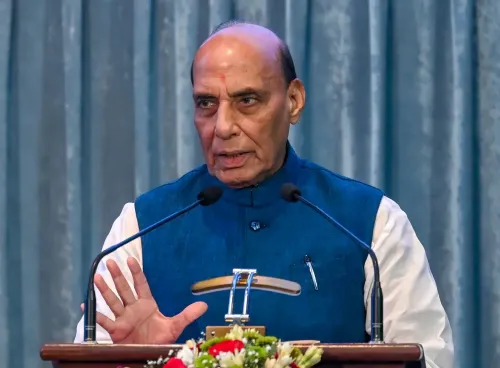
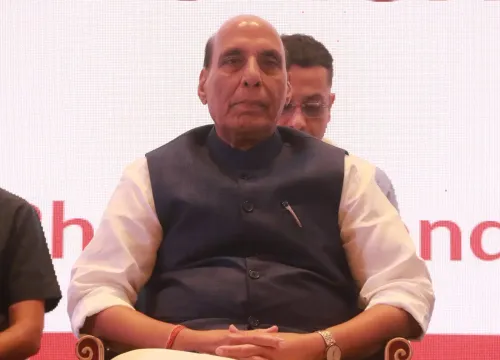
Defence Minister Rajnath Singh on Tuesday, 20 October told the Indian diaspora in Dushanbe, Tajikistan that India's economic transformation, reform-driven governance, and technological advancement under Prime Minister Narendra Modi are positioning the country to combine prosperity, knowledge, and strength with a firm commitment to global peace. He was speaking on the sidelines of the Shanghai Cooperation Organisation (SCO) Heads of Government meeting in the Tajik capital.
Key Remarks to the Diaspora
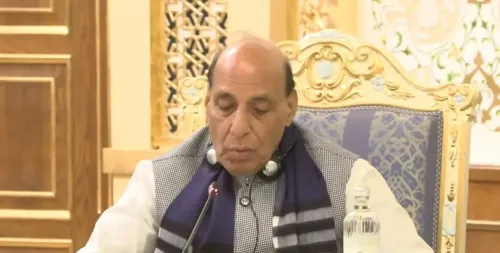
Addressing members of the Indian community, Singh invoked the philosophy of Vasudhaiva Kutumbakam — the ancient Sanskrit principle meaning 'the world is one family' — to articulate India's foreign-policy outlook. 'Guided by the philosophy of Vasudhaiva Kutumbakam, India aspires to become a nation that combines prosperity, knowledge and strength with a commitment to global peace and the well-being of humanity,' he said, according to a statement issued by the Ministry of Defence.
Singh also described India's policy journey in stark terms, contrasting an earlier era of 'policy paralysis' with what he called a 'reform express' driven by clear policy direction. 'For us, reforms are not a compulsion; they are a conviction,' he said.
Defence Manufacturing Milestones
Highlighting India's strides in strategic sectors, Singh cited two headline figures: defence exports have reached a record ₹38,424 crore, and overall defence production has climbed to ₹1.80 lakh crore. He framed both numbers as evidence of a structural shift rather than cyclical growth.
'We're moving towards manufacturing both ships and chips, strengthening our position in strategic sectors,' Singh said, referencing India's simultaneous push in shipbuilding and semiconductor manufacturing — two domains widely regarded as benchmarks of advanced industrial capability.
India-Tajikistan Ties and Diaspora's Role
Singh described people of Indian origin as 'cultural ambassadors,' noting the enduring popularity of Indian songs, music, literature, and cinema among Tajiks as a foundation for bilateral friendship. He said the diaspora serves as a living bridge between the two nations.
On the occasion, Singh also felicitated Professor Habibullo Rajabov, a renowned Indologist and the first Padma Shri awardee from Tajikistan, for his contributions to Hindi literature and education, the Ministry of Defence said.
SCO Meeting and Bilateral Talks
Earlier on Tuesday, Singh met Tajikistan's Prime Minister Qohir Rosulzoda on the sidelines of the SCO Heads of Government meeting. In a post on X, Singh wrote: 'Delighted to meet H.E. Mr Qohir Rosulzoda, Prime Minister of Tajikistan, at the commencement of the SCO Heads of Government meeting in Dushanbe. Underlined the longstanding civilisational ties and deep people-to-people links between India and Tajikistan.'
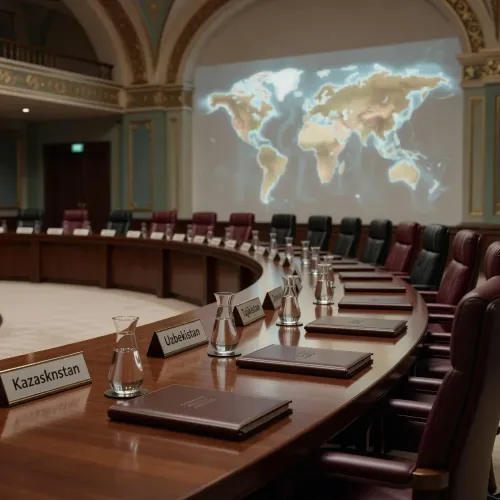
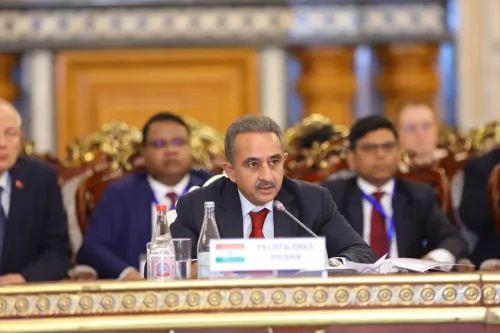
The SCO gathering brings together heads of government from the bloc's member states, and India's participation underscores its continued engagement with Central Asian multilateralism even amid evolving geopolitical alignments. This comes as India has sought to deepen its strategic and economic footprint across Central Asia, a region where China and Russia have historically dominated influence.
What This Signals
Singh's remarks in Dushanbe carry significance beyond the diaspora address. The dual emphasis on record defence exports and the 'ships and chips' agenda signals that India is increasingly willing to project its defence-industrial rise as a component of its global soft power, rather than keeping it confined to domestic policy discourse. All eyes will now be on the formal SCO outcomes and any bilateral agreements that may follow from the Dushanbe meetings.
Point of View
A framing designed for multilateral forums like the SCO where China's presence looms large. The ₹38,424 crore exports figure deserves scrutiny: it is a record, but the baseline was low, and the gap with established arms exporters remains vast. Meanwhile, the 'ships and chips' line is aspirational — India's semiconductor ambitions are still in early infrastructure stages. The real diplomatic test will be whether the SCO sideline meetings translate into concrete Central Asia partnerships, or remain goodwill gestures at a forum India has historically found difficult to leverage.
NationPress
21 Oct 2026
Frequently Asked Questions
What did Rajnath Singh say at the SCO meeting in Dushanbe?
Defence Minister Rajnath Singh told the Indian diaspora in Dushanbe on 20 October 2026 that India aims to combine prosperity, knowledge, and strength with a commitment to global peace, invoking the principle of Vasudhaiva Kutumbakam. He also cited record defence exports of ₹38,424 crore and total defence production of ₹1.80 lakh crore as markers of India's transformation.
What are India's current defence export figures?
According to Singh's address, India's defence exports have reached a record ₹38,424 crore, while overall defence production has risen to ₹1.80 lakh crore. Singh described these as evidence of India's push into strategic sectors including shipbuilding and semiconductor manufacturing.
Why is the SCO Heads of Government meeting significant for India?
The SCO Heads of Government meeting in Dushanbe brings together senior officials from member states including China, Russia, and Central Asian nations. India's active participation signals its intent to remain engaged in Central Asian multilateralism and deepen bilateral ties, as reflected in Singh's meeting with Tajikistan PM Qohir Rosulzoda.
Who is Professor Habibullo Rajabov and why was he felicitated?
Professor Habibullo Rajabov is a renowned Indologist from Tajikistan and the first Padma Shri awardee from that country. Rajnath Singh felicitated him during the diaspora event in Dushanbe for his contributions to Hindi literature and education, underscoring the cultural ties between India and Tajikistan.
What did Rajnath Singh mean by 'ships and chips'?
Singh used 'ships and chips' as a shorthand for India's simultaneous push into shipbuilding and semiconductor manufacturing — two sectors widely seen as indicators of advanced industrial and strategic capability. He cited this alongside record defence export numbers to illustrate India's ambition to become a major defence-industrial power.