Rajnath Singh at SCO Meet: India's Zero Tolerance on Terror Message
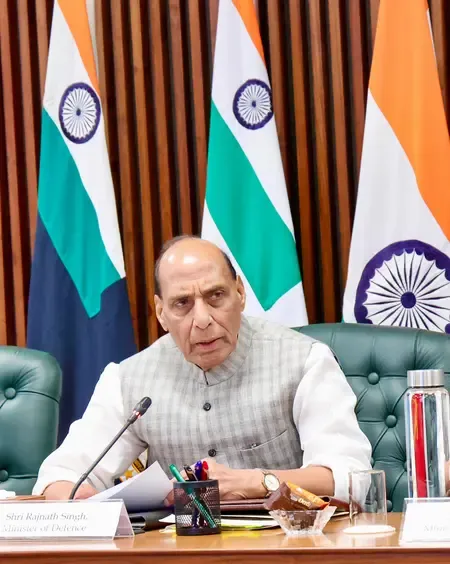
Synopsis
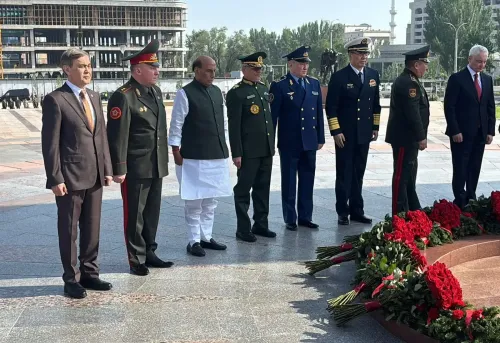
Defence Minister Rajnath Singh arrived in Bishkek, Kyrgyzstan, for the SCO Defence Ministers' Meeting on April 28, carrying India's sharpest diplomatic message yet — zero tolerance for terrorism. Coming after India withheld its signature on last year's SCO joint statement, Singh's Bishkek visit signals India is done with diplomatic ambiguity on cross-border terror.
Key Takeaways
Defence Minister Rajnath Singh departed for Bishkek, Kyrgyzstan on April 27 to attend the SCO Defence Ministers' Meeting on April 28, 2025 .
Singh announced he will highlight India's commitment to global peace and convey the nation's Zero Tolerance for Terrorism and Extremism stance at the forum.
India withheld endorsement of the SCO joint statement at the 2024 meeting in China , pushing for stronger anti-terrorism language — a precedent likely to influence the Bishkek engagement .
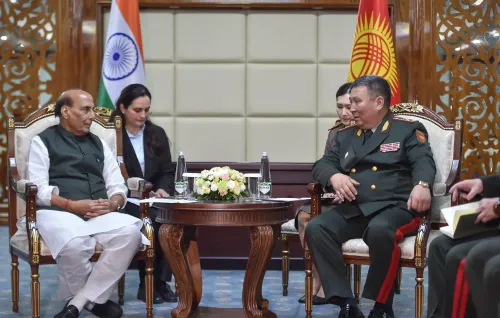
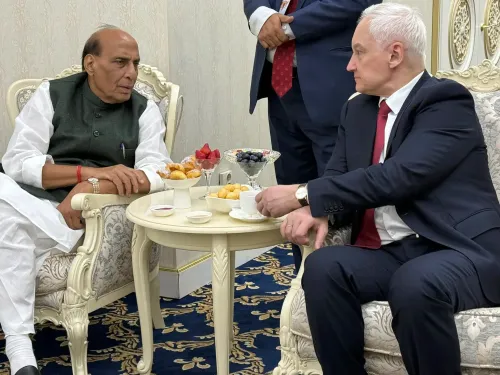
Singh is scheduled to hold bilateral discussions with defence ministers of other SCO member states , aimed at deepening strategic and defence cooperation.
The Bishkek SCO meeting comes amid heightened India-Pakistan tensions following the Pahalgam terror attack , adding significant diplomatic weight to India's counter-terror messaging.
Singh also plans to interact with the Indian diaspora community in Bishkek during his two-day visit from April 27–28 .
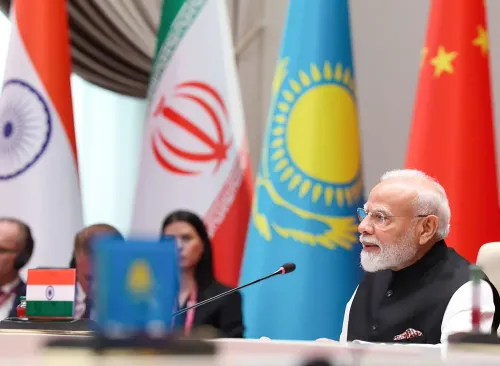
New Delhi, April 27: Union Defence Minister Rajnath Singh departed for Bishkek, Kyrgyzstan, on April 27 to attend the Shanghai Cooperation Organisation (SCO) Defence Ministers' Meeting scheduled for April 28. Singh announced via his official X (formerly Twitter) handle that he will firmly project India's commitment to global peace and reiterate the nation's unwavering stance on Zero Tolerance for Terrorism and Extremism before defence leaders of member states.
Singh's Message at the SCO Platform
In his social media post, Rajnath Singh wrote: "Leaving for Bishkek in Kyrgyzstan. Looking forward to attend the SCO Defence Ministers' Meeting scheduled to be held tomorrow. Shall highlight India's commitment towards global peace, amidst the security challenges prevailing in the world, apart from conveying India's consistent stance on Zero Tolerance for Terrorism and Extremism."
Singh also confirmed he will engage in bilateral interactions with defence counterparts from other SCO member states and meet with the Indian diaspora community in Bishkek during his two-day visit from April 27–28.
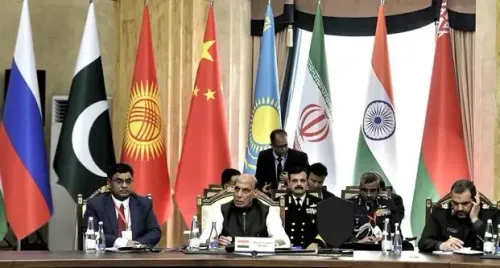
The SCO Defence Ministers' Meeting is one of the most significant multilateral security forums in the Eurasian region, bringing together defence chiefs to deliberate on regional security threats, counter-terrorism strategies, and military cooperation frameworks.
Key Focus: Eurasian Security and Collective Counter-Terror Action
The 2025 Bishkek edition of the meeting is expected to place heavy emphasis on evolving security dynamics across Central Asia and the broader Eurasian corridor, including rising threats from radical extremism and cross-border terrorism.
India has consistently leveraged the SCO platform to push for coordinated multilateral action against terrorism — a position that has gained added urgency in the wake of the Pahalgam terror attack that rattled the nation earlier this year.
At previous SCO Defence Ministers' meetings, Singh has stressed the critical importance of trust-building measures, regional stability, and firm action against radicalisation, reinforcing India's broader vision of a secure and peaceful neighbourhood.
India's Bold Stand at Last Year's SCO Meet in China
In a significant diplomatic moment, at the SCO Defence Ministers' Meeting held in China in 2024, Rajnath Singh notably withheld India's endorsement of the joint communiqué. Reports indicated that India pushed for stronger, more explicit language on terrorism — particularly in the context of cross-border terror threats emanating from the region.
This was not a symbolic gesture. It reflected India's frustration with what it perceives as inadequate collective will among certain SCO members to unequivocally condemn state-sponsored terrorism. Pakistan, also an SCO member, has long been at the centre of India's counter-terror concerns.
Critics and strategic analysts argue that India's refusal to co-sign without stronger anti-terror language was one of the most assertive diplomatic moves within the SCO framework in recent years — a precedent that is likely to shape Singh's engagement in Bishkek as well.
Bilateral Meetings and Strategic Engagement
Beyond the multilateral forum, Rajnath Singh is scheduled to hold one-on-one bilateral discussions with defence ministers of participating SCO nations. These engagements are aimed at deepening defence cooperation agreements, strategic partnerships, and security intelligence-sharing frameworks.
Such bilateral meetings on the sidelines of multilateral summits are often where the most substantive diplomatic progress occurs — away from the formalities of joint statements. For India, these interactions are particularly important given the complex security environment in South Asia and Central Asia.
The visit also comes at a time when India's foreign policy posture has grown increasingly assertive, particularly on the issue of cross-border terrorism — a stance that has broad domestic political support and growing international resonance post the Pahalgam attack.
What to Watch Next
Observers will closely monitor whether India endorses the joint statement emerging from the Bishkek SCO Defence Ministers' Meeting, or once again withholds its signature in the absence of strong anti-terrorism language. The outcome will serve as a key indicator of India's evolving posture within the SCO framework and its willingness to use multilateral platforms as instruments of strategic pressure.
With bilateral tensions in South Asia running high and the global security order under stress, Rajnath Singh's Bishkek visit carries significance well beyond the conference room — it is a statement of intent from one of the world's largest democracies on how it intends to shape the regional security architecture.
Point of View
And it set a new bar for how New Delhi engages with forums that include Pakistan. The Pahalgam terror attack has only hardened India's position, making this SCO meeting a test of whether the bloc can muster the political will to confront state-sponsored terrorism — or whether India will once again stand alone in demanding accountability. The mainstream narrative frames this as a 'peace mission'; the harder truth is that India is using every multilateral platform available to isolate cross-border terror and its patrons.
NationPress
25 Sept 2026
Frequently Asked Questions
Why is Rajnath Singh attending the SCO Defence Ministers' Meeting in Bishkek?
Rajnath Singh is attending the SCO Defence Ministers' Meeting in Bishkek on April 28 to highlight India's commitment to global peace and reiterate its zero-tolerance stance on terrorism and extremism. He will also hold bilateral talks with defence counterparts from other SCO member states.
What is India's position at SCO meetings on terrorism?
India consistently advocates for zero tolerance on terrorism at SCO forums and has pushed for strong, unambiguous language against cross-border terror in joint statements. At the 2024 SCO Defence Ministers' Meeting in China, India withheld its endorsement of the joint statement over inadequate anti-terror language.
What happened at the SCO Defence Ministers' Meeting in China in 2024?
At the 2024 SCO Defence Ministers' Meeting held in China, Rajnath Singh withheld India's endorsement of the joint communiqué, reportedly demanding stronger language condemning terrorism. This was widely seen as one of India's most assertive diplomatic moves within the SCO framework.
Which countries are part of the SCO Defence Ministers' Meeting?
The Shanghai Cooperation Organisation (SCO) includes member states such as India, China, Pakistan, Russia, Kazakhstan, Kyrgyzstan, Tajikistan, Uzbekistan, and Iran, among others. Defence ministers from these nations gather periodically to deliberate on regional security, counter-terrorism, and military cooperation.
What is the significance of India's bilateral meetings at the SCO summit in Bishkek?
India's bilateral meetings on the sidelines of the SCO summit allow Rajnath Singh to deepen defence cooperation and strategic partnerships with individual member nations beyond the constraints of the multilateral forum. These talks are especially significant given India's heightened security concerns following the Pahalgam terror attack.