What Significance Does Defence Minister Rajnath Singh's Commissioning of ICG’s Pollution Control Vessel ‘Samudra Pratap’ Hold?
Synopsis
Defence Minister Rajnath Singh launched the ICGS ‘Samudra Pratap’, India's first indigenously designed pollution control vessel. This significant addition enhances the Indian Coast Guard's capabilities in tackling environmental challenges. Singh emphasized the vessel's multifaceted role in maritime safety and its moral imperative in the face of climate change.
Key Takeaways
ICGS Samudra Pratap is India's first indigenously designed pollution control vessel.
The vessel enhances the operational capability of the Indian Coast Guard significantly.
It incorporates over 60% indigenous content.
The design integrates multiple capabilities for improved maritime safety.
Marine environment protection is a strategic and moral imperative.
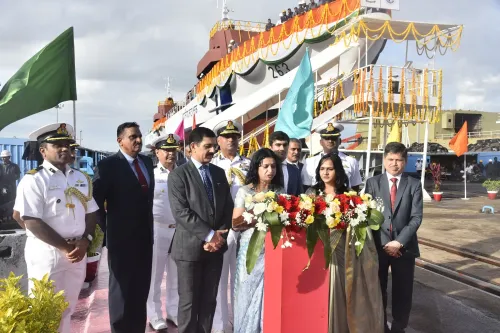
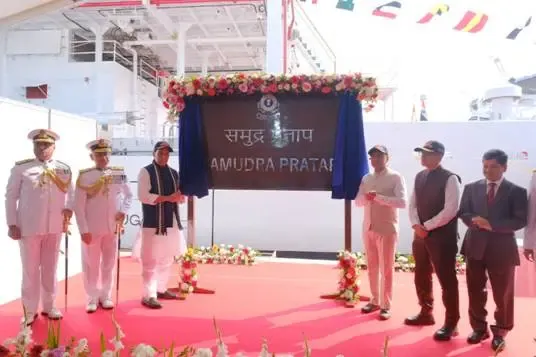
Panaji, Jan 5 (NationPress) - On Monday, Defence Minister Rajnath Singh officially launched the Indian Coast Guard Ship (ICGS) ‘Samudra Pratap’, marking the debut of the first of two dedicated pollution control vessels. He hailed it as a symbol of India’s advanced defence industrial ecosystem.
Rajnath Singh commended the ecosystem's proficiency in addressing complex manufacturing challenges, emphasizing that the introduction of ICGS Samudra Pratap will substantially bolster the ICG’s capabilities in pollution management, firefighting, maritime safety, and environmental safeguarding.
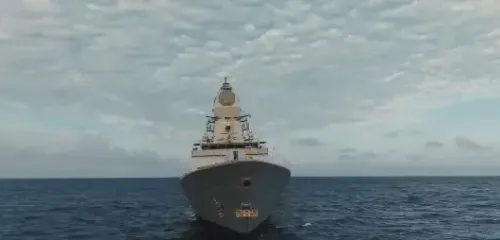
With more than 60 percent indigenous content, ICGS Samudra Pratap is recognized as India's inaugural indigenously designed pollution control vessel and is the largest vessel in the ICG fleet thus far.
The incorporation of ICGS Samudra Pratap will significantly amplify the operational capabilities of the ICG in pollution control, firefighting, maritime safety, and environmental protection. Furthermore, it will enhance its capacity for extensive surveillance and responsive missions across India's expansive maritime territories.
“ICGS Samudra Pratap has been meticulously crafted for pollution management, yet its functions extend beyond this scope. The integration of multiple capabilities within a single platform will make the vessel invaluable for coastal patrols and enhancing maritime safety. This is a result of the progressive strategies adopted by Goa Shipyard Limited (GSL) to bolster flexibility and readiness in confronting contemporary maritime challenges,” remarked Rajnath Singh.
The Defence Minister applauded the ICG for its multifaceted role, which ranges from combating marine pollution to maintaining coastal cleanliness, conducting search and rescue operations, and enforcing maritime law.
He noted that the effective execution of duties by the Coast Guard sends a clear warning to potential adversaries that any threat to India’s maritime frontiers will be met with a decisive response.
The vessel is outfitted with cutting-edge pollution detection technologies, specialized pollution response boats, and state-of-the-art firefighting capabilities.
Additionally, it boasts a helicopter hangar and aviation support facilities, significantly enhancing its operational reach and effectiveness.
Rajnath Singh expressed confidence that with these advanced features, the vessel will maintain stability even in challenging sea conditions, providing a significant advantage in real-world operations.
He emphasized that protecting the marine environment is not just a strategic imperative but also a moral obligation, especially in light of the pressing challenges posed by climate change and global warming.
The Defence Minister recognized the ICG for its proficiency in executing oil spill responses, firefighting, and salvage missions, positioning India among a select group of nations equipped with advanced environmental response capabilities.
“With its swift detection, precise station-keeping, and effective recovery systems, ICGS Samudra Pratap will enhance operational capabilities. It will facilitate timely management of pollution incidents, thus averting damage to coral reefs, mangroves, fisheries, and marine biodiversity, which are crucial for the sustainability of coastal communities and the blue economy,” he added.
Point of View
The commissioning of ICGS ‘Samudra Pratap’ underscores India's commitment to enhancing its maritime security and environmental protection efforts. This move is not only a testament to India's growing defence capabilities but also reflects a proactive stance towards addressing pressing environmental issues. The ICG's expanded role in pollution control positions India as a responsible player in global maritime governance.
NationPress
5 Oct 2026
Frequently Asked Questions
What is the purpose of ICGS Samudra Pratap?
ICGS Samudra Pratap is designed for pollution control and is equipped to handle firefighting, maritime safety, and environmental protection.
How much indigenous content does ICGS Samudra Pratap have?
The vessel boasts over 60 percent indigenous content, marking it as India's first indigenously designed pollution control vessel.
What are the advanced features of ICGS Samudra Pratap?
It includes advanced pollution detection systems, dedicated response boats, modern firefighting capabilities, and a helicopter hangar.
What message does the commissioning of ICGS Samudra Pratap send?
It sends a strong message to potential adversaries about India's readiness to defend its maritime borders.
Why is marine environment protection important?
Protecting the marine environment is essential for sustainability and is a moral responsibility in the face of climate change.