What Impact Does the Ramayana Exhibition Have on Maryland Lawmakers?
Synopsis
Discover how a captivating exhibition on the Ramayana at the Maryland State Assembly brought together lawmakers, diplomats, and community leaders, highlighting the epic's cultural significance and moral teachings that resonate across generations and borders.
Key Takeaways
Exhibition highlights cultural significance Lawmakers engage in cultural dialogue Ramayana’s teachings resonate in modern society Unity and diversity are celebrated Educational impact on policymakers
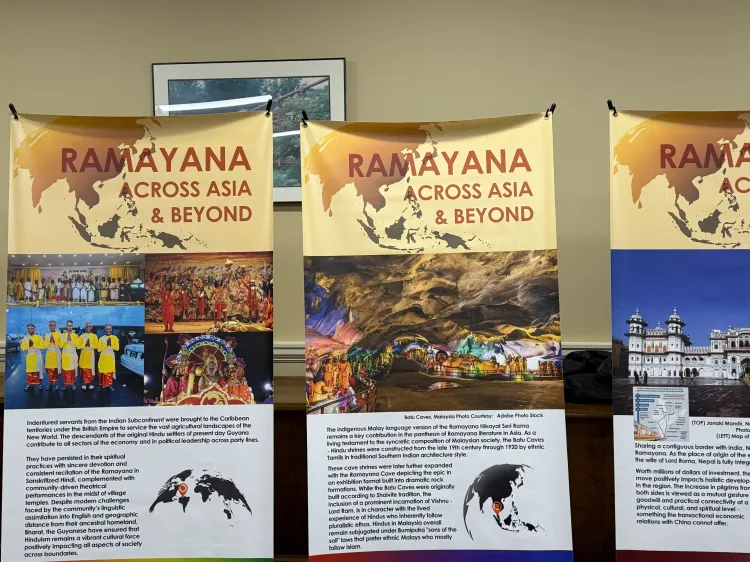
Annapolis, Jan 23 (NationPress) A one-day exhibition showcasing the Ramayana’s influence across Asia and beyond took place at the Maryland State Assembly Building, attracting state lawmakers, diplomats, and community leaders to the Annapolis complex.
Numerous delegates from Maryland expressed their thoughts during the event. Delegate Wu Chao, representing segments of Howard and Montgomery counties, emphasized that the exhibition illustrates how culture unites individuals across borders and diverse backgrounds.
“It’s a culture that connects people and enhances understanding among different backgrounds,” Chao remarked, highlighting that such cultural exchanges serve as a counterbalance to the divisions often seen in politics.
Delegate Harry Bhandari shared insights on the moral teachings of the Ramayana and their significance in today’s society. He described the epic as beyond a mere religious text, referring to it as a guide to character, sacrifice, and inner peace.
“When we discuss the Ramayana, we can reflect on the modern world,” Bhandari noted, focusing on its lessons about family values, humility, and the perils of ego. He stated that the narratives remain instructive during times when many communities face social fragmentation and challenges to mental well-being.
Delegate Mike Roger, a military veteran with extensive travels through Asia, found the exhibition relatable to his own experiences. “We share more similarities than differences,” he expressed, emphasizing that understanding shared traditions fosters mutual respect and contributes to making “the world a better place.”
Diplomatic representatives also spoke, emphasizing the Ramayana’s significance beyond India. Aruna Ghising from the Embassy of Nepal recalled her childhood memories of televised versions of the epic, recognizing its connections across continents.
“I’m amazed to learn about links to nations as distant as Guyana,” Ghising mentioned. She described the exhibition as “a beautiful celebration,” showcasing the tapestry of cultural connections among numerous countries, and expressed her desire for future collaboration.
Organizers stated that the exhibition was strategically placed within the state legislature to engage policymakers and staff who might be unaware of the broader Asian civilizational context surrounding the Ramayana. Utsav Chakrabarti of HinduAction noted that Maryland’s diversity made it an optimal venue.
“In Maryland, there are over 160,000 Hindu community members,” Chakrabarti remarked, adding that the state also hosts large Thai, Vietnamese, Cambodian, and Filipino communities. He noted that many legislators possess limited knowledge of Hindu history in countries where Hindus are no longer a majority, such as Malaysia, Indonesia, or the Philippines.
Chakrabarti emphasized that the exhibition sought to inform elected officials about the civilizational ties the Ramayana fosters among diverse faith groups and ethnicities. He reported that around a dozen delegates and several senators attended during the day, calling their response encouraging.
The exhibition was organized in Maryland by Dr. Vidya Sathiamoorthy, a pathologist and volunteer with HinduAction, who was inspired after learning that the display had been showcased at both the US Capitol and the Ohio State Capitol earlier.
“Upon hearing that, I knew we needed to bring it to Maryland,” Sathiamoorthy stated, citing the state’s extensive and diverse diaspora. She characterized the Ramayana as a historic epic whose moral ideals continue to resonate as a lived experience across generations and borders.
Sathiamoorthy noted that the exhibition included representations from approximately 11 countries, reflecting the reality that the Ramayana is celebrated in over 16 nations. She highlighted its themes of unity, duty, sacrifice, and family, particularly for the younger members of the diaspora.
Point of View
The epic's teachings on family and humility resonate deeply in contemporary society, offering a lens through which we can reflect on our shared values and experiences, making this event significant for both the local community and broader cultural understanding.
NationPress
20 Sept 2026
Frequently Asked Questions
What was the purpose of the Ramayana exhibition?
The exhibition aimed to showcase the **Ramayana’s influence** across cultures and educate lawmakers about its significance in fostering connections among diverse communities.
Who organized the exhibition?
The exhibition was organized by **Dr. Vidya Sathiamoorthy**, a dedicated pathologist and volunteer with HinduAction, inspired by prior displays at the **US Capitol**.
How many countries are represented in the exhibition?
The exhibition featured representations from **approximately 11 countries**, highlighting the Ramayana's celebration in over **16 nations**.
What themes does the Ramayana address?
The Ramayana addresses themes of **unity**, **duty**, **sacrifice**, and **family values**, which are particularly relevant to contemporary society.
How did lawmakers respond to the exhibition?
Around a dozen delegates and several senators visited the exhibition, with many expressing encouragement and interest in the cultural connections presented.