Rejinagar bypoll 2024: Seven-way race to test Muslim voter loyalty in Bengal
Synopsis
Six opposition parties are splitting the Muslim vote in Rejinagar's 6 October bypoll — and that fragmentation could hand the BJP a surprise opening in a constituency where over 65% of voters are Muslim. The result on 9 October may be the clearest signal yet of whether Mamata Banerjee still commands Bengal's minority electorate.
Key Takeaways
Rejinagar bypoll is scheduled for 6 October , with results on 9 October ; it is a seven-cornered contest in Murshidabad district, West Bengal .
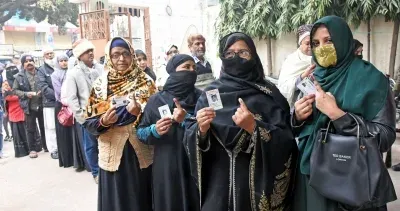
Muslims constitute over 65 per cent of the electorate in Rejinagar, making minority voter sentiment the central political question.
Six non-BJP candidates — from TMC, rebel TMC, CPI(M), RSP, Congress, and AJUP — are all competing for the same minority vote pool.
The BJP's candidate Sakharav Sarkar could benefit if the saffron camp consolidates the 35 per cent non-Muslim vote while opposition votes fragment.
The bypoll was necessitated after Humayun Kabir vacated the seat, having won it by over 58,000 votes before choosing to retain the Naoda constituency.
The outcome is widely seen as a barometer for Muslim voter loyalty to Mamata Banerjee and the TMC ahead of future state elections.
The Rejinagar Assembly constituency in Murshidabad district, West Bengal, is set for a high-stakes seven-cornered bypoll on 6 October, with political observers closely watching whether the results will reveal a shift in Muslim voter sentiment across the state. With Muslims accounting for over 65 per cent of the electorate in Rejinagar, the contest is being seen as a litmus test for the community's political allegiances ahead of future elections.
Key Candidates in the Fray
The bypoll features a crowded field of seven candidates, with six non-Bharatiya Janata Party (BJP) contenders all vying for a share of the dominant minority vote bank. The All India Trinamool Congress (TMC) faction led by Mamata Banerjee has fielded Rabiul Alam Chowdhury, while the rebel TMC faction led by Ritabrata Banerjee has fielded Sheikh Saifuddin. The CPI(M)-led Left Front's official nominee is Syed Asad Ali, while the Revolutionary Socialist Party's Bikash Chandra is contesting as a rebel Left Front candidate. The Indian National Congress (INC) has fielded Mohammad Kafi, and the Aam Janata Unnayan Party (AJUP) has fielded Golam Nabi Azad, son of AJUP founder Humayun Kabir. The BJP's candidate is Sakharav Sarkar.
Why the Split Vote Could Upend Calculations
Political observers note that the fragmented opposition field could paradoxically benefit the BJP. With six parties competing for the same 65 per cent minority electorate, votes are likely to be split significantly. If the BJP consolidates the remaining 35 per cent non-Muslim vote, Sarkar's prospects could improve despite the constituency's demographic tilt against the saffron camp.
'The voting pattern in Rejinagar will also be an indication if the mass Muslim sentiment in favour of Mamata Banerjee is still intact, or has it shifted to any other non-BJP parties,' a city-based political observer said. This comes amid broader questions about whether the TMC retains its grip on minority voters statewide, or whether the Left Front and Congress are making inroads.
Historical Context: The Humayun Kabir Factor
The bypoll was necessitated after Humayun Kabir — who had won the Rejinagar seat in the previous Assembly election by a margin of over 58,000 votes, defeating BJP's Bapan Ghosh — was simultaneously elected from the Naoda Assembly Constituency in Murshidabad district earlier this year. Kabir chose to retain Naoda, vacating Rejinagar. Notably, in that earlier contest, the united TMC candidate Ataur Rahaman finished third with just 41,718 votes, suggesting that non-Muslim votes had already consolidated behind the BJP even then.
The Nandigram Parallel
Rejinagar is one of two constituencies going to the polls on 6 October; the other is Nandigram Assembly constituency in East Midnapore district. Results for both seats will be declared on 9 October. While Nandigram carries its own political symbolism — it was the seat where Chief Minister Banerjee herself contested in 2021 — it is Rejinagar's minority-majority arithmetic that is drawing sharper analytical focus this cycle.
What the Results Could Signal
Analysts argue that the Rejinagar outcome will carry significance well beyond a single bypoll. A strong TMC showing would suggest Banerjee's hold over Muslim voters remains intact. A fractured result with the Left or Congress picking up significant minority votes could signal a realignment that reshapes Bengal's opposition politics ahead of the next Assembly election. The BJP's performance, even in a constituency where it is not the frontrunner, will indicate whether Hindu vote consolidation is deepening in Murshidabad.
Point of View
But six parties now competing for that same bloc is a structural crack, not a blip. What mainstream coverage underplays is the precedent from the last Assembly election: even with a united TMC, the Hindu vote was already consolidating for the BJP in Murshidabad. If that pattern holds and the minority vote splinters, Rejinagar could produce a result that forces a serious re-evaluation of Bengal's political arithmetic — long before the next Assembly election arrives.
NationPress
16 Sept 2026
Frequently Asked Questions
When is the Rejinagar bypoll and when will results be declared?
The Rejinagar Assembly bypoll is scheduled for 6 October, and results will be declared on 9 October. It is being held alongside the Nandigram Assembly bypoll in East Midnapore district.
Why is the Rejinagar bypoll significant for Muslim voters in Bengal?
Rejinagar has a Muslim-majority electorate of over 65 per cent, making it a key indicator of minority voter sentiment in West Bengal. Political observers say the result will show whether Muslim voters remain loyal to the TMC under Mamata Banerjee or are shifting toward the Left Front or Congress.
Who are the main candidates in the Rejinagar bypoll 2024?
The seven candidates include Rabiul Alam Chowdhury (TMC), Sheikh Saifuddin (rebel TMC), Syed Asad Ali (CPI(M)/Left Front), Bikash Chandra (rebel Left Front/RSP), Mohammad Kafi (Congress), Golam Nabi Azad (AJUP), and Sakharav Sarkar (BJP).
Why was the Rejinagar bypoll necessitated?
The bypoll became necessary after Humayun Kabir, who had won Rejinagar in the previous Assembly election by over 58,000 votes, was also elected from the Naoda Assembly constituency in Murshidabad district. He chose to retain Naoda, vacating the Rejinagar seat.
Can the BJP win Rejinagar despite the Muslim-majority electorate?
Political observers say the BJP's chances depend on consolidating the non-Muslim vote, which accounts for roughly 35 per cent of the electorate, while the six opposition parties split the 65 per cent Muslim vote among themselves. In the previous Assembly election, Hindu votes had already shown signs of consolidating behind the BJP in Rejinagar.