How is Azamgarh’s black pottery being revived through ODOP?
Synopsis
In the heart of Azamgarh, the revival of black pottery under the ODOP initiative showcases the transformative power of government support. Artisans are witnessing a renaissance in their craft, with national and international recognition. Discover how this ancient art form is not just surviving but thriving in the modern world.
Key Takeaways
Azamgarh's black pottery is undergoing a revival through government initiatives.
The ODOP scheme has played a crucial role in this transformation.
Artisans now access low-interest loans and training programs.
The craft received a GI tag in 2015, enhancing its heritage value.
Local products are gaining international recognition .
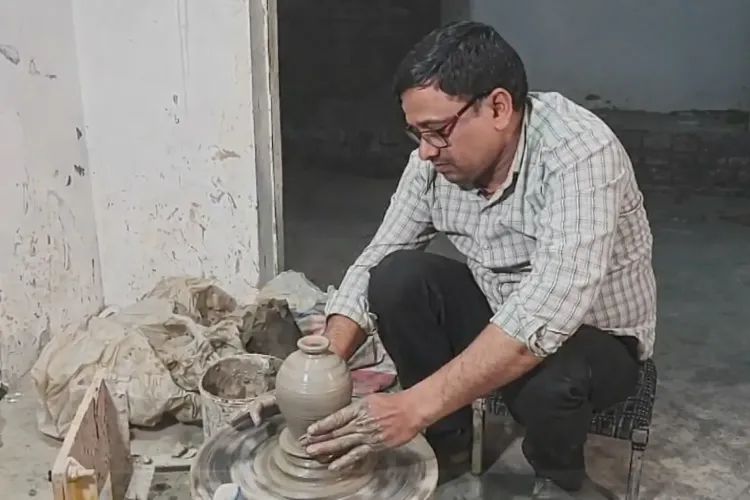
Azamgarh (Uttar Pradesh), Feb 11 (NationPress) Amid various self-employment initiatives launched by the double-engine government at both the Central and State levels, Nizamabad in Azamgarh district is establishing a unique identity through the One District One Product (ODOP) program, with its renowned black pottery receiving both national and international acclaim.
The traditional craft of black pottery, once facing extinction, has seen a remarkable resurgence in recent years. In 2015, it was awarded the Geographical Indication (GI) tag, marking a pivotal achievement in preserving its cultural significance. According to artisans, the genuine transformation began after the craft was included in the ODOP scheme.
Sanjay Prajapati, Director of Black Pottery Nizamabad, an organization that creates clay idols and various decorative items, stated that the support from both the Central and State governments has been instrumental in revitalizing this age-old craft.
“The youth had turned away from this art, leading to its gradual decline. Following its recognition under ODOP, we found it easier to access bank loans. Today, black pottery is celebrated not only in India but also internationally. This advancement has been made possible due to the efforts of our Hon’ble Chief Minister,” he remarked.
Local entrepreneur and artisan Sohit Kumar Prajapati shared his views, stating that artisans can now secure loans at lower interest rates, supplemented by a 25% subsidy under the scheme. Additionally, they are receiving training and toolkits, which have significantly enhanced both production capacity and quality.
“Previously, many young individuals migrated in search of employment. Now, they are returning to this craft and progressing rapidly. Our exports are consistently on the rise,” he added.
He expressed appreciation to the Prime Minister for advocating local products on global stages. “When Prime Minister Narendra Modi presented black pottery items as gifts to the Prime Minister of Japan, it was a moment of immense pride for us. It felt as if we were soaring. Our handmade creations are now gaining international recognition,” he concluded.
Artisans attribute the initiative to transforming a traditional rural craft into a globally acknowledged product. They regard it as a symbol of “New India and New Uttar Pradesh,” asserting that government support has enabled even small-scale, traditional industries to achieve new heights, propelling black pottery from local markets onto the global stage.
Point of View
The revival of Azamgarh's black pottery underlines the significance of governmental initiatives in preserving cultural heritage while fostering economic growth. The collaborative efforts between artisans and the state exemplify how traditional crafts can be rejuvenated in a modern context, ensuring their survival for future generations.
NationPress
29 Sept 2026
Frequently Asked Questions
What is black pottery?
Black pottery is a traditional craft known for its unique black clay items, including decorative pieces and household utensils, primarily produced in Azamgarh, Uttar Pradesh.
What is the ODOP initiative?
The One District One Product (ODOP) initiative aims to promote specific products from each district in India to boost local economies and preserve traditional crafts.
How has government support impacted artisans?
Government support has facilitated access to loans, training, and resources, enabling artisans to enhance production capabilities and improve the quality of their products.
What is the Geographical Indication (GI) tag?
The Geographical Indication (GI) tag is a certification that recognizes products unique to a specific geographical region, helping protect and promote traditional crafts.
Why is black pottery significant?
Black pottery is significant as it represents a rich cultural heritage and showcases the craftsmanship of local artisans, gaining recognition both nationally and internationally.