Sabarimala virtual queue crisis: 35,000 booked pilgrims skip darshan daily
Synopsis
Sabarimala's virtual queue is fully booked through January, yet up to 35,000 slot-holders are missing darshan on some days — leaving the shrine under-visited while locking out devotees who want to go. Kerala has ordered an inquiry, and the Devaswom Employees' Front is demanding spot booking be restored at Pampa before the peak season peaks further.
Key Takeaways
Sabarimala's virtual queue slots are fully booked through 9 January , yet 20,000–35,000 pilgrims fail to show up on certain days.
On opening day ( 19 November ), 56,000 slots were booked but only around 48,000 devotees arrived.
Unused slots cannot be reassigned, effectively denying access to other pilgrims despite lower-than-expected footfall.
Devaswom Minister K.
Muraleedharan has directed ADGP P.
Vijayan and Travancore Devaswom Board president K.
Jayakumar to investigate possible irregularities.
Police have ruled out bulk booking fraud, citing mandatory Aadhaar-based verification ; they suspect voluntary no-shows due to rush fears and travel difficulty.
The Travancore Devaswom Employees' Front has demanded restoration of spot booking at Pampa and relaxed time restrictions.
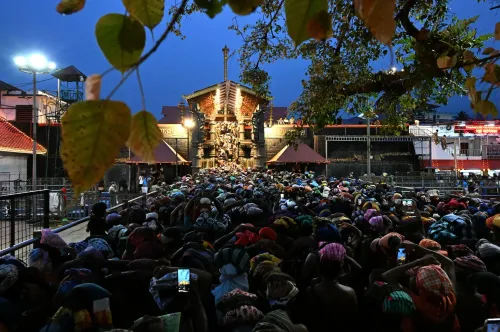
The Sabarimala pilgrimage in Kerala is grappling with a deepening paradox this season: virtual queue slots are booked solid through 9 January, yet significantly fewer devotees are actually making it to the hilltop shrine for darshan, casting doubt on the booking system and the restrictions governing it. The two-month annual pilgrimage season opened on Tuesday, 19 November 2025.
The Numbers Behind the No-Show
On the opening day alone, more than 56,000 devotees had reserved slots through the virtual queue system, but only around 48,000 reportedly reached the shrine — a gap of roughly 8,000 pilgrims in a single day. Officials have flagged that on certain days, between 20,000 and 35,000 slot-holders do not turn up for darshan at all.
The practical consequence is stark: when a booked devotee fails to appear, that slot cannot be reassigned to another pilgrim. The result is an online dashboard that shows zero availability even when the shrine is physically receiving fewer visitors than permitted — effectively locking out genuine devotees who are ready and willing to travel.
Who Is Raising the Alarm
The Travancore Devaswom Employees' Front has formally demanded the restoration of spot booking at Pampa — the base camp for the ascent to Sabarimala — and a relaxation of the time restrictions embedded in the current virtual queue framework. The organisation has submitted a complaint to Chief Minister V.D. Satheesan and Devaswom Minister K. Muraleedharan, seeking an inquiry into the growing gap between bookings and actual pilgrim arrivals.
Minister Muraleedharan has directed ADGP P. Vijayan, the officer in charge of law and order at Sabarimala, and Travancore Devaswom Board president K. Jayakumar to examine whether any irregularities lie behind the pattern. He has also written separately to the Board president requesting a detailed inquiry and report.
Bulk Booking Fears and the Aadhaar Defence
Suspicions initially centred on the possibility that agencies or organised groups were making bulk bookings and subsequently staying away — a form of slot hoarding that would explain the artificial scarcity. However, police have rejected this theory, pointing out that the system's mandatory Aadhaar-based verification makes large-scale coordinated bookings difficult to execute without detection.
Investigators now suspect that a significant share of no-shows may be ordinary devotees who pre-booked slots and then reconsidered their travel plans — reportedly deterred by anticipated overcrowding, the strict time-window rules, or logistical difficulties reaching the hill shrine. The employees' organisation has argued that rigid time restrictions and travel inconveniences may themselves be compounding the dropout rate.
Revenue and Livelihoods at Stake
The shortfall in pilgrim numbers has consequences well beyond the shrine's gates. The Travancore Devaswom Board depends significantly on pilgrimage-season collections to fund temple operations and welfare activities across its managed shrines. Traders, vendors, transporters, and hospitality workers along the Pampa–Sannidhanam route also face reduced earnings when footfall falls short of capacity.
Notably, this is not the first time the Sabarimala virtual queue system — introduced to manage the massive annual rush and avoid stampede risks — has drawn criticism for creating unintended barriers to access. Critics argue that system design must balance crowd management with flexibility for devotees who travel long distances and cannot always adhere to rigid time slots.
What Happens Next
The Travancore Devaswom Board and the Kerala Police are expected to submit findings to the minister in the coming days. The government faces pressure to decide quickly, given that virtual queue slots are already filled through 9 January and the peak pilgrimage weeks — including Mandala Pooja — are still ahead. Any structural change to the booking rules at this stage of the season will require careful calibration to avoid disrupting the queue order for the tens of thousands who have already secured slots.
Point of View
With no-show slots locked rather than recycled. Aadhaar-linking may deter fraud, but it does nothing to address the deterrence effect of inflexible time windows on pilgrims travelling hundreds of kilometres on faith. The deeper question is whether a system optimised for crowd control should also be engineered for access — and whether the Devaswom Board has the administrative agility to recalibrate mid-season without unravelling the queue order for those already booked. With peak weeks still ahead, the cost of inaction compounds daily in both temple revenue and devotee trust.
NationPress
20 Nov 2026
Frequently Asked Questions
Why are Sabarimala virtual queue slots fully booked but fewer pilgrims arriving?
Virtual queue slots for Sabarimala are booked through 9 January 2026, yet between 20,000 and 35,000 slot-holders reportedly do not turn up on certain days. Police suspect devotees are voluntarily cancelling travel after factoring in expected rush and strict time window rules, rather than any organised bulk-booking fraud.
What problem does the no-show gap create for other pilgrims?
When a booked pilgrim does not arrive, the vacant slot cannot be reassigned to another devotee. This means the online booking portal shows no availability even when the shrine is physically receiving fewer visitors than its permitted capacity, effectively denying darshan to pilgrims who are ready to travel.
What action has the Kerala government taken on the Sabarimala booking issue?
Devaswom Minister K. Muraleedharan has directed ADGP P. Vijayan and Travancore Devaswom Board president K. Jayakumar to examine whether irregularities are behind the pattern. The minister has also written to the Board president requesting a detailed inquiry report.
What is the Travancore Devaswom Employees' Front demanding?
The organisation has demanded the restoration of spot booking at Pampa base camp and a relaxation of the time restrictions under the virtual queue system. It has submitted a complaint to Chief Minister V.D. Satheesan and Devaswom Minister K. Muraleedharan seeking a formal inquiry.
Could bulk bookings by agents be behind the Sabarimala no-shows?
Police have ruled out this possibility, stating that mandatory Aadhaar-based verification makes large-scale coordinated bookings difficult. Investigators now lean toward the explanation that individual devotees are pre-booking and then reconsidering their trips due to anticipated crowds and logistical difficulties.