SC grants 6-month interim bail to Tasleem Ahmed, Khalid Saifi in Delhi riots UAPA case
Synopsis
The Supreme Court has freed Delhi riots accused Tasleem Ahmed and Khalid Saifi on six-month interim bail — but the bigger story is what it has set in motion: a larger bench will now decide whether years behind bars can override UAPA's near-absolute bar on bail, a ruling that could reshape how India's anti-terror law is applied to hundreds of undertrial detainees.
Key Takeaways
The Supreme Court granted six months' interim bail to Tasleem Ahmed and Khalid Saifi in the Delhi riots UAPA larger conspiracy case on 22 May .
The bench referred to a larger bench the question of whether prolonged incarceration can justify bail despite the embargo in Section 43D(5) of UAPA .
The court held that Article 21 and the right to speedy trial remain relevant even under UAPA, but that mere passage of time is not an automatic trigger for bail.
Bail conditions include a personal bond of ₹2 lakh , surrender of passports, no travel outside Delhi without court permission, and a ban on public statements on the case.
The trial court was directed to proceed 'with utmost expedition' ; the Chief Justice of India will constitute the larger bench.
The referral follows conflicting rulings on K.A.
Najeeb, including the Gulfisha Fatima judgment that denied bail to Umar Khalid and Sharjeel Imam .
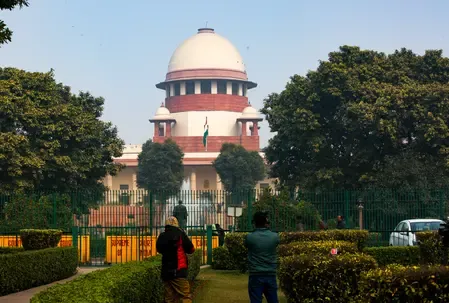
The Supreme Court on Friday, 22 May granted six months' interim bail to Delhi riots accused Tasleem Ahmed and Khalid Saifi in the larger conspiracy case registered under the Unlawful Activities (Prevention) Act (UAPA), while simultaneously referring to a larger bench the critical legal question of whether prolonged incarceration and inordinate trial delays can override the stringent bail embargo under Section 43D(5) of the anti-terror law. The decision was delivered by a bench of Justice Aravind Kumar and Justice Prasanna B. Varale.
The Core Legal Question Referred
The bench directed the Registry to place the matter before the Chief Justice of India — as master of the roster — to constitute an appropriate bench for settling the law. The referral stems from divergent views expressed by different Supreme Court benches on how to apply the three-judge bench ruling in Union of India vs K.A. Najeeb.
'The question, therefore, is not whether Article 21 survives Section 43D(5). It undoubtedly does. The true question is how Article 21 is to be applied in a statutory field where Parliament has consciously imposed restrictions on bail in respect of offences alleged to affect the security of the state and the stability of civic life,' the bench stated.
What the Court Said on Article 21 vs UAPA
The bench drew on the judgments in K.A. Najeeb and the more recent Gulfisha Fatima ruling, reaffirming that Article 21 and the right to a speedy trial remain relevant even in prosecutions under UAPA. It cautioned against an 'unqualified insistence' on Section 43D(5) without accounting for prolonged incarceration, warning that such rigidity 'would imperil Article 21'.
At the same time, the court was careful to add that the K.A. Najeeb ruling could neither be read as a 'charter for indefinite incarceration' nor as a 'mathematical command' that the mere passage of time automatically entitles an accused to bail. 'In matters touching personal liberty, national security, statutory restrictions on bail and prolonged incarceration, uncertainty in the law is itself an institutional cost,' the bench observed.
Government's Position and Conflicting Precedents
Additional Solicitor General S.V. Raju, appearing for the Delhi Police, submitted that the controversy extended beyond the present appellants and raised a broader issue about how constitutional courts should handle bail pleas under special statutes with stringent bail conditions. The bench also took note of the later judgment in Syed Iftikhar Andrabi vs National Investigation Agency, where a coordinate bench had expressed reservations about certain aspects of the Gulfisha Fatima ruling — the same ruling that denied bail to Umar Khalid and Sharjeel Imam while granting relief to five other accused in the same Delhi riots larger conspiracy case.
Bail Conditions Imposed
Without commenting on the merits of the prosecution's case, the court granted interim bail on grounds that both accused had 'undergone substantial incarceration' and the trial was not likely to conclude in the near term. 'The appellants cannot be made to suffer continued incarceration merely because an important question of law has arisen for authoritative settlement,' the bench said.
The bail comes with several strict conditions: furnishing a personal bond of ₹2 lakh with two local sureties, surrendering passports, not leaving Delhi without prior permission of the trial court, and refraining from making any public statement on the merits of the case. The accused were also directed not to contact prosecution witnesses, tamper with evidence, or engage in any activity prejudicial to public order or the integrity of the trial.
What Happens Next
The trial court has been directed to proceed 'with utmost expedition', and both the prosecution and the accused have been asked to cooperate in ensuring swift conduct of proceedings. The larger bench, once constituted by the Chief Justice of India, will deliver what is expected to be a definitive ruling on the interplay between UAPA's bail restrictions and constitutional guarantees — a judgment that will have far-reaching implications for all pending UAPA bail matters across the country.
Point of View
Gulfisha Fatima, and Syed Iftikhar Andrabi is not a minor doctrinal wrinkle; it means that whether a UAPA accused gets bail can depend on which bench hears the case. The larger bench referral is overdue, but it will do nothing for those currently awaiting trial under UAPA who lack the resources to reach the Supreme Court. The real accountability question — why trials under UAPA routinely stretch to five, seven, or more years — remains unaddressed by this order.
NationPress
20 Oct 2026
Frequently Asked Questions
Why did the Supreme Court grant bail to Tasleem Ahmed and Khalid Saifi?
The Supreme Court granted six months' interim bail because both accused had undergone substantial incarceration and the trial was not expected to conclude soon. The court held that the accused could not be kept imprisoned simply because an important question of law needed to be settled by a larger bench.
What is Section 43D(5) of UAPA and why is it significant?
Section 43D(5) of the Unlawful Activities (Prevention) Act imposes a near-absolute bar on bail if the court is satisfied that the accusation against the accused is prima facie true. It is more stringent than ordinary bail provisions and has been central to keeping several Delhi riots accused in custody for years.
What legal question has been referred to the larger bench?
The larger bench will decide whether prolonged incarceration and inordinate delay in trial can justify granting bail despite the statutory embargo in Section 43D(5) of UAPA. The referral was triggered by conflicting interpretations of the Supreme Court's own ruling in Union of India vs K.A. Najeeb.
What conditions were imposed on the interim bail?
The accused must furnish a personal bond of ₹2 lakh with two local sureties, surrender their passports, and not leave Delhi without the trial court's permission. They are also barred from making public statements on the case, contacting prosecution witnesses, or tampering with evidence.
How does this ruling relate to the bail cases of Umar Khalid and Sharjeel Imam?
The Gulfisha Fatima judgment — which denied bail to Umar Khalid and Sharjeel Imam in the same Delhi riots larger conspiracy case — is one of the conflicting precedents that prompted the referral. A subsequent bench in Syed Iftikhar Andrabi vs NIA expressed reservations about that ruling, deepening the legal uncertainty the larger bench must now resolve.