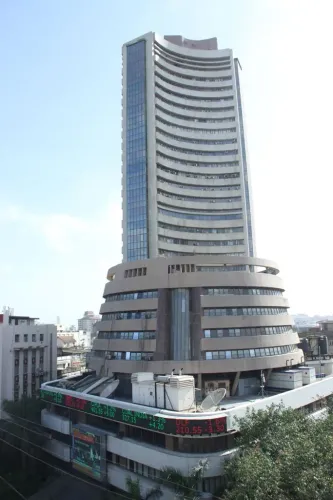
Why Did Sensex and Nifty Close Lower Due to Profit Booking?
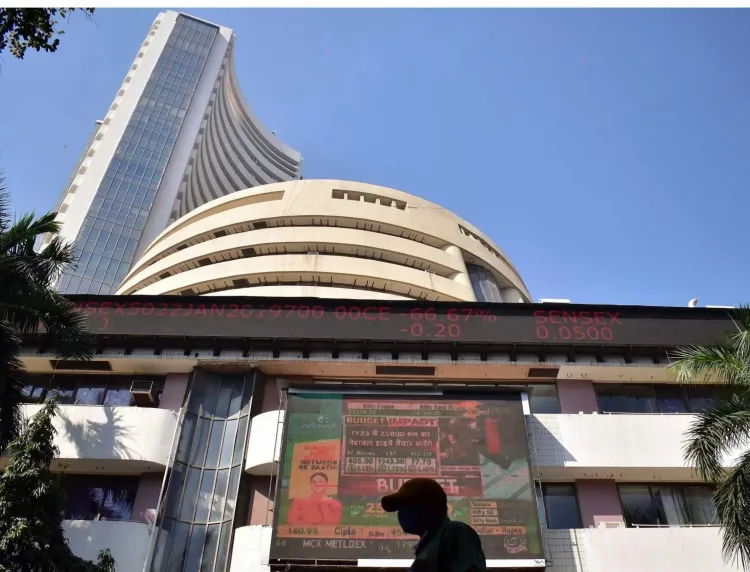
Synopsis
The Indian stock market faced a challenging start to the week, with both Sensex and Nifty closing lower amidst profit booking. This decline raises questions about market stability and investor sentiment as we navigate through a consolidation phase. Will the markets find their footing again?
Key Takeaways
Sensex fell by 271.17 points to close at 82,059.42 .
Nifty dropped by 74.35 points, settling at 24,944.85 .
Consolidation phase expected in the market.
Major declines seen in IT and other frontline stocks.
Positive performance in small and mid-cap sectors .
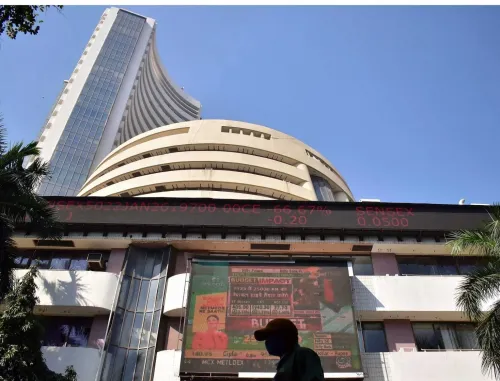
Mumbai, May 19 (NationPress) The Indian stock market started the week on a downward trajectory as key indices concluded lower on Monday, primarily due to profit booking at elevated levels.
The Sensex decreased by 271.17 points, equating to 0.33 percent, closing at 82,059.42. Similarly, the Nifty also finished in the red, dropping by 74.35 points or 0.30 percent to settle at 24,944.85.
“From a technical standpoint, the index seems to be in a consolidation phase, which is likely to persist for the next few days. The market may remain under pressure unless it manages to reclaim the 25,000 mark,” stated Rupak De of LKP Securities.
“On the downside, the Nifty could slide toward the 24,800–24,750 zone. A more significant correction may occur if it falls below 24,750. On the other hand, a rise above 25,000 could initiate a rally towards the 25,250–25,350 range,” he added.
Numerous major stocks experienced declines within the 30-share index, including Infosys, which fell by 1.95 percent, and Tata Consultancy Services (TCS), down by 1.20 percent.
Tech Mahindra saw a drop of 1.19 percent, while Asian Paints lost nearly 1 percent. Eternal (formerly known as Zomato) also faced a decline of around 3 percent during the intra-day session.
Power Grid Corporation led the gainers, rising by 1.27 percent, followed by Bajaj Finance with a gain of 0.91 percent.
NTPC increased by 0.64 percent, State Bank of India (SBI) rose by 0.32 percent, and HDFC Bank ended slightly higher, gaining 0.17 percent.
Despite the selling pressure on large-cap stocks, the broader market held steady. The Nifty Smallcap100 index rose by 0.51 percent, and the Nifty Midcap100 index managed a modest gain of 0.07 percent.
This indicates that, even amidst weakness in frontline stocks, investors displayed interest in select small and mid-cap companies.
The Nifty Realty and PSU Bank indices were the standout performers among sectoral indices, posting gains of 2.25 percent and 1.50 percent, respectively.
Other sectors that finished positively included Bank Nifty, Auto, Financial Services, Metal, Pharma, and Healthcare, indicating buying interest in select segments.
However, IT, FMCG, Media, Consumer Durables, and Oil and Gas concluded in the red, with the Nifty IT index emerging as the poorest performer, declining by 1.37 percent.
Market volatility experienced an uptick, with the India VIX, known as the fear gauge, surging 4.89 percent to close at 17.36.
Meanwhile, gold prices opened the week positively as safe-haven bids increased after Moody’s downgraded the US sovereign credit rating from AAA to AA1, while apprehensions over trade tariffs and geopolitical tensions in the Middle East likely supported the bullion.
“The focus this week will be on the upcoming US data related to manufacturing/services PMI and housing data,” remarked Pranav Mer of JM Financial Services Ltd.
Point of View
It is crucial to understand that fluctuations are part of the market cycle. While profit booking has led to declines in major indices, the resilience shown by small and mid-cap stocks highlights a selective investor interest. This duality reflects the ongoing dynamics within the market. Therefore, maintaining a balanced perspective is essential as we navigate these turbulent times.
NationPress
19 Sept 2026
Frequently Asked Questions
What caused the decline in Sensex and Nifty?
The decline was primarily due to profit booking at higher levels.
What is the current market outlook?
Experts suggest the market may continue in a consolidation phase, with key levels to watch being 25,000 for Nifty.
Which stocks were major contributors to the decline?
Stocks like Infosys and TCS saw significant declines, contributing to the overall downturn.
Are small-cap stocks performing better?
Yes, despite the pressure on large-cap stocks, small and mid-cap indices showed gains.
What sectors performed well during this decline?
The Realty and PSU Bank indices were among the top performers, gaining significantly.