Did PM Modi Praise HM Shah's 'Fact-Driven' Rebuttal in Parliament?
Synopsis
PM Modi's recent praise for HM Shah's impactful speech in Parliament sheds light on the ongoing debate about electoral integrity. With solid evidence presented, Shah's rebuttal to Opposition claims, particularly Rahul Gandhi's allegations, has sparked significant discussions about democracy and transparency in India's electoral system. Discover the critical highlights of this parliamentary showdown.
Key Takeaways
PM Modi commended HM Shah's rebuttal.
HM Shah countered Opposition claims with facts.
Electoral integrity remains a contentious issue.
Historical precedents were cited to support claims.
Public trust in democratic processes is vital.
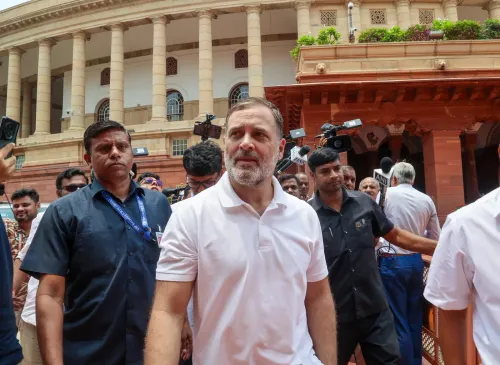
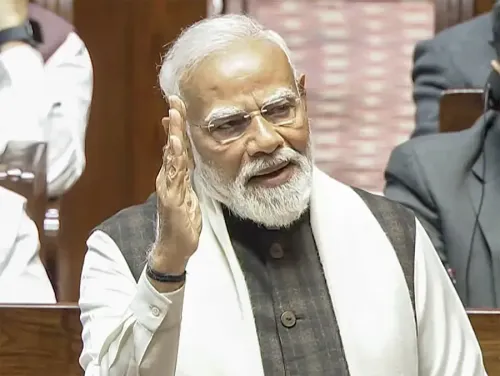
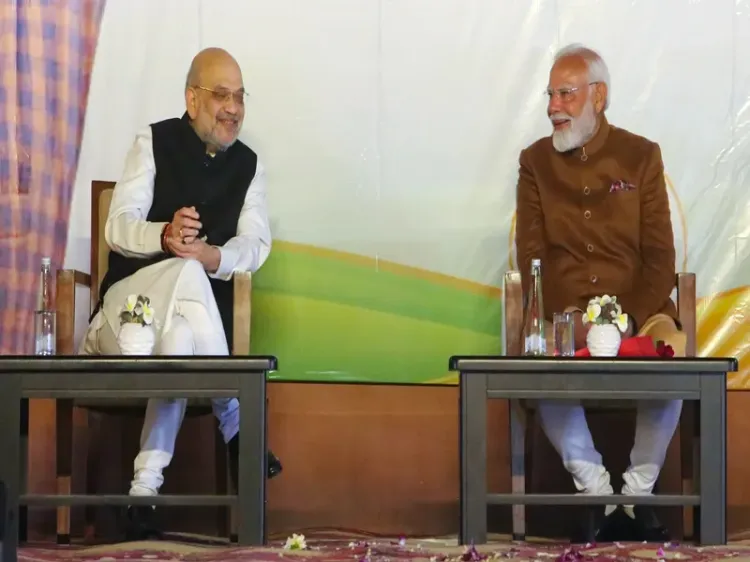
New Delhi, Dec 10 (NationPress) Prime Minister Narendra Modi on Wednesday commended Home Minister Amit Shah for his remarkable address in Parliament, where the Home Minister effectively countered the Opposition's claims regarding the electoral process and responded to Congress MP Rahul Gandhi's accusation of 'vote theft'.
In a post on X, PM Modi stated that HM Shah had provided solid evidence while addressing the concerns raised by the Opposition about the electoral system. He emphasized that the Home Minister illustrated the strength of India's democratic framework and unmasked the falsehoods that have been circulated recently.
PM Modi remarked, 'A commendable address by Home Minister Shri Amit Shah Ji. He has used solid facts to showcase the various aspects of our electoral process, the resilience of our democracy, and has also revealed the false claims made by the Opposition.'
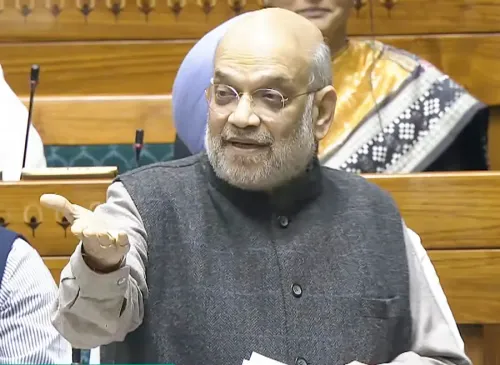
HM Shah's address occurred during a contentious discussion about the integrity of elections, where the Home Minister dismissed the allegations of manipulation as 'groundless' and accused the Opposition of trying to erode public trust in democratic institutions. He elaborated on procedural safeguards, historical contexts, and legal frameworks to affirm that India's electoral system remains secure and transparent.
This exchange represented one of the most intense confrontations of the ongoing session, with the Treasury benches uniting behind HM Shah's detailed response while the Opposition maintained that the issues raised by Rahul Gandhi and others warranted further scrutiny.
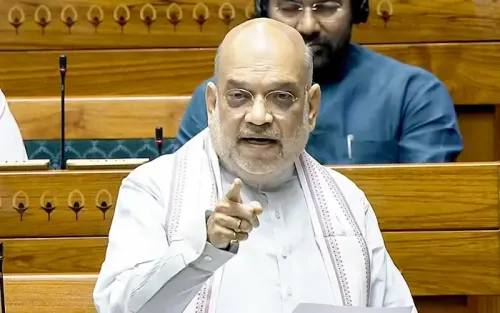
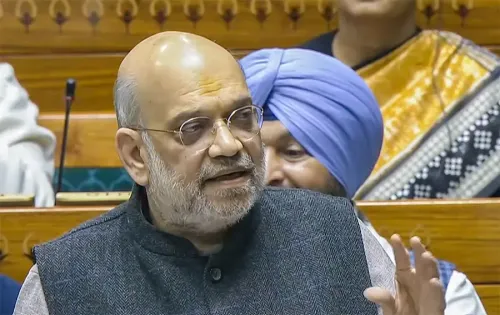
Union Home Minister Amit Shah, during a discussion on electoral reforms in the Lok Sabha on Wednesday, addressed each point raised by Congress leader Rahul Gandhi regarding his 'vote theft' allegations, citing instances of electoral misconduct by the Opposition itself.
He delivered his remarks amidst persistent interruptions from the Opposition benches, which caused him to occasionally pause, even as Speaker Om Birla attempted to restore order in the House.
The Home Minister mockingly referred to Congress leader’s 'nuclear bomb' press conference and highlighted the inconsistencies in his claims. He pointed out Gandhi's assertion that over 500 voters listed in Haryana came from the same residential address, clarifying that the Election Commission of India (ECI) had stated that the residence 'House No. 265' spans a one-acre ancestral property, accommodating multiple families in distinct homes.
In this scenario, individual house numbers were not assigned. 'It is possible for three generations of a family to reside in a single house,' the Bharatiya Janata Party (BJP) leader noted, referring to the clarifications provided by the poll body, then adding, 'they would have cast their votes even during the Congress's tenure in Haryana.'
His 'counter bombshell' astonished the Opposition as he claimed that a voter from Bihar had been coerced by the Congress party to make false declarations regarding voter list irregularities. Additionally, the Home Minister illustrated how Congress leaders had themselves engaged in 'vote theft', leading to loud protests from the Opposition benches. 'After India's Independence, when the Congress decided on a mandate from state chiefs to determine who should be the Prime Minister, Jawaharlal Nehru received two votes compared to Sardar Vallabhbhai Patel's 28,' he asserted.
'Yet, Nehru became the Prime Minister,' he added. HM Shah also referenced an Allahabad High Court ruling in June 1975 that invalidated Indira Gandhi's victory from the Rae Bareli constituency after Opposition leader Raj Narain challenged it over alleged electoral fraud.
This ruling triggered significant political turbulence in India, including the imposition of the Emergency in 1975 by Indira Gandhi.
In response to Rahul Gandhi's inquiry about the National Democratic Alliance (NDA) government led by Prime Minister Narendra Modi implementing a law to shield the Election Commissioner from legal actions, the Home Minister reminded him of how Congress had ensured similar immunity for Prime Ministers. HM Shah defended SIR as a necessary measure for the 'purification' of voter lists, tracing its history back to the era of Jawaharlal Nehru's government while countering interruptions from the Opposition.
He described it as a process to 'clean and purify electoral rolls', eliminating deceased individuals, those who have migrated or transferred, and foreign nationals while incorporating new voters. By referencing its historical context in India's electoral management, the Home Minister highlighted that the first three exercises were conducted during Nehru’s administration, followed by those under Lal Bahadur Shastri, Indira, and Rajiv Gandhi, and then Narasimha Rao as Prime Ministers. All these instances occurred while Congress was in power. The only time there was a non-Congress government led by Atal Bihari Vajpayee was when this process came to a halt with the onset of Manmohan Singh's coalition government in 2004.
'There have been no complaints or protests until it resumed under our government,' he reminded, noting that there was no SIR of electoral rolls from 2004-2025. Previously, a returning officer had the authority to remove names of deceased individuals, duplicate entries, etc., but 'in 2010, the Chief Election Commissioner decided against it,' the Home Minister reminded the House. Thus, SIR is essential for the updating of the voters’ list, he argued, maintaining his strong rebuttal against attempts to disrupt his address.
When consistently interrupted, HM Shah asserted control of his remarks, stating, 'I will determine the order of my speech,' emphasizing his commitment to parliamentary decorum and his extensive legislative experience.
Point of View
The exchange between PM Modi and HM Shah represents a crucial moment in the ongoing dialogue about electoral integrity in India. As the political landscape evolves, it is imperative to scrutinize claims made by both sides, ensuring a balanced view that reflects the democratic values upheld by the nation. This engagement is essential for maintaining public trust and confidence in the electoral process.
NationPress
11 Oct 2026
Frequently Asked Questions
What did PM Modi say about HM Shah's speech?
PM Modi praised HM Shah for his outstanding address in Parliament, highlighting the concrete facts presented to counter Opposition allegations about the electoral process.
What were the main allegations addressed by HM Shah?
HM Shah addressed allegations of 'vote theft' made by Rahul Gandhi and dismissed claims of electoral manipulation as baseless.
How did the Opposition respond to HM Shah's speech?
The Opposition maintained that the concerns raised by Rahul Gandhi and others were legitimate and called for further examination.
What historical context did HM Shah provide?
HM Shah referenced past electoral processes during the Congress regime and emphasized the importance of updating the electoral rolls for transparency.
What is the significance of this parliamentary exchange?
The exchange highlights the ongoing debate about electoral integrity and the need for public confidence in India's democratic institutions.