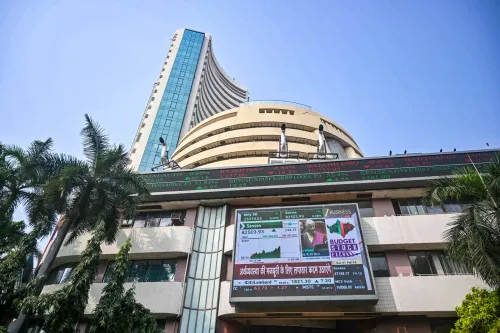
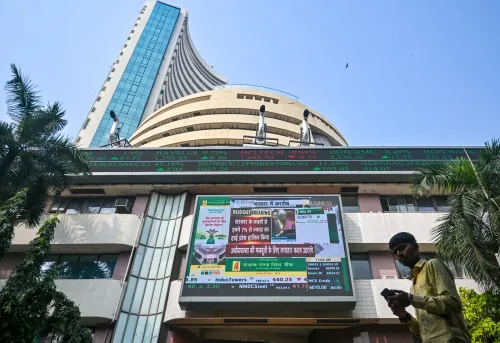
Sensex drops 417 points on oil price spike; Rupee holds firm at 84.48
Synopsis
Sensex gave up all intraday gains to close 417 points lower on 3 September, with crude oil prices and bond yield movements driving rate-hike anxiety. The real story: mid- and small-cap indices held firm, and the Rupee strengthened — signalling a market that is cautious on large-caps but not yet in full retreat.
Key Takeaways
Sensex fell 417.49 points to close at 76,152.86 on 3 September .
Nifty50 ended down 41 points at 23,873.45 .
Bajaj Auto , Tech Mahindra , and Trent were the biggest Nifty laggards.
Nifty Realty was the worst-performing sector, falling more than 2% .
Nifty MidCap gained 0.37% and Nifty SmallCap advanced 1.2% , outperforming headline indices.
The Rupee remained firm at 84.48 per dollar, supported by $127 billion in FCNR deposit buffers.
The BSE Sensex declined 417.49 points, or 0.55%, to settle at 76,152.86 on Thursday, 3 September, as benchmark equity indices surrendered intraday gains under the weight of rising crude oil prices, elevated bond yields, and growing concerns over prolonged interest rates. The Nifty50 shed 41 points, or 0.17%, to close at 23,873.45.
What Triggered the Selloff
Market sentiment remained cautious through the session as a spike in crude oil prices stoked fresh inflation worries. Simultaneously, movements in bond yields reinforced expectations that interest rates could stay elevated for longer — a combination that eroded investor appetite for risk. Analysts noted the session reflected a market caught between competing macro signals, with no clear catalyst to break the deadlock.
Key Laggards and Sectoral Damage
Among Nifty constituents, Bajaj Auto, Tech Mahindra, and Trent were the biggest drags on the benchmark. Sectorally, the Nifty Realty index was the session's worst performer, declining more than 2%. The Nifty Media, Nifty Private Bank, Nifty PSU Bank, and Nifty Bank indices also ended in the red, while Nifty IT, Nifty Auto, Nifty FMCG, and Nifty Healthcare underperformed the broader market.
Broader Markets Show Resilience
Despite the headline index weakness, broader markets held up. The Nifty MidCap index gained 0.37%, while the Nifty SmallCap index advanced 1.2% — a divergence suggesting selective buying in smaller counters even as large-caps came under pressure. This is the third consecutive session this week where mid- and small-cap indices have outperformed the Nifty benchmark.
Nifty Technical Levels to Watch
Analysts flagged 24,000 as the key psychological resistance on the upside. On the downside, the 23,800 zone is seen as the immediate and critical support level. According to market experts, the index has so far managed to hold above this region, but a decisive break below 23,800 could intensify selling pressure and pull the Nifty toward the 23,600 level.
Rupee Holds Firm Against Dollar
The Indian Rupee bucked the broader risk-off mood, remaining strong at 84.48 against the US dollar. Analysts attributed the currency's resilience to improved dollar liquidity, with FCNR deposits of around $127 billion providing additional buffers to manage sharp currency movements and prevent a rapid depreciation. The Rupee is expected to maintain a positive bias, with the range seen between 84.25 and 85.00, according to analysts.
With oil prices and bond yields likely to remain in focus, the near-term trajectory of Indian equities will hinge on global cues and domestic inflation data due in the coming days.
Point of View
Buoyed by domestic retail flows. The crude-inflation-rate-hike chain is not new, but its persistence is a problem — Nifty has now struggled to hold above 24,000 for several sessions, and a break below 23,800 would invite technically-driven selling that fundamentals alone cannot arrest. The Rupee's resilience is a genuine positive, but $127 billion in FCNR buffers is a finite shield. If oil stays elevated and the Fed signals a longer pause, the currency cushion could thin faster than markets currently price in.
NationPress
19 Oct 2026
Frequently Asked Questions
Why did the Sensex fall on 3 September?
The Sensex dropped 417.49 points to 76,152.86 on 3 September as rising crude oil prices stoked inflation fears and bond yield movements reinforced expectations of prolonged elevated interest rates. Investor sentiment turned cautious after the index erased earlier intraday gains.
Which stocks and sectors dragged the Nifty lower?
Bajaj Auto, Tech Mahindra, and Trent were the biggest individual drags on the Nifty. Sectorally, Nifty Realty fell more than 2%, while Nifty Media, Nifty Private Bank, Nifty PSU Bank, and Nifty Bank also closed lower.
How did broader markets perform compared to the headline indices?
Broader markets showed resilience despite large-cap weakness. The Nifty MidCap index gained 0.37% and the Nifty SmallCap index advanced 1.2%, outperforming both the Sensex and Nifty50.
What are the key Nifty technical levels to watch?
Analysts have identified 24,000 as the crucial resistance on the upside. On the downside, 23,800 is the immediate support level; a decisive break below it could drag the Nifty toward 23,600, according to market experts.
Why did the Rupee strengthen despite market weakness?
The Rupee held firm at 84.48 against the dollar, supported by improved dollar liquidity and FCNR deposits of around $127 billion that provide buffers against sharp currency depreciation. Analysts expect the Rupee to maintain a positive bias in the 84.25–85.00 range.