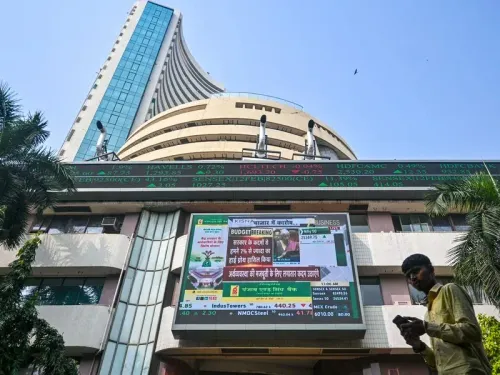
Sensex opens 410 points lower at 73,935 as West Asia tensions rattle markets

Synopsis
India's benchmarks opened deep in the red as West Asia escalations — including a reported Iranian strike on Kuwait's airport and US action near the Strait of Hormuz — overshadowed a fresh Israel-Lebanon ceasefire. With FPIs rotating into the US, Japan, South Korea and Taiwan, analysts say there is little room for a meaningful rebound until the geopolitical fog clears.
Key Takeaways
Sensex opened 410 points lower at 73,935.83 on 4 June , down 0.55% .
Nifty50 fell over 100 points or 0.5% in early trade.
Trent , Eicher Motors , Cipla , Infosys and HDFC Bank were the top Nifty losers, down up to 1% .
Brent eased 1.33% to $96.50 /barrel; WTI slipped 1.31% to $94.76 .
Asian peers — Nikkei, Hang Seng, KOSPI, Jakarta Composite — fell up to 3% ; S&P 500 shed 0.74% overnight.
Indian equity benchmarks opened sharply lower on Thursday, 4 June, with the Sensex sliding 410 points or 0.55% to 73,935.83 at the open, as escalating geopolitical tensions in West Asia and a broad sell-off across US and Asian equities dented investor sentiment. The Nifty50 shed over 100 points or 0.5% in early trade, tracking the global risk-off mood.
Sectoral pressure: realty, IT, pharma lead losses
Nifty Realty declined 0.67%, while Nifty IT dropped 0.53%. Pharma and healthcare indices also slipped up to 0.5%. In contrast, Nifty Consumer Durables, Nifty Oil & Gas, Nifty Cement and Nifty Chemicals traded marginally higher, offering limited cushion to the broader index.
Among Nifty constituents, Trent, Eicher Motors, Cipla, Infosys and HDFC Bank emerged as the top drags, each losing up to 1%.
What's weighing on sentiment
According to market analysts, near-term headwinds continue to outweigh tailwinds, with the unresolved West Asia crisis and sustained foreign portfolio investor (FPI) outflows remaining the dominant pressure points. ‘In the absence of any resolution to the West Asia crisis, there is little scope for a meaningful rally. The strong momentum in US, Japan, South Korea and Taiwan markets suggests continued FPI outflows from India,' market experts said.
Analysts advised investors to adopt a ‘wait and watch' approach in the current volatile environment, while flagging that further weakness could open accumulation opportunities in quality stocks under temporary pressure from foreign flows.
West Asia: ceasefire hopes meet fresh strikes
The geopolitical backdrop remains fluid. The US administration said on Wednesday that Israel and Lebanon have agreed to implement a ceasefire to end hostilities, raising hopes of a broader diplomatic breakthrough that could ease tensions tied to the Iran conflict.
However, Tehran — which had earlier linked any potential agreement with the United States to an end to fighting between Israel and Lebanon — reportedly struck Kuwait earlier in the day, damaging its airport and injuring dozens. In response, the US military carried out strikes near the strategic Strait of Hormuz, keeping the energy corridor in the spotlight.
Crude eases, but Asia and Wall Street stay weak
Despite the escalation, crude oil prices eased. Brent crude fell 1.33% to $96.50 per barrel, while US West Texas Intermediate (WTI) slipped 1.31% to $94.76 per barrel.
Across Asia, sentiment stayed fragile. Japan's Nikkei, Hong Kong's Hang Seng, South Korea's KOSPI and Indonesia's Jakarta Composite fell up to 3%. On Wall Street overnight, the S&P 500 declined 0.74% and the Nasdaq closed 0.9% lower.
What to watch next
With FPI flows tilted negative and West Asia headlines driving intraday swings, traders will track crude movement, any escalation around the Strait of Hormuz, and follow-through cues from US markets through the session.
Point of View
But the deeper signal is capital rotation. With the US, Japan, South Korea and Taiwan running stronger momentum, India is increasingly a funding market for global FPIs — exactly the dynamic that punishes high-multiple pockets first. A ceasefire between Israel and Lebanon is welcome, but with Tehran reportedly hitting Kuwait and US strikes near the Strait of Hormuz, the risk premium on crude and Indian equities won't fade on a single diplomatic line. Until flows turn, every relief rally remains a sell-into-strength setup.
NationPress
20 Oct 2026
Frequently Asked Questions
Why did the Sensex open lower on 4 June?
The Sensex opened 410 points lower at 73,935.83 on Thursday, dragged by weak global cues, escalating West Asia tensions and sustained FPI selling. Heavy losses in US and Asian markets overnight also weighed on sentiment.
Which sectors and stocks led the fall?
Nifty Realty (-0.67%), Nifty IT (-0.53%) and pharma-healthcare (up to -0.5%) led sectoral losses. Trent, Eicher Motors, Cipla, Infosys and HDFC Bank were the top Nifty losers, each declining up to 1%.
How is the West Asia crisis impacting Indian markets?
Analysts say the unresolved West Asia conflict is keeping risk appetite weak and accelerating FPI outflows from India into stronger-performing markets like the US, Japan, South Korea and Taiwan. Tehran's reported strike on Kuwait's airport and US action near the Strait of Hormuz have added to the uncertainty despite an Israel-Lebanon ceasefire.
What happened to crude oil prices?
Crude prices eased despite the geopolitical flare-up. Brent crude fell 1.33% to $96.50 per barrel, while US West Texas Intermediate slipped 1.31% to $94.76 per barrel.
What should investors do in this volatile market?
Market experts have advised a ‘wait and watch' approach given the elevated volatility. They added that further weakness could create accumulation opportunities in quality stocks temporarily pressured by foreign outflows.