Has South Korea Classified the 2024 Knife Attack on President Lee as a Terror Case?
Synopsis
In a groundbreaking decision, the South Korean government has officially designated the 2024 knife attack on President Lee Jae Myung as a terror incident, marking a pivotal moment in the nation's approach to political violence and security.
Key Takeaways
The attack on President Lee Jae Myung has been officially classified as a terror case.
This is the first time an incident has been classified under the Act on Counter-Terrorism since its enactment.
The government is committed to enhancing security measures for political figures.
A task force has been established to conduct a thorough investigation into the attack.
South Korea has a historical context of political violence.
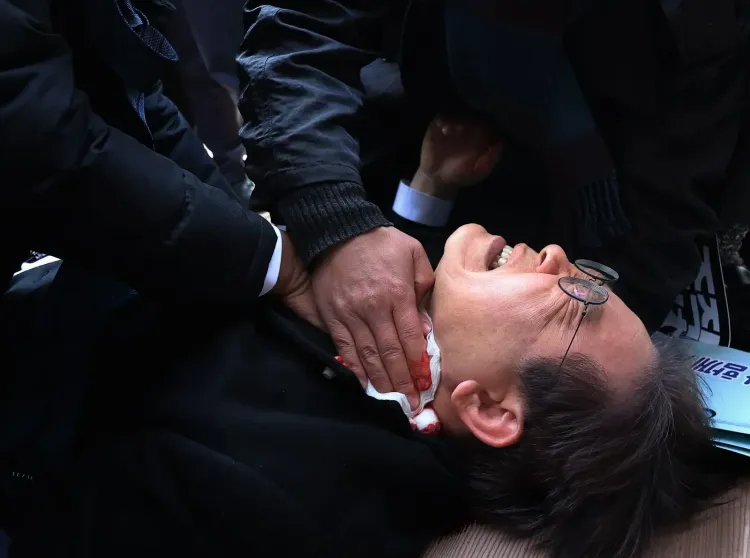
Seoul, Jan 20 (NationPress) In a significant move, the South Korean government has officially categorized a 2024 knife assault on President Lee Jae Myung as a terror incident, according to the prime minister's office. This attack occurred while Lee was the leader of the Opposition.
During a meeting of the National Counterterrorism Committee led by Prime Minister Kim Min-seok, it was determined that the attack on Lee, then head of the main opposition Democratic Party (DP), qualifies as an act of terrorism under the Act on Counter-Terrorism.
This classification marks a historic first since the law's inception in 2016, allowing for a deeper investigation into this serious matter.
On January 2, 2024, Lee was attacked and stabbed in the neck by a 67-year-old man while visiting Busan. He underwent surgery and was hospitalized shortly after the incident.
After the attack, Lee was initially treated at Pusan National University before being airlifted to Seoul National University Hospital. The perpetrator was apprehended at the scene and reportedly aimed to assassinate Lee.
The DP has raised concerns, alleging that authorities under former President Yoon Suk Yeol attempted to manipulate evidence to minimize the incident's gravity, as reported by Yonhap.
Prime Minister Kim condemned the attack, promising a review and enhancement of South Korea's counterterrorism measures to ensure public safety.
The government has committed to conducting an in-depth investigation into the circumstances surrounding the attack and increasing security for key political figures during electoral campaigns to prevent future occurrences.
In light of this designation, the National Investigation Headquarters has set up a task force aimed at conducting a thorough and unbiased inquiry into the case.
According to the department, the task force will investigate potential collusion regarding the incident, the initial classification as a non-terror act, and any evidence tampering by law enforcement.
South Korea has a history of political violence, including the 2006 knife attack on then-Grand National Party leader Park Geun-hye, and the assassination of her father, Park Chung Hee, in 1979. In 2015, Mark W Lippert, the US Ambassador to South Korea, survived a stabbing during a conference in Seoul, and in 2022, then-Democratic Party leader Song Young-gil was attacked with a hammer.
Point of View
It is essential to recognize the gravity of this incident. The formal classification of this attack as a terror case highlights a critical moment in South Korea's ongoing struggle with political violence. It emphasizes the government's commitment to ensuring safety and accountability. Our focus must remain on delivering unbiased reporting and fostering public discourse around these vital issues.
NationPress
30 Sept 2026
Frequently Asked Questions
What classification has the South Korean government given to the 2024 knife attack on President Lee?
The South Korean government has officially classified the 2024 knife attack on President Lee Jae Myung as a terror case.
What led to the classification of the attack as a terror case?
The classification was determined by the National Counterterrorism Committee, which concluded that the attack constituted an act of terrorism under the Act on Counter-Terrorism.
What were the immediate effects of the attack on President Lee?
President Lee suffered a stab wound to the neck, underwent surgery, and was hospitalized for treatment following the incident.
What actions does the government plan to take following this designation?
The government plans to conduct an additional investigation into the case and improve protection for political figures during election campaigns.
Has political violence been a recurring issue in South Korea?
Yes, South Korea has a history of political violence, with several notable incidents occurring over the years.