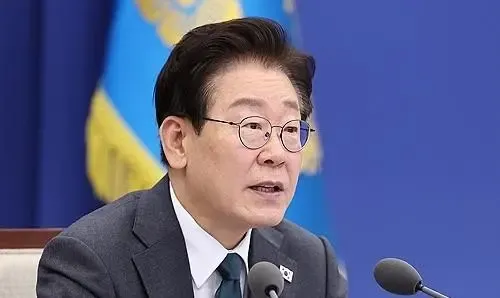
South Korea's Lee Jae Myung: People saved me from 2024 knife attack
Synopsis
South Korean President Lee Jae Myung has publicly credited the people with saving his life — not just from the January 2024 knife attack in Busan, but also from what he called judicial and media-driven threats. His remarks follow a state commission reversing a politically loaded ruling that had targeted the medical workers who airlifted him to Seoul.
Key Takeaways
President Lee Jae Myung said on Saturday that the people saved him from the 2024 knife attack and vowed to devote himself entirely to the country.
Lee was stabbed in the neck in Busan on 2 January 2024 by a 67-year-old man posing as a supporter.
The Anti-Corruption and Civil Rights Commission reversed its earlier ruling, clearing the medical and rescue staff who arranged his helicopter airlift to Seoul .
An internal probe found the then deputy chief of the commission had exercised undue influence in the original ruling against the airlift.
Lee posted his remarks on social platform X , also referencing what he called a "judicial murder" and "honor killing" as additional threats from which the people had saved him.
South Korean President Lee Jae Myung said on Saturday, 10 May 2025, that he survived a 2024 knife attack solely because of the people's support, vowing to devote himself entirely to the country. His remarks came a day after the state civil rights commission reversed its earlier ruling on his emergency helicopter airlift from Busan to Seoul following the attack.
The 2024 Knife Attack
Lee was stabbed in the neck by a 67-year-old man who had posed as a supporter during a visit to the southeastern city of Busan on 2 January 2024. He was initially treated at Pusan National University Hospital before being airlifted by helicopter to Seoul National University Hospital for surgery. At the time of the attack, Lee was serving as leader of the then main opposition Democratic Party, while ousted former President Yoon Suk Yeol was in office.
Commission Reverses Airlift Ruling
The Anti-Corruption and Civil Rights Commission had originally ruled that the helicopter airlift constituted preferential treatment unavailable to ordinary citizens, recommending disciplinary action against the medical staff and rescue workers involved for allegedly violating their code of conduct. However, the commission reversed that decision on Friday, stating that the airlift had been carried out within the lawful scope of authority of those involved. A recent internal probe by the commission found that the then deputy chief had exercised undue influence in reaching the original ruling.
Lee's Statement on Social Platform X
On Saturday, Lee posted a message on social platform X, linking to a news report on the commission's reversal. In his post, he described the original attack as a "terrorist murder attempt" and also referred to what he called a "judicial murder through fabricated indictments by the prosecution" and an "honor killing using manipulated media" — framing all three as threats from which the people had rescued him.
"My life now belongs entirely to the people," Lee wrote. "What I have to do is to build a country solely for the people and create a power that operates solely for the people. ... My fellow citizens. I am truly grateful. Even if my body breaks down, to the very last moment, I will devote my heart and all my strength to the people."
Political Context and What Comes Next
The commission's reversal clears the medical and rescue personnel who were facing potential disciplinary action, and removes a politically charged cloud that had hung over the emergency response to the attack. Notably, the reversal comes amid a broader period of political turbulence in South Korea following the ouster of former President Yoon Suk Yeol. As president, Lee is now the country's highest elected official, and his public messaging around the attack is being closely watched for its political undertones. How the commission's findings will affect those who influenced the original ruling remains to be seen.
Frequently Asked Questions
What happened to Lee Jae Myung in the 2024 knife attack?
Lee Jae Myung was stabbed in the neck by a 67-year-old man posing as a supporter during a visit to Busan on 2 January 2024. He was airlifted from Pusan National University Hospital to Seoul National University Hospital for surgery and survived.
Why did the Anti-Corruption and Civil Rights Commission reverse its airlift ruling?
The commission reversed its earlier ruling — which had deemed the helicopter airlift preferential treatment — after an internal probe found that the then deputy chief had exercised undue influence in reaching that decision. The commission now says the airlift was carried out within lawful authority.
What did Lee Jae Myung say on social platform X?
Lee posted a message on X linking to the commission's reversal, saying the people had saved him from the attack, from what he called a 'judicial murder through fabricated indictments' and an 'honor killing using manipulated media.' He pledged to devote himself entirely to the people.
Who was in power when the knife attack occurred?
At the time of the January 2024 attack, Lee Jae Myung was leader of the opposition Democratic Party, and Yoon Suk Yeol — who was later ousted — was serving as President of South Korea.
What are the implications of the commission's reversal for the medical staff involved?
The reversal clears the medical staff and rescue workers of the disciplinary action they had been facing under the original ruling. It removes the finding that they violated their code of conduct in arranging Lee's emergency airlift.