Supreme Court Dissolves NRI Marriage, Overrules US Divorce Decree
Synopsis
In a landmark decision, the Supreme Court has annulled the marriage of an NRI couple, highlighting the irretrievable breakdown of their relationship. The court exercised its powers under Article 142 to ensure justice, overturning a previous ruling that favored a US divorce decree.
Key Takeaways
The Supreme Court annulled an NRI couple's marriage.
It deemed the relationship irretrievably broken down.
The court exercised powers under Article 142 for justice.
The US divorce decree was not recognized due to legal discrepancies.
The case highlights complexities in international matrimonial law.
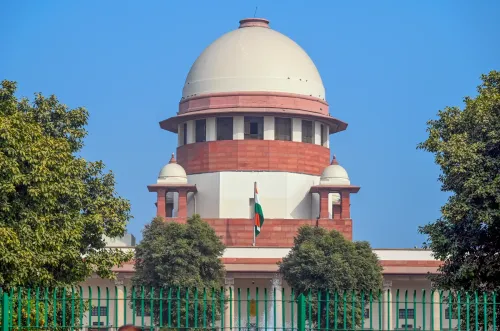
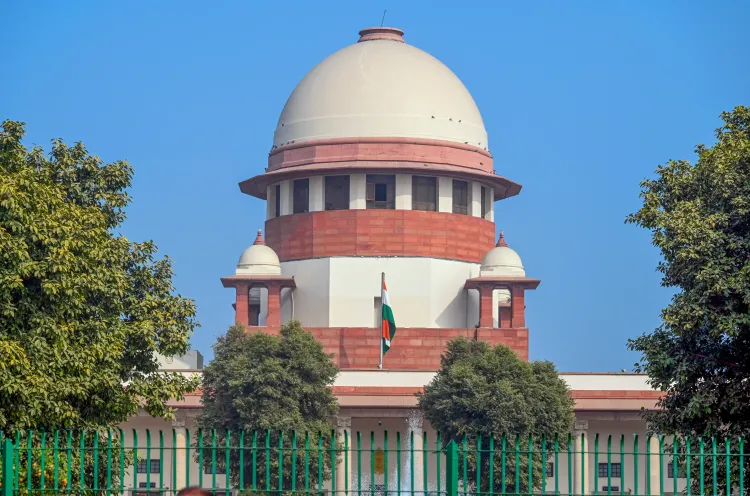
New Delhi, March 18 (NationPress) The Supreme Court has officially annulled the marriage of an NRI couple, utilizing its exceptional authority under Article 142 of the Constitution to achieve “complete justice” after determining that the marital relationship had irreversibly disintegrated, with no chance for reconciliation.
Granting the husband’s appeal, a panel of Justices Vikram Nath and Sandeep Mehta overturned a Bombay High Court decision which stated that Indian courts lacked the requisite jurisdiction and upheld a divorce decree issued by a US court.
“This is clearly a matter of irreparable marital breakdown, as the wife sought a divorce decree in the US while the husband initiated divorce proceedings in India,” remarked the Justice Nath-led panel. “Both parties acknowledge that the marriage has irreversibly deteriorated and that reconciliation is impossible.”
The couple was married on December 25, 2005, in Mumbai through traditional Hindu customs and subsequently resided in the United States. Disputes arose within a few years, prompting the wife to file for divorce in a Michigan court in September 2008, followed by the husband who filed in Pune under the Hindu Marriage Act (HMA) the following month.
The US court issued a divorce decree in February 2009, citing the irretrievable breakdown of the marriage, along with directives regarding asset division and financial settlements.
However, the Supreme Court concluded that a foreign decree could not be automatically recognized within India unless it met specific criteria under Indian law. “In this instance, the US court issued a divorce decree based on irretrievable breakdown, a ground not recognized under the HMA applicable to the parties,” stated the Justice Nath-led panel.
The court also highlighted that the husband did not adequately engage in the foreign proceedings, having merely submitted a written statement contesting jurisdiction. “Thus, it cannot be claimed that he voluntarily submitted to the foreign court’s jurisdiction or that he had a genuine opportunity to contest,” the Supreme Court added.
Referring to its earlier judgment in Y. Narasimha Rao vs. Y. Venkata Lakshmi, the panel reiterated that a foreign divorce decree would only be acknowledged if granted on grounds recognized by the applicable matrimonial law and where the other party effectively participated in the proceedings.
“Consequently, the foreign decree does not meet the requirements outlined in Y. Narasimha Rao, and principles of natural justice appear to have been disregarded,” the apex court determined.
Determining that the foreign decree was neither conclusive nor binding, the Supreme Court indicated that resolving the issue of territorial jurisdiction between Indian and US courts was no longer essential.
“The parties have been separated since 2008, nearly eighteen years, making it clear that no marital bond remains,” the Justice Nath-led panel noted.
Exercising its authority under Article 142 of the Constitution, the Supreme Court issued a divorce decree on the basis of irretrievable breakdown of marriage.
The Supreme Court clarified that, given its ruling, the jurisdictional issue between the Pune Family Court and the US court need not be definitively addressed.
It stated that the divorce petition pending in the Pune Family Court would be closed in light of the decree issued by the apex court.
Point of View
Particularly how different jurisdictions intersect. By prioritizing justice over jurisdictional technicalities, the court has provided clarity in a situation that reflects the evolving nature of matrimonial law in India.
NationPress
7 Oct 2026
Frequently Asked Questions
What powers did the Supreme Court invoke in this case?
The Supreme Court invoked its extraordinary powers under Article 142 of the Constitution to ensure complete justice in the dissolution of the marriage.
Why was the US divorce decree not recognized in India?
The Supreme Court ruled that the grounds for the US divorce decree, namely irretrievable breakdown, are not recognized under the Hindu Marriage Act applicable to the couple.
What was the timeline of events in this case?
The couple married in December 2005, faced disputes, and the wife filed for divorce in the US in September 2008, while the husband filed in India shortly after.
What does Article 142 of the Constitution allow?
Article 142 allows the Supreme Court to pass any decree or order necessary to do complete justice in any matter before it.
What implications does this ruling have for international divorce cases?
This ruling clarifies that foreign divorce decrees must comply with Indian law to be recognized, emphasizing the importance of jurisdiction and participation in proceedings.