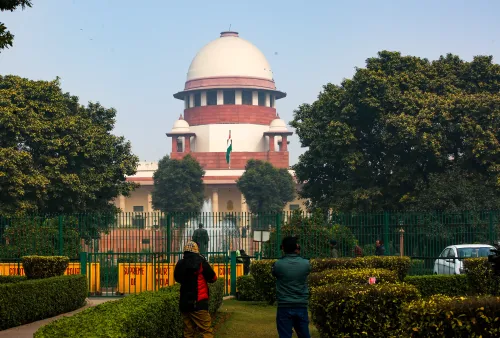
Supreme Court to Review PIL Aimed at Ending Temple Animal Sacrifice
Synopsis
The Supreme Court is set to examine a vital PIL seeking to end the practice of animal sacrifice in temples, emphasizing compassion and animal welfare. As the case unfolds, it raises questions about cultural traditions versus modern legal values.
Key Takeaways
The Supreme Court is reviewing a PIL against animal sacrifice in temples.
The practice raises ethical and legal questions about animal rights.
Advocate Shruti Bist filed the petition under Article 32 of the Constitution.
The case is set for a hearing in four weeks.
Animal welfare laws could be reinforced based on the court's decision.
New Delhi, March 12 (NationPress) The Supreme Court has agreed to review a public interest litigation (PIL) aimed at restricting animal sacrifice in temples nationwide. On Wednesday, a Bench led by Justices Vikram Nath and Sandeep Mehta issued a notice seeking feedback from the Union Ministry of Animal Husbandry and Dairying, and scheduled the case for a hearing in four weeks.
The Bench ordered, “Issue notice, returnable in four weeks,” indicating the seriousness with which they are treating the matter.
Submitted under Article 32 of the Constitution by advocate Shruti Bist, the petition claims that authorities have failed to act against the practice of killing animals in temples under the guise of religious customs.
The petition argues that this ongoing ritual of animal sacrifice contradicts the values of compassion and non-violence inherent in Indian philosophical traditions and legal statutes.
While the PIL acknowledges that animal sacrifice has historical significance in religious observances—especially in the veneration of specific deities—the petitioner contends that it increasingly clashes with contemporary constitutional principles and animal welfare laws.
According to the petition, animal sacrifice, or balidanam, has historically been a part of Hindu rituals, particularly in the worship of goddesses like Ma Durga and Ma Kali. However, this practice has diminished over time, largely due to the influence of non-violence movements.
The petition references religious scriptures and philosophical ideas that advocate respect for all living beings, noting that Indian traditions acknowledge the interconnection of life and emphasize the principle of Ahimsa, or non-violence.
Despite India’s rich cultural heritage that promotes compassion towards animals, the petition states that cruelty persists in various forms, including ritualistic sacrifices tied to certain religious ceremonies.
The PIL also cites sections of the Bharatiya Nyaya Sanhita (BNS) concerning animal cruelty, calling for stronger enforcement to prevent maltreatment.
Additionally, the petition highlights that animals endure suffering through practices such as ritual sacrifices, entertainment, laboratory testing, and mistreatment in both domestic and agricultural settings.
In highlighting constitutional mandates, the plea points out that Article 51A(g) establishes a fundamental duty for every citizen to show compassion towards all living creatures. The petitioner is urging the Supreme Court to compel authorities to take decisive actions to ban animal sacrifices in temples and to enhance the implementation of animal protection laws across the nation.
Point of View
The Supreme Court's willingness to engage with this PIL reflects a broader societal shift regarding animal rights and ethical considerations in religious practices. This case could redefine the balance between tradition and modern values in India.
NationPress
24 Sept 2026
Frequently Asked Questions
What is the purpose of the PIL?
The PIL aims to seek judicial directions to curb the practice of animal sacrifice in temples across India, emphasizing animal welfare and non-violence.
What did the Supreme Court order?
The Supreme Court ordered the Union Ministry of Animal Husbandry and Dairying to provide responses and scheduled the case for a hearing in four weeks.
What are the implications of this case?
This case could lead to stricter regulations on animal sacrifices in the context of religious practices, aligning them with modern ethical standards and legal frameworks.
Does the PIL reference any specific laws?
Yes, the PIL references the Bharatiya Nyaya Sanhita (BNS) concerning cruelty to animals and calls for stronger enforcement of animal protection laws.