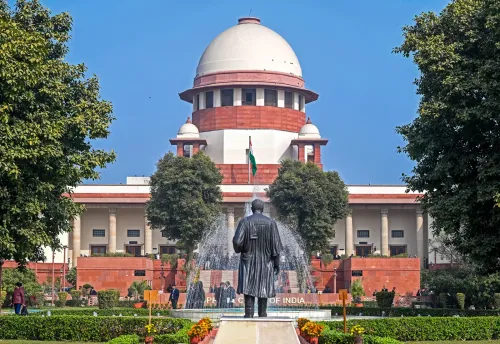
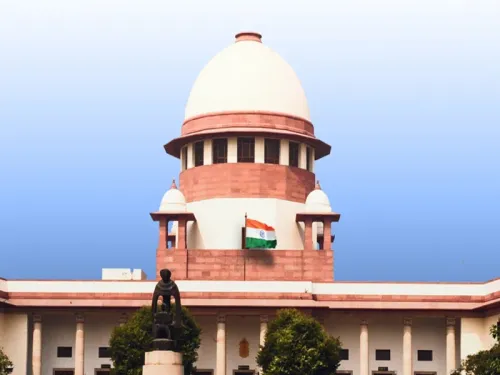
Supreme Court to Address PIL Aiming to Combat False FIRs
Synopsis
In a pivotal case, the Supreme Court will discuss a PIL requesting the installation of informative boards regarding the consequences of filing false complaints, aiming to protect citizens' rights and reduce frivolous litigation.
Key Takeaways
Supreme Court hearing on PIL regarding false FIRs.
Proposal for display boards to inform about penalties.
Focus on protecting innocent citizens under Article 21.
Call for preventive measures to combat frivolous litigation .
Data from NCRB highlights systemic issues in the justice system.
New Delhi, Feb 26 (NationPress) The Supreme Court is set to deliberate on a public interest litigation (PIL) today, advocating for the implementation of “display boards” at police stations, court complexes, and public offices. These boards would emphasize the legal ramifications and penalties associated with filing false complaints, false charges, and fabricated evidence.
According to the agenda issued on the apex court's website, a panel comprising Chief Justice of India (CJI) Surya Kant, Justice Joymalya Bagchi, and Justice Vipul M. Pancholi will address this issue.
The petition, submitted by advocate Ashwini Kumar Upadhyay through advocate-on-record Ashwani Kumar Dubey, argues that such preventive measures are crucial to uphold the right to life, liberty, and dignity of innocent individuals as enshrined in Article 21 of the Constitution.
The request specifies that the proposed display boards should be placed in all police stations, tehsil and district courts, panchayat bhawans, municipal offices, and educational institutions, clearly outlining the laws and penalties for false complaints, false charges, false statements, false information, and false evidence.
The plea further urges state authorities to inform complainants about the legal repercussions of submitting false complaints before accepting any FIR or grievance.
“Authorities must notify complainants about the penalties for false complaints, false charges, false statements, false information, and false evidence prior to accepting the complaint, to protect the freedom of speech and expression of innocent individuals,” the petition emphasized.
Additionally, the petitioner seeks a requirement for an undertaking or affidavit from complainants confirming that their claims made in the complaint, evidence, and charges are accurate and truthful, aiming to reduce frivolous litigation and malicious prosecution.
Referencing data from the National Crime Records Bureau (NCRB), the plea highlights a significant imbalance between cases filed and convictions under various special criminal laws, with acquittals occurring at alarmingly high rates.
“This statistical trend points to a systemic issue of false complaints, false charges, and fabricated evidence overwhelming the criminal justice system,” the petition asserts.
Quoting the Law Commission’s 277th Report, the petition claims that false charges, wrongful prosecutions, and fabricated evidence are primary contributors to miscarriages of justice and violations of Article 21.
The plea also mentions that despite the enactment of Chapter XIV of the Bharatiya Nyaya Sanhita, 2023, the lack of administrative or preventive measures has rendered these provisions largely ineffective.
It contends that the unchecked misuse of criminal law creates a chilling effect on the freedoms guaranteed under Article 19, encompassing free speech, movement, and the right to engage in trade and profession, as the fear of malicious prosecution stifles legitimate dissent and entrepreneurship.
“False complaints and malicious prosecutions turn the criminal process into a form of punishment, leading to loss of liberty, social stigma, mental anguish, and irreparable harm to reputation, even in cases that culminate in acquittal,” the plea stated, further arguing that the concepts of speedy trial and presumption of innocence lose significance when false accusations proliferate unchallenged.
The petitioner asserts that the judiciary is overwhelmed due to false complaints, false charges, and fabricated evidence, and claims that neither the Centre nor the states have implemented effective measures to combat this issue, thereby necessitating judicial intervention from the Supreme Court.
Point of View
It is crucial to recognize the significance of this PIL in promoting justice and protecting innocent citizens from the devastating effects of false accusations. The Supreme Court's intervention could lead to necessary reforms that bolster the integrity of the legal system.
NationPress
20 Sept 2026
Frequently Asked Questions
What is the purpose of the PIL being heard by the Supreme Court?
The PIL aims to mandate the installation of display boards at public offices to inform citizens about the penalties for filing false complaints, thereby protecting the rights of innocent individuals.
Who filed the PIL and what are its main arguments?
The PIL was filed by advocate Ashwini Kumar Upadhyay, arguing that preventive measures are essential to uphold the rights guaranteed under Article 21 of the Constitution and to combat frivolous litigation.
What specific measures does the PIL propose?
The PIL proposes the installation of information boards in various public institutions and requires authorities to inform complainants about the legal consequences of false complaints before accepting them.
What data supports the claims made in the PIL?
The PIL references data from the National Crime Records Bureau, highlighting a significant disparity between registered cases and convictions, indicating a systemic issue with false accusations.
Why is this PIL significant for citizens?
This PIL is significant as it seeks to protect citizens from the adverse impacts of false accusations, which can lead to severe consequences like loss of liberty and reputation.