Rakesh Tikait in Patna: BKU rejects 2013 rates for Bihar satellite city land
Synopsis
Rakesh Tikait took his farmers' campaign to Patna, rejecting Bihar's plan to acquire land for satellite city projects at 2013 circle rates. With rallies in Khagaria and Nawada lined up, the BKU is signalling that this dispute — invoking the legacy of Gandhi's Champaran movement — is only getting started.
Key Takeaways
Rakesh Tikait arrived in Patna on 7 October 2026 to protest Bihar's proposed land acquisition for satellite city projects.
The BKU rejects compensation based on 2013 circle rates, demanding valuation at current market prices.
Tikait alleged that new land-acquisition formulas are being introduced under the guise of development, hurting farmers disproportionately.
He invoked Mahatma Gandhi's Champaran movement to underline Bihar's agrarian protest tradition.
A farmers' rally in Khagaria is scheduled for 8 October , with further gatherings planned in Nawada .
Tikait also criticised the BJP over centralised leadership and expressed support for the opposition's agitation over alleged vote theft in Delhi .
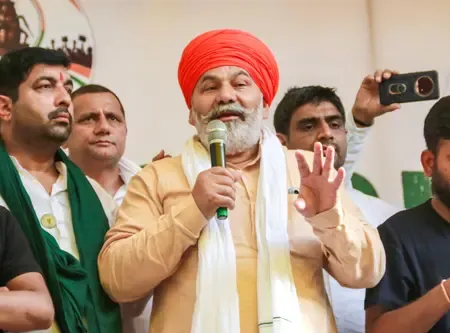
Bharatiya Kisan Union (BKU) leader Rakesh Tikait arrived in Patna on Wednesday, 7 October 2026, and launched a sharp attack on the Bihar government over its proposed land acquisition for satellite city projects, demanding that farmers receive compensation reflecting current market values rather than outdated 2013 circle rates. The remarks were made at a press conference held at the residence of Member of Parliament Sudhakar Singh.
The Core Demand: Fair Compensation at Market Rates
Tikait made clear that farmers are not opposed to development — including the construction of cities and hospitals — but will not accept valuations frozen more than a decade ago. He argued that land prices, like those of gold and other assets, have risen significantly since 2013, and that applying those outdated rates amounts to forcing farmers to subsidise urban expansion at their own expense.
'If the government insists on using 2013 rates for land acquisition,' Tikait said, 'then the prices of all other commodities should also be rolled back to their 2013 levels.' The rhetorical challenge was aimed squarely at the Bihar administration, which farmers allege is preparing to invoke old circle rates for the satellite city projects.
Key Allegations Against the Bihar Government
Tikait alleged that new land-acquisition formulas are being quietly introduced under the banner of development, with farmers bearing a disproportionate burden when their land is taken up for large infrastructure and urban-development projects. He demanded that the government first revise applicable circle rates and put in place a transparent framework for fair compensation before any acquisition proceeds.
He did not name any individual government official but criticised the Bharatiya Janata Party (BJP), alleging that the party appoints chief ministers who operate primarily at the direction of its central leadership — a comment made without reference to a specific individual.
Invoking Champaran: The Historical Context
Tikait invoked Mahatma Gandhi's historic Champaran movement in Bihar, drawing a direct line between that century-old farmers' agitation and the present dispute over land rights and compensation. The reference was a deliberate appeal to Bihar's deep agrarian identity and the state's historical association with farmers' resistance.
This comes amid a broader national conversation about whether India's land-acquisition framework — despite the Right to Fair Compensation and Transparency in Land Acquisition, Rehabilitation and Resettlement Act, 2013 — adequately protects small and marginal farmers when their land is acquired for urban and infrastructure projects.
Planned Agitation and October Programme
Tikait announced plans for farmers' gatherings in Nawada and Khagaria, appealing to farmers, youth, and members of the public to unite over land and agrarian rights. The BKU's announced October programme includes a farmers' rally in Khagaria on 8 October.
He also expressed solidarity with the opposition's ongoing agitation over allegations of vote theft in Delhi, calling on political parties and civil society groups to converge on the issue. He reiterated that the BKU's campaign over land acquisition and compensation would continue until the Bihar government offers a credible response.
Point of View
However, is real: India's 2013 land-acquisition law was meant to ensure fair compensation, but the use of outdated circle rates is a well-documented loophole that state governments exploit to lower acquisition costs. Bihar's satellite city ambitions, if pursued on the back of artificially suppressed land values, risk repeating the dispossession cycles that have fuelled agrarian unrest from Singur to Noida. The Champaran invocation is rhetorical, but the underlying legal question — whether circle rates must be periodically revised to reflect market reality — deserves a serious legislative answer that Bihar has not yet provided.
NationPress
7 Oct 2026
Frequently Asked Questions
Why is Rakesh Tikait opposing Bihar's satellite city land acquisition?
Tikait and the BKU oppose the acquisition because the Bihar government is allegedly using outdated 2013 circle rates to calculate compensation, which farmers argue grossly undervalues their land relative to current market prices. The BKU demands that rates be revised to reflect present-day land values before any acquisition proceeds.
What are circle rates and why do they matter in land acquisition?
Circle rates are government-fixed minimum prices for property transactions in a given area, used as the baseline for calculating stamp duty and land compensation. When circle rates are not updated to match market values — as Tikait alleges in Bihar's case — farmers end up receiving compensation far below what their land would fetch in an open sale.
What events has the BKU planned in Bihar in October 2026?
The BKU has announced farmers' gatherings in Nawada and Khagaria as part of its October agitation programme. A rally in Khagaria is specifically scheduled for 8 October 2026, with Tikait appealing to farmers, youth, and the public to participate.
What is the significance of the Champaran movement reference made by Tikait?
Tikait invoked Mahatma Gandhi's Champaran Satyagraha — one of India's earliest mass farmers' movements, launched in Bihar in 1917 against exploitative indigo cultivation rules — to draw a historical parallel with the current land-acquisition dispute. The reference was aimed at reinforcing Bihar's agrarian protest identity and the legitimacy of the BKU's agitation.
What else did Tikait say at the Patna press conference?
Apart from the land-acquisition demand, Tikait criticised the BJP for allegedly appointing chief ministers who operate under central leadership direction, without naming any individual. He also expressed support for the opposition's agitation over alleged vote theft in Delhi and called for a broader coalition of political parties and civil society groups on farmers' and electoral issues.