Trump White House flags foreign STEM students as US national security risk
Synopsis
A sweeping White House report has reframed America's dependence on international STEM students as a national security vulnerability — not just an education policy question. With temporary visa holders making up roughly half of 2024 doctoral graduates in computer science, the Trump administration is signalling a pivot toward domestic talent pipelines, a shift with potentially far-reaching consequences for Indian students who form one of the largest international cohorts in US graduate programmes.
Key Takeaways
The Trump administration released a White House report titled 'Science: A New Golden Age' on 22 July , flagging US reliance on foreign STEM students as a national security challenge .
Temporary visa holders accounted for roughly half of US doctoral graduates in computer science and mathematics with confirmed post-graduation plans in 2024 .
The share of US research doctorates awarded to temporary visa holders has doubled over four decades , rising from ~ 20% to 40% in natural sciences and engineering.
The report does not name India or propose changes to student visas , employment visas , or university admissions rules.
The administration's proposed response focuses on building a domestic STEM talent pipeline through school-level science education, apprenticeships, and stronger support for American graduate researchers.
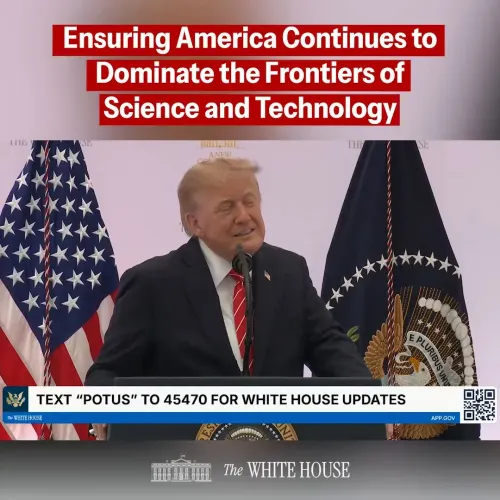
The Trump administration has characterised America's dependence on international students in science, technology, engineering, and mathematics (STEM) programmes as a national security challenge, asserting that overseas rivals are exploiting the openness of the US education system to penetrate the country's innovation infrastructure. The assessment was published on Tuesday, 22 July in a sweeping White House report titled 'Science: A New Golden Age', which outlines a proposed restructuring of the US scientific research enterprise.
What the White House Report Says
The document states that 'for decades, the United States has funded large cohorts of foreign students and tolerated technology transfer abroad under lax security standards.' It further argues that America trains extraordinary global talent at enormous expense, only to lose those gains when foreign governments recruit those researchers to strengthen their own technological capabilities.
According to the report, temporary visa holders accounted for approximately half of all US doctoral graduates in computer science and mathematics with confirmed post-graduation plans in 2024. A chart in the document shows that their share of US research doctorates has doubled over four decades — rising from roughly 20% to 40% in natural sciences and engineering, and from about 10% to 20% in social, behavioural, and health sciences.
The report contends that this reliance 'sidelines American students, a deep domestic talent pool that remains under-supported by its own government.'
Security Concerns and Alleged Exploitation
The White House document alleges that US competitors exploit the asymmetry between America's open scientific system and more restrictive environments abroad. According to the report, these actors use American educational institutions as entry points into the country's broader research and innovation network while simultaneously building their own domestic capabilities.
'America's over-reliance on foreign students also creates a security challenge our institutions are ill-equipped to address,' the document states.
Notably, the report does not name any specific country, including India, Indian students, or Indian researchers. It also stops short of proposing changes to student visas, employment visas, or permanent-residency rules, and does not recommend nationality-based restrictions on university admissions.
Implications for Indian Students
Despite the absence of India-specific language, the report carries considerable significance for the large cohort of Indian nationals enrolled in graduate-level STEM programmes across the United States — one of the most prominent international student communities in American higher education.
Any future tightening of access to federally funded research or the introduction of enhanced security requirements could affect international researchers, including Indians, though the report announces no such measures at this stage. Analysts note this comes amid a broader pattern of the current US administration scrutinising international academic participation on security grounds.
The Administration's Proposed Domestic Push
The administration's proposed response centres on expanding America's homegrown scientific workforce. The report calls for identifying talented students nationwide, strengthening advanced mathematics and science education in schools, and scaling up hands-on technical training, apprenticeships, and research placements.
It also recommends greater institutional support for American graduate students, postdoctoral researchers, and early-career scientists, with selection based on demonstrated technical ability rather than institutional pedigree or personal networks. How these recommendations translate into policy — and whether they are accompanied by restrictions on international participation — will be closely watched in the months ahead.
Point of View
But its framing is significant: by categorising foreign student participation as a security liability rather than an economic asset, the administration is laying rhetorical groundwork that could precede harder policy. For Indian students — who dominate US STEM graduate enrolment and depend heavily on post-study work pathways — the absence of specific measures today offers only partial reassurance. What mainstream coverage underplays is the structural tension the report exposes: the US has long subsidised global STEM talent because domestic supply fell short, and redirecting that pipeline inward will take years, not a policy document. The real question is whether this report becomes a blueprint or a talking point.
NationPress
20 Oct 2026
Frequently Asked Questions
What does the Trump administration's 'Science: A New Golden Age' report say about foreign students?
The report, released on 22 July, describes US reliance on foreign students in STEM programmes as a national security challenge, arguing that overseas competitors exploit America's open academic system to access its research and innovation networks. It notes that temporary visa holders accounted for roughly half of 2024 doctoral graduates in computer science and mathematics.
Does the report propose restricting visas for Indian students?
No. The report does not name India, Indian students, or Indian researchers, and does not propose changes to student visas, employment visas, permanent-residency rules, or nationality-based admissions restrictions. Its focus is on expanding America's domestic STEM workforce rather than curtailing international participation.
Why does this matter for Indian students in the US?
Indian nationals form one of the largest international student communities in US graduate-level STEM programmes. While the report announces no immediate restrictions, any future tightening of federally funded research access or security requirements could affect international researchers, including Indians, making the document worth monitoring closely.
How has the share of foreign doctoral graduates in the US changed over time?
According to the report, the proportion of US research doctorates awarded to temporary visa holders has doubled over four decades — rising from roughly 20% to 40% in natural sciences and engineering, and from about 10% to 20% in social, behavioural, and health sciences.
What domestic measures does the administration propose as an alternative?
The report calls for identifying talented students across the country, strengthening school-level mathematics and science education, expanding apprenticeships and research placements, and providing greater support to American graduate students and early-career scientists. Selection, it says, should be based on demonstrated technical ability rather than institutional credentials or personal connections.