Trump calls on Americas to crush drug cartels, urges sanctions on 24 terror groups
Synopsis
Trump didn’t just call for tougher drug enforcement — he unveiled a hemisphere-wide military and sanctions framework, offering to ‘take out’ cartels directly if partner governments ask. With Peru’s Fujimori already on board and 24 terrorist designations on the table, the Shield of the Americas is shaping up as the most ambitious US-led regional security alliance in decades.
Key Takeaways
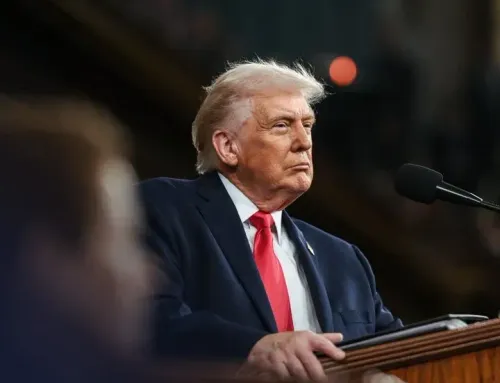
President Trump addressed the Shield of the Americas event in New York on 23 September 2026 , calling drug cartels the hemisphere’s gravest threat.
He urged all member nations to formally designate narcoterrorists as common threats and sanction all 24 US-listed foreign terrorist organisations.
Trump claimed fentanyl arriving by sea had fallen 97% — a figure not independently attributed to an official source.
The Department of War’s America Counter Cartel Coalition was acknowledged, with Trump describing the alliance as the most powerful security grouping ever convened in the Western Hemisphere.
Peruvian President Keiko Fujimori endorsed the initiative, citing Peru’s experience against Shining Path and MRTA .
Trump also called for protecting regional energy pipelines , rare earths , and agricultural corridors from hostile foreign powers.
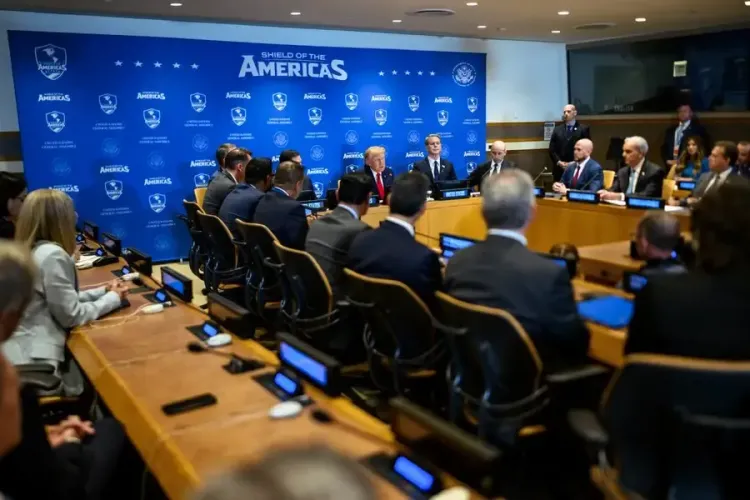
President Donald Trump on 23 September 2026 urged every nation in the Western Hemisphere to formally designate narcoterrorist organisations as common regional threats and impose sweeping sanctions on all 24 groups already listed by Washington as foreign terrorist entities. Speaking at the Shield of the Americas event in New York, Trump called drug cartels the most serious threat facing the hemisphere and pledged direct US military and intelligence support to governments moving against them.
Key Demands and Trump's Pledge
“Today, I’m asking all nations in the Shield of the Americas to formally designate narcoterrorists as common threats to stability and apply crushing sanctions against all 24 US designated foreign terrorist organizations,” Trump said. He described cartels as “violent terrorists” and “paramilitary forces in control of physical territory,” framing the campaign as a war the hemisphere must collectively win.
Trump offered an unusually direct military guarantee: “You let us know and we take them out, or you take them out yourself. I like that even better. But if you can’t, we’ll do it for you.” The pledge signals a potentially expanded US operational role in partner countries that formally request assistance.
Fentanyl Claims and Counter-Cartel Coalition
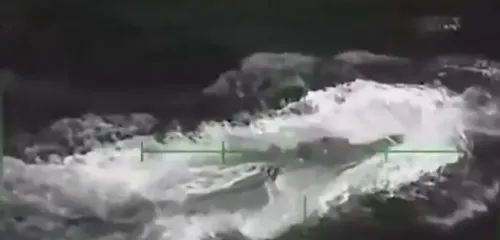
Trump thanked participating governments for joining the Department of War’s America Counter Cartel Coalition and described the gathering as “the largest and most powerful alliance for economic and national security ever to convene in the Western Hemisphere.” He also claimed a dramatic reduction in fentanyl smuggling by sea, asserting it was “down 97 percent coming into the United States” — a figure he did not attribute to an official source. The claim could not be independently verified from the event address alone.
Regional Voices: Peru Backs the Initiative
Peruvian President Keiko Fujimori said her country was joining the initiative with “great determination and great enthusiasm,” drawing on Peru’s history of confronting the Shining Path and the Tupac Amaru Revolutionary Movement (MRTA). “But right now, we have a different type of problem. This crime that we are facing doesn’t respect frontiers,” Fujimori said, praising Trump’s leadership.
Her endorsement reflects a broader regional shift: several Latin American governments that once resisted US-led security frameworks have moved closer to Washington, partly driven by worsening cartel violence and its cross-border spillover.
Resource Sovereignty and Foreign Interference
Beyond narcotics, Trump urged participating countries to block “hostile foreign powers” from gaining control of the region’s natural resources and strategic infrastructure. He specifically identified energy pipelines, rare earth elements, and agricultural trade corridors as areas requiring collective protection. “The resources of the Americas must always belong to the people of the Americas,” he said.
This framing notably expands the Shield of the Americas beyond a purely drug-enforcement agenda into a geopolitical containment posture — an implicit warning directed at China and other external actors with growing investments in the region.
What Comes Next
The Shield of the Americas framework now links organised crime, migration control, economic security, and foreign-interference concerns under a single multilateral umbrella coordinated from Washington. Trump argued that cartel-driven instability had already reshaped politics across the region, suggesting the alliance is as much about political consolidation as law enforcement. Concrete timelines for sanctions implementation and criteria for the formal narcoterrorist designation were not announced at the event.
Point of View
Migration control, resource sovereignty, and anti-China geopolitics are now a single package sold as hemispheric security. The 97% fentanyl-by-sea reduction claim demands independent verification — if accurate, it is a significant policy win; if overstated, it undermines the credibility of the broader framework. The military offer to ‘take out’ cartels on behalf of partner governments raises hard sovereignty questions that Fujimori’s enthusiasm does not resolve. Whether this alliance holds together beyond the summit stage depends entirely on whether Washington backs its rhetoric with sustained resources — a pattern that has historically been the weakest link in US-led regional security initiatives.
NationPress
23 Sept 2026
Frequently Asked Questions
What is the Shield of the Americas?
The Shield of the Americas is a US-led multilateral framework bringing together Western Hemisphere governments to cooperate on organised crime, migration, economic security, and foreign interference. President Trump described it as the largest security alliance ever convened in the region, anchored by the Department of War’s America Counter Cartel Coalition.
What did Trump specifically ask other nations to do about drug cartels?
Trump urged all member nations to formally designate narcoterrorist groups as common regional threats and impose sweeping sanctions on all 24 organisations already listed by the United States as foreign terrorist entities. He also offered direct US military action against cartels if partner governments request it.
What is Trump’s claim about fentanyl reaching the US?
Trump claimed that fentanyl arriving in the United States by sea had fallen by 97%, attributing this to ongoing enforcement efforts. He did not cite a specific government agency or data source for the figure during his address, and it has not been independently verified.
Which countries publicly backed the initiative at the event?
Peruvian President Keiko Fujimori was the most prominent endorser, saying Peru was joining with ‘great determination and great enthusiasm.’ She drew parallels to Peru’s past battles against the Shining Path and MRTA, while noting that modern cartel crime does not respect national borders.
Why did Trump raise energy pipelines and rare earths at a drug enforcement summit?
Trump broadened the agenda beyond narcotics to include protection of the region’s natural resources and strategic infrastructure from ‘hostile foreign powers,’ an implicit reference to China’s growing economic presence in Latin America. He identified energy pipelines, rare earth elements, and agricultural trade corridors as priority areas, framing resource sovereignty as inseparable from regional security.