Is Trump Considering a Limited Military Strike on Iran?
Synopsis
In a potential escalation of tensions, President Trump is reportedly considering a limited military strike against Iran to coerce the nation into a nuclear agreement. This move could have significant implications for international relations and security in the region. Stay tuned as developments unfold over the coming days.
Key Takeaways
Trump is considering a limited military strike on Iran to enforce nuclear deal compliance.
The initial strike would likely target specific military or government sites.
Iran has threatened retaliation against US military assets.
Diplomatic talks are ongoing, with both sides making some progress.
Tensions have risen since the US withdrew from the 2015 nuclear agreement.
Washington, Feb 20 (NationPress) US President Donald Trump is contemplating a restricted military strike against Iran to compel Tehran into a nuclear agreement, according to a report by The Wall Street Journal.
The publication indicates that Trump is evaluating an "initial limited military strike on Iran to compel it to adhere to his conditions for a nuclear deal." This strategy aims to exert pressure on Iran without instigating a full-scale conflict.
If permitted, the initial strike would focus on a select number of military or governmental locations, as informed sources revealed to the Journal. Should Iran ignore Trump's ultimatum to cease its nuclear enrichment, the United States might escalate its operations to target additional regime installations.
One source mentioned that Trump could "escalate his actions, beginning with minor strikes before advancing to larger ones until the Iranian regime either dismantles its nuclear program or collapses entirely."
Trump indicated that a decision is forthcoming.
“We will reach a deal or secure one somehow,” he stated on Thursday.
During another event in Washington, he remarked, “Perhaps a deal will happen. Perhaps it won’t.” He added that Americans should expect news “within the next, maybe, 10 days.” Later, he termed the timeframe as “10 to 15 days, at most.”
White House spokesperson Anna Kelly refrained from detailing potential actions. “Only President Trump knows what he may or may not decide,” she conveyed to the Journal.
In a separate report, The Washington Post stated that the administration “seems poised to initiate an extended military offensive against Iran” as the Pentagon bolsters its presence in the Middle East.
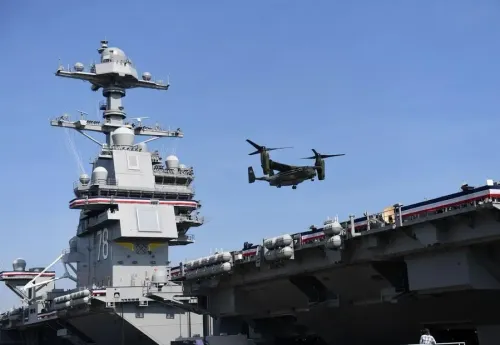
The aircraft carrier USS Gerald R. Ford and its accompanying vessels are approaching the area. Officials informed the Post that US forces deployed there are anticipated to be fully operational by mid-March.
Daniel B. Shapiro, a former US ambassador to Israel, commented that the United States, with Israeli support, would hold an “overwhelming advantage” over Iran. However, he cautioned about the inherent risks.
“They would undoubtedly suffer significant damage from combined US-Israeli assaults,” Shapiro noted. “But that does not imply a swift or clean resolution — they possess some capacity to retaliate.”
Iran’s Supreme Leader Ali Khamenei responded with threats.
He claimed his forces could sink a US aircraft carrier and strike the American military “so severely that it cannot recover.”
In another statement, he remarked: “Certainly, a warship is a perilous piece of military equipment. However, more perilous than that warship is the weapon that can send it to the ocean floor.”
Diplomatic negotiations are still ongoing.
White House press secretary Karoline Leavitt noted that the two parties had “made some progress” but remained “far apart on several issues.” She stated that Iranian officials are “expected to return with further details in the upcoming weeks.”
Iran maintains that it does not aspire to develop nuclear weapons, asserting its right to enrich uranium for civilian uses.
Tensions have escalated since the United States exited the 2015 nuclear agreement during Trump’s first term. Sanctions and intermittent confrontations have ensued, heightening anxiety over a broader conflict in the Middle East.
Point of View
The potential military action by the United States raises critical questions about international diplomacy and the balance of power in the Middle East. While the administration seeks to enforce compliance regarding nuclear policies, the risks of escalation cannot be overlooked. Our focus remains on promoting peace and stability in the region.
NationPress
16 Oct 2026
Frequently Asked Questions
What is the nature of the military action being considered?
The military action being considered is a limited strike aimed at specific military or governmental sites in Iran to compel compliance with nuclear deal negotiations.
What are the implications of a military strike on Iran?
A military strike could escalate tensions significantly, potentially leading to broader conflicts in the region while impacting international relations.
How has Iran responded to the threats of military action?
Iran's Supreme Leader has issued threats, asserting that Iranian forces could inflict severe damage on US military assets, including aircraft carriers.
Are diplomatic talks still ongoing?
Yes, diplomatic negotiations are still underway, with both sides reportedly making some progress but remaining far apart on key issues.
What is Iran's stance on nuclear weapons?
Iran claims it does not seek nuclear weapons and asserts its right to enrich uranium for peaceful, civilian purposes.