How Are Researchers at Nagaland University Turning Pineapple Waste into Valuable Products?

Synopsis
Discover how researchers at Nagaland University are ingeniously converting pineapple waste into valuable products, paving the way for sustainable practices and boosting rural livelihoods. This groundbreaking research not only addresses environmental concerns but also opens up new avenues for entrepreneurship and innovation in the pineapple industry.
Key Takeaways
Pineapple waste is rich in nutrients .
Innovative vinegar production from peels .
Research enhances rural livelihoods .
Government initiatives support commercial farming .
Potential for new entrepreneurial ventures .
Kohima, Dec 8 (NationPress) A dedicated research team from Nagaland University, the sole Central university in the state, has showcased innovative methods to convert pineapple processing waste into valuable products.
University officials mentioned that the research outcomes provide practical and sustainable solutions aimed at enhancing rural livelihoods while mitigating the environmental consequences associated with fruit waste.
Pineapple ranks among the most extensively cultivated tropical fruits globally, with India being a significant producer. Notably, Nagaland has emerged as a key region for pineapple cultivation, renowned for its exceptionally sweet, juicy, and low-fiber fruit.
The widely cultivated variety is 'Kew', while the 'Queen' variety is less common.
Officials stated that government initiatives, including the Mission for Integrated Development of Horticulture (MIDH), the Mission Organic Value Chain Development for the North Eastern Region (MOVCDNER), and other organic value-chain programs, have motivated farmers to adopt commercial pineapple farming.
Districts such as Chumoukedima, Niuland, Dimapur, Kiphire, and Mokokchung are significant pineapple production zones within Nagaland.
Pineapple processing results in substantial amounts of peel, pomace, core, and crowns, much of which ends up as waste. Additional waste arises from improper handling and storage, leading to serious environmental issues.
These by-products, although often deemed waste, are abundant in fiber, proteins, pectin, vitamins, and minerals. If left unmanaged, they contribute to landfill overflow, contamination risks, and increased disposal costs.
However, these same waste materials can act as excellent substrates for fermentation and other value-added processes.
One promising avenue is vinegar production, as the sugar-rich residues provide an optimal foundation for both alcoholic and acetic fermentation. Vinegar has historically been utilized as a preservative and condiment, with fruit-based vinegars gaining recognition for their functional and nutritional advantages.
This groundbreaking research illustrates the potential to substitute the costly apple-based vinegar, thereby facilitating sustainable waste management and increased revenue generation in the commercial pineapple cultivation sector.
The research findings from Nagaland University were published in a peer-reviewed, open-access journal focusing on human nutrition and food safety.
The research paper was co-authored by Dr. Sentinaro Walling, Prof. Akali Sema, Prof. C.S. Maiti, Dr. Animesh Sarkar, Prof. S.P. Kanaujia, and Alemla Imchen from the university's Department of Horticulture.
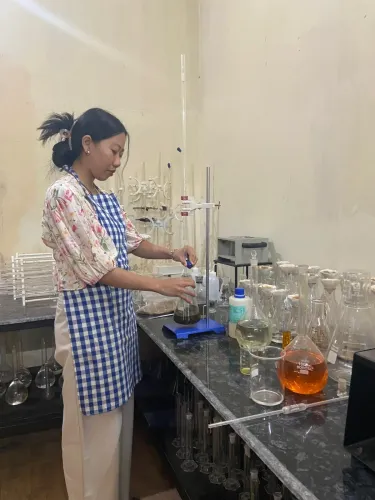
Detailing the research, team leader Prof. Sema stated: "Our study explored whether various components of pineapple processing waste could be transformed into high-quality vinegar. Through standard fermentation with yeast (Saccharomyces cerevisiae) and acetic acid bacteria, we discovered that vinegar derived from the peel consistently exhibited superior acidity, color, and flavor.
He added that a sensory panel favored the peel-based vinegar due to its taste, aroma, and overall quality, aligning with commercial fruit-based vinegars. This indicates that this frequently discarded material has immense potential for transformation from waste to wealth.
Prof. Maiti mentioned: "Efforts are also ongoing to minimize crown size for export compatibility, enhance packaging, and identify treatments that improve fruit quality, yield, and shelf life."
Dr. Sarkar, Associate Professor in the Department of Horticulture, emphasized: "The School of Agricultural Sciences has also refined and disseminated technology for commercial cultivation, guiding farmers to plant at intervals to avoid seasonal overproduction, maintain a consistent supply throughout the year via staggered planting, mitigate price fluctuations, and ensure stable income and employment year-round."
Researcher Walling is preparing to file a patent for a product development category aimed at creating candy from pineapple core waste.
Emphasizing the research's impact on local communities, Vice Chancellor Prof. Jagadish K Patnaik remarked: "I am thrilled to announce a major scientific breakthrough by researchers at Nagaland University, who have successfully produced high-quality vinegar from pineapple peels, marking an innovative stride towards sustainable, value-added processing of agricultural by-products."
This research exemplifies the university's dedication to environmentally conscious innovation, rural livelihood improvement, and scientific advancements rooted in local resources, he added.
"Transforming these discarded peels into a commercially viable, nutritious, and eco-friendly product not only diminishes waste but also unveils new avenues for entrepreneurship, food processing industries, and community-based enterprises," the VC stated.
The research contributes to ongoing efforts aimed at enhancing sustainable pineapple production, improving value addition, and strengthening rural livelihoods in Nagaland. The favorable geo-ecological conditions ensure excellent fruit quality, which is reflected in its unique sweetness and other desirable biochemical properties that may reinforce its popularity among pineapple enthusiasts.
Point of View
This research from Nagaland University highlights the importance of innovative solutions in addressing agricultural waste management while simultaneously enhancing rural economies. The emphasis on sustainability and the potential for entrepreneurship underscore a significant step towards responsible agricultural practices in India.
NationPress
29 Sept 2026
Frequently Asked Questions
What is the main focus of the research conducted by Nagaland University?
The research primarily focuses on converting pineapple processing waste into value-added products, particularly high-quality vinegar.
What are the environmental benefits of this research?
The research aims to reduce landfill waste, lower disposal costs, and mitigate environmental impacts associated with pineapple processing waste.
Which pineapple varieties are commonly grown in Nagaland?
The 'Kew' variety is widely cultivated, while the 'Queen' variety is grown in smaller areas.
How does this research impact local farmers?
The findings encourage farmers to adopt sustainable practices and commercial cultivation, enhancing their livelihoods and creating steady income opportunities.
What other products can be derived from pineapple waste?
Beyond vinegar, the research explores creating candy and other value-added products from pineapple waste.